
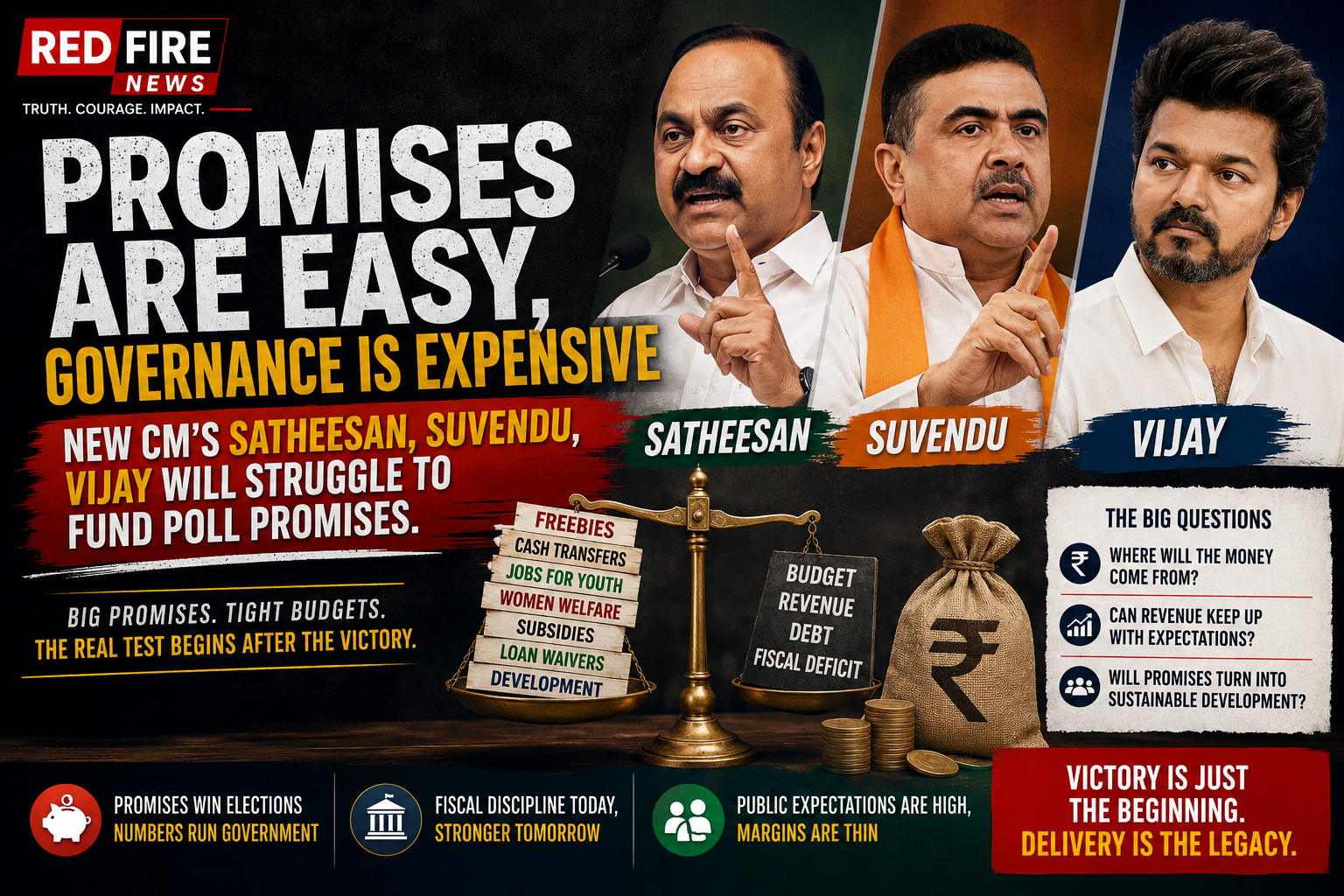
Elections are won with emotion, vision and promises. Governments, however, survive on numbers, budgets and execution.
Across India’s increasingly competitive political landscape, election campaigns have evolved into high-stakes battles of ambition. Free welfare schemes, direct cash transfers, subsidies, employment guarantees, expanded social infrastructure and citizen-centric benefits have become central to winning public trust.
But as political excitement builds around emerging leadership possibilities and discussions around leaders such as V. D. Satheesan, Suvendu Adhikari and Vijay entering or shaping future chief ministerial equations, a difficult question is beginning to surface:
Who pays for the promises?
Winning an election and governing a state are two completely different challenges. Campaign speeches can expand possibilities; public finance eventually defines limits.
And for any new administration, the first major political reality check may not come from opposition parties-but from the treasury itself.
The Age of Competitive Promising
Indian elections have entered an era where policy announcements increasingly resemble economic packages.
Political parties now compete not only on ideology but also on immediate citizen benefits.
Voters are presented with commitments that may include:
- Monthly cash support
- Free or subsidized electricity
- Expanded health coverage
- Job creation targets
- Youth allowances
- Women-focused economic schemes
- Transport subsidies
- Loan relief measures
- Expanded pension programs
While many such initiatives aim to improve quality of life and address inequality, their long-term sustainability often becomes the central governance challenge.
Economists frequently point out that promises create expectations immediately, but revenue takes years to build.
That gap can become politically dangerous.
Satheesan’s Challenge: Expectations Versus Fiscal Space
If Kerala’s future political equations were to bring Satheesan into executive leadership, financial management could become one of the defining tests.
Kerala has historically maintained strong human development indicators and extensive welfare structures. But maintaining social spending while expanding new commitments requires steady revenue growth.
The challenge is straightforward but difficult.
Citizens rarely want existing benefits reduced.
At the same time, campaign promises usually add new obligations.
This creates pressure in three directions:
- Protect existing welfare
- Fund new commitments
- Control borrowing
Balancing those priorities requires political discipline.
Any government entering office with ambitious commitments quickly discovers that every rupee allocated to one scheme limits flexibility elsewhere.
Suvendu’s Potential Test: Development Speed Meets Budget Reality
If political conditions eventually place Suvendu in a chief ministerial role, expectations around infrastructure, industry, employment and administrative delivery would likely accelerate.
Campaign promises often create a perception of rapid transformation.
But implementation requires financing mechanisms.
State governments primarily depend on:
- Tax collections
- Shared central revenues
- Borrowings
- Non-tax income
- Public investment partnerships
Large-scale public commitments require sustained revenue expansion rather than one-time announcements.
Economic observers often warn that the danger is not making promises—it is making promises without sequencing.
If multiple schemes launch simultaneously without adequate funding structures, governments may encounter delayed payments, expenditure compression or difficult trade-offs.
Vijay’s Political Transition Could Face Economic Questions
Few political figures entering public life attract as much public attention as Vijay.
Celebrity-driven political momentum often generates extraordinary public expectations because supporters associate leadership with quick change.
But governance rarely moves at cinematic speed.
If electoral success translates into executive responsibility, expectations could become unusually high from day one.
Supporters may seek visible transformation.
Citizens may expect immediate delivery.
Markets may expect stability.
Government employees may expect continuity.
The difficulty is that state budgets cannot expand overnight.
Even highly popular governments eventually confront administrative realities:
How much revenue exists?
How much is already committed?
How much borrowing remains available?
How much can realistically be delivered within five years?
Those questions define governments more than campaign slogans.
Why Poll Promises Are Becoming More Expensive
Several structural trends are increasing pressure on state finances.
Rising Welfare Expectations
Citizens increasingly expect government support across healthcare, education, mobility and household economics.
Infrastructure Competition
States compete for investment through roads, industrial parks, urban development and logistics.
Administrative Costs
Salaries, pensions and operational expenses consume major portions of budgets.
Revenue Volatility
Economic slowdowns can reduce collections while public demand remains unchanged.
Political Expectations
Once one state introduces a benefit, neighboring states face pressure to match.
This creates what some analysts describe as “competitive welfare economics.”
The Fiscal Tightrope Every New CM Must Walk
There is a common misconception that election victories create unlimited governing power.
In reality, incoming governments inherit financial structures they did not design.
A new chief minister typically enters office with:
- Existing debt obligations
- Ongoing welfare commitments
- Infrastructure spending commitments
- Administrative liabilities
- Revenue projections already under pressure
This means campaign commitments must fit into an already crowded budget.
That process often produces difficult decisions.
Should flagship promises launch immediately?
Should rollout happen in phases?
Should taxes increase?
Should borrowing expand?
Every answer carries political consequences.
The Public Has Changed Too
One major difference from previous political eras is that voters increasingly track delivery.
Campaign promises no longer disappear after elections.
Citizens compare timelines.
Media tracks implementation.
Digital platforms amplify unmet expectations.
People now ask:
What was promised?
What was delivered?
What changed?
What was delayed?
That accountability environment means governments must think differently.
Grand announcements may create headlines.
Execution builds credibility.
Can Growth Pay for Promises?
Supporters of expansive campaign commitments argue that strong governance can generate growth, which eventually creates revenue to fund welfare.
There is truth in that argument.
Economic expansion increases tax collections.
Better investment climates support employment.
Infrastructure can improve productivity.
But growth is rarely immediate.
Political promises usually operate on much shorter timelines.
That mismatch creates pressure.
Governments often need bridge strategies:
- Phased implementation
- Targeted delivery
- Public-private participation
- Spending prioritization
- Administrative reforms
Success depends less on promise size and more on execution design.
The Politics of Saying “Not Yet”
One of the most difficult moments for any new government comes after victory.
Campaign language rewards certainty.
Governance rewards prioritization.
Sometimes leaders must tell supporters:
Not immediately.
Not at full scale.
Not in year one.
Those messages can disappoint voters.
Yet delayed realism may be healthier than rushed spending followed by fiscal stress.
Political leadership often means managing expectations as much as managing budgets.
What Determines Success?
History suggests governments are judged on three questions:
Did they deliver enough?
People rarely expect perfection, but they expect visible action.
Did they remain financially responsible?
Unsustainable expansion creates future costs.
Did they communicate honestly?
Citizens respond better when priorities and constraints are explained clearly.
The future political journeys of Satheesan, Suvendu and Vijay-if they evolve into executive leadership opportunities—may ultimately be measured not by campaign speeches but by budget documents.
A New Political Era Needs New Economics
India’s politics is changing.
Citizens want both welfare and growth.
They want ambitious leaders and responsible spending.
They want immediate benefits and long-term development.
That combination is difficult-but not impossible.
The next generation of chief ministers may need a new formula:
Promise carefully.
Spend strategically.
Deliver visibly.
Because in modern politics, victory begins on election day.
But credibility begins when the budget is presented.
About The Author