Beyond Skyscrapers and Software: Can a Giant Bull Become the Defining Symbol of Hyderabad’s Economic Century?
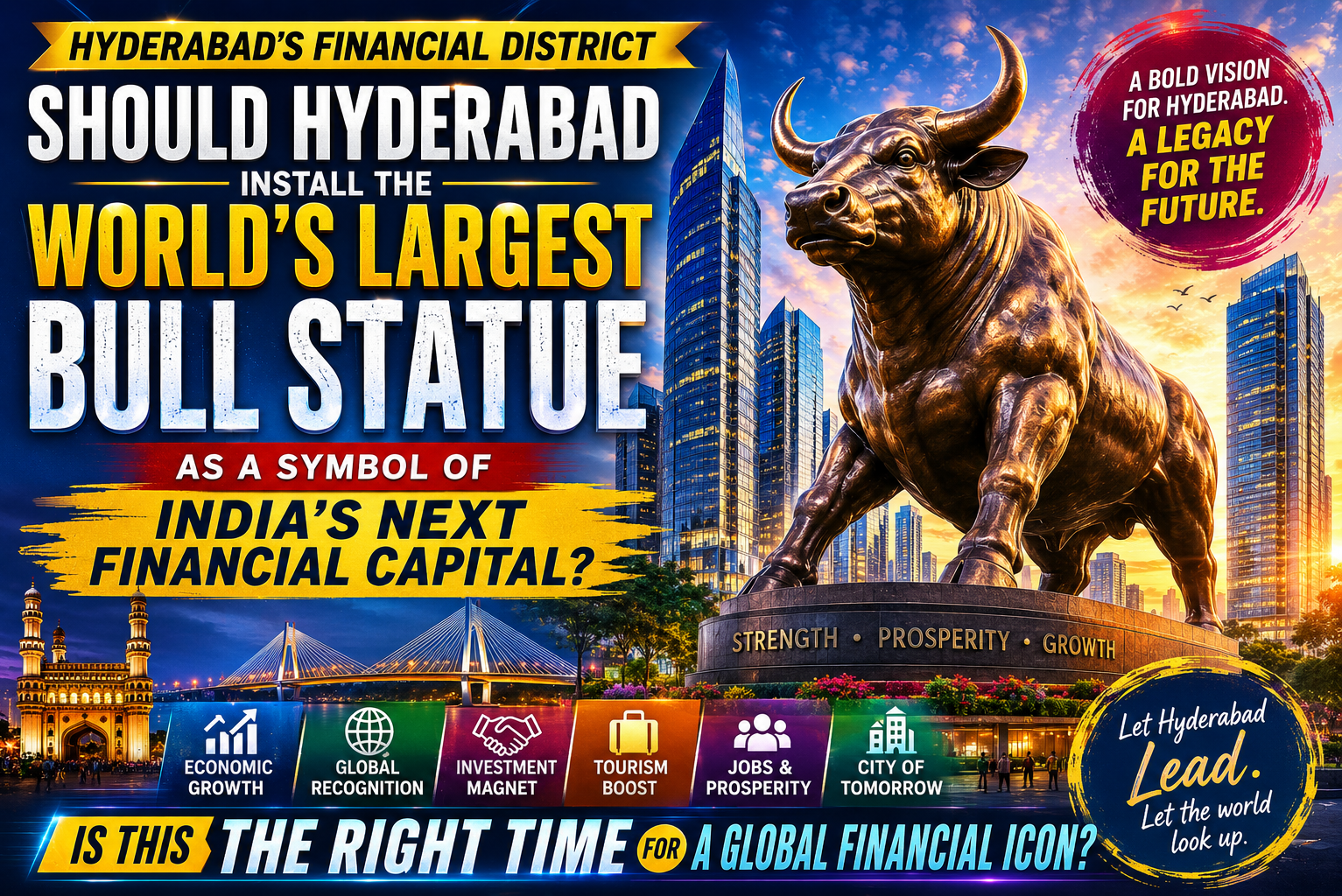
As Hyderabad’s Financial District emerges as India’s fastest-growing economic corridor, a proposal for the World’s Largest Bull Statue sparks debate. Can this iconic landmark transform Hyderabad into a globally recognized financial destination?
A decade ago, Hyderabad’s Financial District was largely viewed as an extension of the city’s IT corridor. Today, it stands as one of India’s most dynamic economic ecosystems, attracting multinational corporations, global capability centers, technology giants, financial institutions, venture capital firms, and premium real-estate investments. Towering glass structures now dominate the skyline, replacing what were once sparsely developed outskirts. The transformation has been so rapid and substantial that many urban planners and business leaders have begun referring to the area as Hyderabad’s version of Manhattan.
The district’s growth has not occurred in isolation. Telangana’s proactive industrial policies, infrastructure investments, and focus on technology-driven development have positioned Hyderabad as one of the most competitive investment destinations in India. Global corporations continue to establish major operations in the city, while domestic enterprises increasingly view Hyderabad as a preferred location for expansion. This convergence of capital, talent, innovation, and infrastructure has created an economic corridor that extends far beyond traditional IT services.
With every passing year, the Financial District gains greater significance in India’s economic landscape. New office towers, luxury residential developments, educational institutions, healthcare facilities, and lifestyle destinations are creating a self-sustaining urban ecosystem. It is no longer simply a workplace destination but a complete urban environment where professionals live, work, learn, and socialize. Such integrated development mirrors the evolution of some of the world’s most successful financial hubs.
As Hyderabad’s influence continues to grow, an important question emerges. Should a city that aspires to become a global financial and innovation center also create a landmark capable of symbolizing its ambitions to the world? This question has given rise to a bold and intriguing proposal—installing the World’s Largest Bull Statue in Hyderabad’s Financial District.
Why Great Financial Cities Need Great Symbols
Throughout history, cities have relied on iconic landmarks to communicate their identity to the world. These landmarks often become more recognizable than the cities themselves. New York is represented by the Statue of Liberty and the Charging Bull. Dubai is synonymous with the Burj Khalifa. Paris has the Eiffel Tower. Singapore showcases Marina Bay Sands. Such structures transcend architecture and become symbols of economic confidence, cultural influence, and global relevance.
The power of symbolism should never be underestimated. Investors, tourists, entrepreneurs, and international organizations often associate cities with specific visual identities. A landmark becomes a storytelling device that communicates a city’s ambitions in a matter of seconds. It provides a memorable image that appears in media coverage, tourism campaigns, business presentations, and global discussions.
Hyderabad has no shortage of historic monuments. Charminar, Golconda Fort, and Hussain Sagar remain enduring symbols of the city’s rich heritage. However, as Hyderabad transforms into a technology and financial powerhouse, many believe the city also needs a modern symbol that reflects its contemporary identity. A monument representing economic growth and innovation could complement Hyderabad’s historical landmarks while projecting a vision of its future.
This is where the concept of a giant bull statue gains relevance. Unlike many cultural symbols that may be region-specific, the bull is universally recognized as an emblem of prosperity, confidence, resilience, and economic optimism. In financial markets across the world, the term “bull market” signifies growth, expansion, and investor confidence. For a city seeking global financial recognition, few symbols are as universally understood.
The Bull as a Universal Language of Prosperity
The proposal for a World’s Largest Bull Statue is rooted in symbolism rather than mere architecture. Across civilizations and cultures, the bull has represented power, determination, abundance, and prosperity. In Indian tradition, the bull carries spiritual significance through Nandi, symbolizing strength and devotion. In global financial circles, the charging bull has become synonymous with market confidence and wealth creation.
Supporters of the proposal argue that the symbolism aligns perfectly with Hyderabad’s economic journey. The city has transformed from a historic princely state into one of the world’s fastest-growing technology hubs. It has attracted global investments, created hundreds of thousands of jobs, and developed a reputation for innovation and entrepreneurship. A monumental bull could capture this narrative in a way that resonates with both domestic and international audiences.
Imagine a visitor arriving in Hyderabad and driving through a modern boulevard lined with multinational headquarters, innovation centers, and financial institutions. At the heart of this district stands a massive bull monument rising above the skyline. The visual impact alone would communicate confidence, ambition, and growth. It would become an unmistakable statement about Hyderabad’s aspirations and achievements.
More importantly, the monument could create a powerful emotional connection with residents. Great cities often have symbols that inspire civic pride. Just as New Yorkers identify with the Statue of Liberty and Parisians with the Eiffel Tower, Hyderabad could develop a contemporary icon that reflects the spirit of its economic transformation.
More Than a Statue: Creating a Global Destination
The proposal’s true potential lies not in the monument itself but in the ecosystem surrounding it. Urban development experts emphasize that iconic landmarks succeed when they function as destinations rather than standalone attractions. A giant bull statue could become the centerpiece of a much larger development designed to attract tourists, investors, students, entrepreneurs, and business leaders.
The surrounding area could evolve into a world-class financial and innovation district featuring an International Financial Plaza, a Telangana Economic Museum, a Global Investor Convention Center, and advanced digital experience galleries. Observation decks could provide panoramic views of Hyderabad’s skyline, while cultural amphitheaters could host events, performances, and international conferences.
A dedicated Startup and Entrepreneurship Pavilion could showcase Telangana’s innovation ecosystem and inspire future generations of entrepreneurs. Interactive exhibits could highlight Hyderabad’s economic journey, technological achievements, and investment opportunities. Such facilities would transform the monument into a hub of learning, engagement, and economic promotion.
Tourism infrastructure could also be integrated into the project. Restaurants, retail outlets, hospitality facilities, and entertainment zones could create a vibrant destination capable of attracting visitors throughout the year. Rather than functioning solely as a monument, the development could become an economic engine supporting employment, tourism, and local businesses.
Economic Impact Beyond the Skyline
One of the strongest arguments supporting the project is its potential economic impact. Around the world, iconic landmarks have generated returns far exceeding their construction costs. Tourism revenues, hospitality growth, retail activity, international visibility, and increased investor interest often contribute to long-term economic gains.
The Statue of Unity in Gujarat provides a compelling example. Beyond becoming a tourist attraction, it stimulated infrastructure development, employment generation, and regional economic activity. Similar outcomes have been observed around other global landmarks. The success of these projects demonstrates that iconic infrastructure can become a catalyst for broader economic transformation.
For Hyderabad, a globally recognized bull monument could attract business tourists, conference delegates, and international visitors. It could enhance the city’s profile among investors considering expansion into India. Increased media attention would strengthen Hyderabad’s brand as a financial and innovation destination. Such visibility often influences investment decisions in ways that are difficult to quantify but highly valuable.
The monument could also create substantial employment opportunities during construction and operation. Architects, engineers, designers, hospitality professionals, event organizers, and maintenance teams would all benefit from such a project. Additionally, small businesses operating nearby could experience increased demand from visitors and tourists.
Addressing Concerns and Building Consensus
Despite the excitement surrounding the proposal, critics have raised legitimate concerns. Some argue that public resources should prioritize roads, transportation, affordable housing, healthcare, and education rather than monumental structures. Others question whether such a project would generate sufficient returns to justify its cost.
These concerns deserve thoughtful consideration. Successful landmark projects are typically those that complement essential infrastructure rather than compete with it. A balanced development strategy would ensure that investments in transportation, public services, and urban amenities continue alongside any iconic project.
One possible solution lies in adopting a Public-Private Partnership model. Corporate sponsors, institutional investors, tourism funds, and private developers could contribute significantly to financing the project. This approach would reduce pressure on public finances while allowing the monument to serve as a shared investment in Hyderabad’s future.
Transparency and stakeholder engagement would also be critical. Citizens, industry leaders, urban planners, and cultural organizations should have opportunities to contribute to discussions about design, funding, and implementation. A landmark intended to represent Hyderabad must reflect the aspirations of the people who call the city home.
A Symbol for the Future
Hyderabad stands at a defining moment in its history. The city is expanding through Future City initiatives, artificial intelligence ecosystems, innovation parks, global capability centers, and new economic corridors. Its influence is no longer limited to technology services. Increasingly, it is becoming a center for finance, innovation, entrepreneurship, and global business.
As cities compete for investment and talent in an increasingly connected world, visual identity becomes a strategic asset. The world remembers cities that create memorable symbols. Such symbols help shape perceptions, attract attention, and communicate ambition. Hyderabad’s remarkable economic story deserves a visual representation capable of resonating across continents.
Whether the World’s Largest Bull Statue ultimately becomes reality remains to be seen. What is undeniable, however, is that the proposal has initiated an important conversation about Hyderabad’s future. It challenges policymakers, business leaders, and citizens to think beyond conventional infrastructure and consider how the city wishes to present itself to the world.
If Hyderabad’s Financial District is truly emerging as India’s new Manhattan, then the city may indeed require a landmark worthy of that transformation. A giant bull would not merely be a monument of steel, concrete, and engineering excellence. It would be a declaration of confidence in Hyderabad’s future-a bold symbol announcing that the city is ready not only to participate in the global economy but to help shape it.
For a city that has repeatedly reinvented itself over centuries, that vision may be the most powerful statement of all.
AI Conversationalist, Global Marketer, TEDx Speaker, Member-Board Of Studies-CDSW, AI Governance, Mentor Onboarded CCMB-Atal Incubation Center, Entrepreneurship Coach