30 Minutes of Rain, Years of Neglect Exposed: Why HYDRAA May Be Hyderabad’s Most Important Urban Reform
A brief spell of rain exposed Hyderabad’s growing urban flood crisis. Explore how lake encroachments, flawed urban planning, and the HYDRAA initiative are shaping the city’s future resilience.
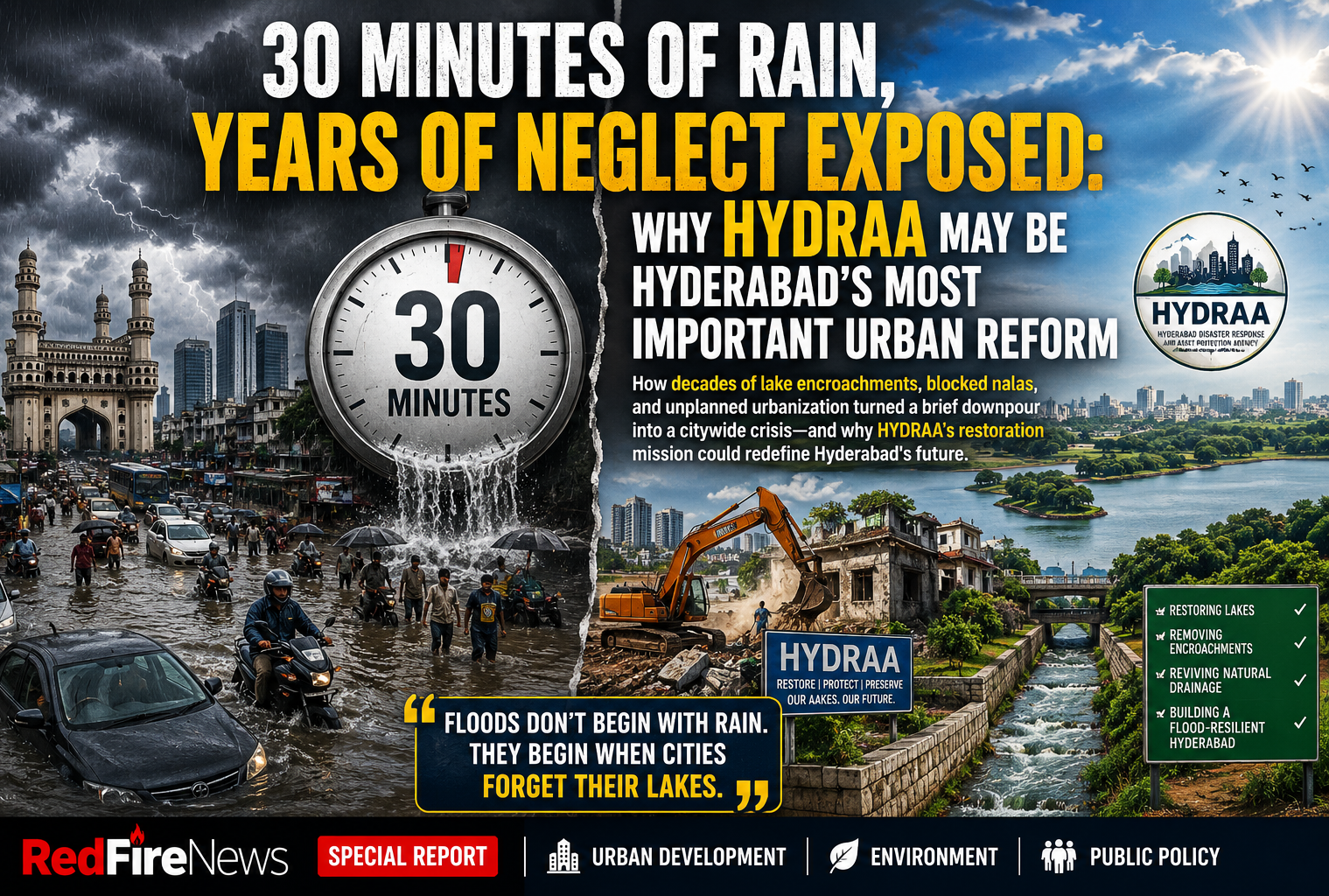
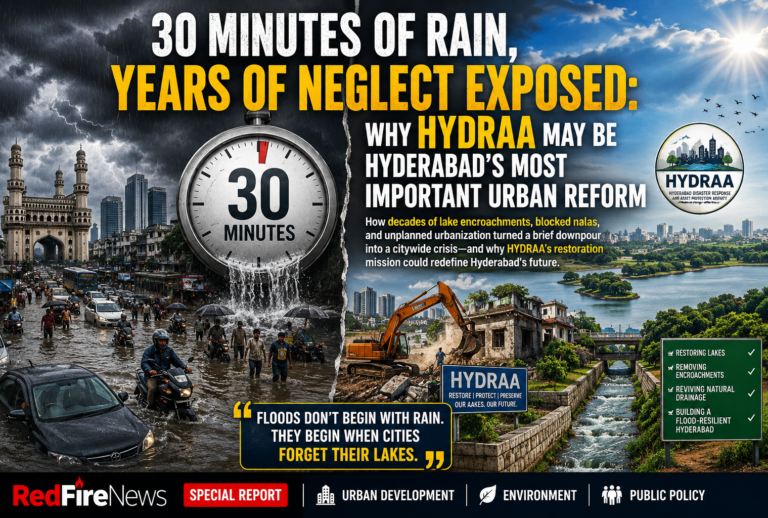
It took less than half an hour of intense rainfall to expose a problem that has been decades in the making. On what appeared to be a routine rainy day, several parts of Hyderabad witnessed severe waterlogging, traffic gridlocks, overflowing drains, and stranded commuters. Social media quickly filled with images and videos showing submerged roads, stalled vehicles, and frustrated residents questioning how a globally recognized technology hub could become so vulnerable after just 30 minutes of rain.
The answer, according to urban planners, environmentalists, and civic observers, lies not in the intensity of the rainfall alone but in years of neglect of Hyderabad’s natural water systems. The rain merely revealed the structural weaknesses hidden beneath the city’s rapid urban expansion. What citizens experienced was not a natural disaster but the visible outcome of accumulated planning failures.
For many residents, the flooding was both familiar and alarming. Familiar because similar scenes have occurred repeatedly over the past decade, and alarming because each year the consequences seem to grow more severe despite ongoing infrastructure investments.
Hyderabad’s Relationship with Water Was Once Its Greatest Strength
Historically, Hyderabad was celebrated for its intricate network of lakes, tanks, ponds, and interconnected water channels. These water bodies were not accidental geographical features; they were carefully planned and developed over centuries to manage rainfall, support agriculture, recharge groundwater, and prevent flooding.
The city’s founders and successive rulers understood the importance of preserving natural drainage systems. Lakes acted as buffers during heavy rainfall, absorbing excess water and gradually releasing it through interconnected nalas. This system ensured that rainwater flowed naturally without causing widespread disruption.
However, as Hyderabad transformed into one of India’s fastest-growing metropolitan regions, urban expansion began consuming these ecological assets. Lakes that once protected the city slowly became targets for commercial and residential development. Natural waterways that carried stormwater safely across the landscape were narrowed, diverted, or completely blocked.
The consequences of these decisions have become increasingly difficult to ignore.
The Cost of Unplanned Urbanization
Urban growth is often celebrated as a sign of economic progress. Hyderabad’s rise as an IT and investment destination undoubtedly contributed to employment generation, infrastructure development, and economic prosperity. Yet growth without ecological planning carries hidden costs.
Over the years, large tracts of land surrounding lakes became attractive destinations for real estate projects. Residential communities, commercial complexes, roads, and industrial establishments emerged in areas that once served as natural floodplains. Buffer zones designed to protect water bodies gradually shrank under development pressure.
Environmental experts have repeatedly warned that every encroached lake and obstructed nala reduces the city’s ability to handle rainfall. Water that once flowed freely now encounters physical barriers. When intense rain occurs, these barriers force water onto roads, into residential colonies, and across commercial districts.
The flooding witnessed during recent rains illustrates this reality. The water has not disappeared; it is simply unable to follow its natural path.
How Political Decisions Contributed to the Problem
Urban flooding cannot be attributed to a single administration or political party. The issue has evolved over several decades through a combination of weak enforcement, administrative oversight, and policy decisions that prioritized short-term development over long-term sustainability.
Successive governments approved land allocations, building permissions, and infrastructure projects in environmentally sensitive areas. In many cases, authorities failed to fully account for the hydrological significance of lakes, catchment areas, and drainage corridors.
As property values increased, pressure mounted to convert open land into commercial assets. What appeared profitable at the time often came at the expense of natural water management systems. Encroachments multiplied, and enforcement mechanisms struggled to keep pace with rapid urbanization.
Today’s flooding challenges are therefore the cumulative result of decisions taken over many years. While individual projects may have appeared justified in isolation, their combined impact has significantly weakened Hyderabad’s natural resilience against rainfall.
Why Climate Change Is Making the Situation Worse
While encroachments and urban planning failures are central factors, climate change is amplifying existing vulnerabilities. Meteorologists have observed that rainfall patterns are becoming increasingly unpredictable across many Indian cities.
Instead of steady rainfall spread over several days, cities are experiencing shorter bursts of extremely intense precipitation. Such cloudburst-like events place enormous pressure on urban drainage systems.
A healthy network of lakes, wetlands, and drainage channels can absorb and distribute excess water. However, when these systems are compromised, even moderate rainfall can create severe flooding conditions.
Hyderabad now faces a dual challenge. The city must adapt to changing climate realities while simultaneously correcting decades of ecological damage. Addressing only one aspect of the problem will not be sufficient.
The Human Cost Behind Waterlogged Streets
Flooding is often measured through images of submerged roads and damaged infrastructure. Yet the true impact extends far beyond visible inconvenience.
Thousands of commuters lose productive hours trapped in traffic congestion. Businesses experience disruptions as employees struggle to reach workplaces. School schedules are affected, emergency services face delays, and small vendors often suffer financial losses when customers stay away.
Residents living in low-lying areas face even greater hardships. Water entering homes damages furniture, appliances, documents, and personal belongings. Repeated flooding can also contribute to health concerns through contaminated water and increased mosquito breeding.
For middle-class families, recurring urban floods create anxiety and uncertainty. Property owners who invested life savings into homes suddenly find themselves vulnerable to environmental risks that were never adequately disclosed during development.
The economic and emotional costs accumulate year after year.
HYDRAA: A New Approach to an Old Problem
Amid growing concerns over urban flooding and environmental degradation, the Telangana government’s HYDRAA initiative has emerged as a significant intervention aimed at restoring Hyderabad’s natural water systems.
HYDRAA has focused attention on identifying encroachments affecting lakes, buffer zones, and drainage networks. The initiative seeks to reclaim public land, remove illegal structures where necessary, and revive natural water flow channels that have been obstructed over time.
Supporters argue that such measures are essential if Hyderabad hopes to prevent future flooding disasters. They point out that engineering solutions alone cannot compensate for the destruction of natural ecosystems. Restoring lakes and drainage pathways offers a more sustainable long-term strategy.
The initiative has also generated public debate, particularly when enforcement actions affect influential interests. Nevertheless, many environmental advocates believe that difficult decisions are necessary if meaningful change is to occur.
Reclaiming Water Bodies Is Not Anti-Development
One of the most common misconceptions surrounding lake restoration efforts is the belief that environmental protection opposes economic growth. In reality, sustainable urban development depends upon ecological stability.
Cities that ignore environmental constraints often face escalating infrastructure costs. Flood damage, road repairs, emergency response expenditures, and public health challenges create significant financial burdens for governments and taxpayers alike.
Protecting lakes and drainage systems should therefore be viewed as an investment rather than a restriction. Healthy ecosystems reduce flood risk, improve groundwater recharge, enhance urban biodiversity, and contribute to better quality of life.
Global cities increasingly recognize that economic competitiveness and environmental sustainability are interconnected goals. Hyderabad’s future success may depend on embracing this principle more fully.
Lessons from Other Global Cities
Several international cities have confronted challenges similar to Hyderabad’s and offer valuable lessons. Cities such as Singapore, Seoul, and Rotterdam have invested heavily in restoring natural waterways while integrating flood management into urban planning.
Rather than treating water as an obstacle, these cities incorporated it into their development strategies. Floodplains were protected, wetlands restored, and drainage systems modernized alongside urban expansion.
The results demonstrate that resilience requires long-term thinking. Infrastructure projects must work with nature rather than against it. Hyderabad possesses the resources, expertise, and institutional capacity to pursue a similar path if sufficient political and public commitment exists.
The city’s historical relationship with water provides a strong foundation for such efforts.
Citizens Also Have a Role to Play
Government initiatives alone cannot solve Hyderabad’s flooding challenges. Citizens must also contribute to protecting urban ecosystems.
Illegal dumping of waste into drains continues to obstruct water flow in many areas. Plastic waste frequently accumulates in stormwater channels, reducing their carrying capacity during rainfall events. Community participation in maintaining local water bodies can significantly improve outcomes.
Public awareness is equally important. Residents increasingly need to recognize that lakes and drainage corridors are essential infrastructure, not vacant land awaiting development. Civic engagement can help ensure accountability and strengthen environmental governance.
Sustainable urban management requires cooperation between authorities, businesses, developers, and citizens.
The Road Ahead for Hyderabad
The scenes witnessed after just 30 minutes of rainfall should serve as a warning rather than a temporary news event. Hyderabad stands at a critical crossroads. The city can either continue managing floods as recurring emergencies or address their underlying causes through comprehensive reform.
Restoring lakes, protecting buffer zones, strengthening drainage networks, enforcing environmental regulations, and integrating climate resilience into future planning will require sustained effort over many years. There are no quick fixes for challenges that have accumulated over decades.
However, meaningful progress is possible. The growing recognition of ecological issues, combined with initiatives such as HYDRAA, suggests that Hyderabad has begun confronting realities that were previously overlooked.
The success of these efforts will depend on consistency, transparency, and political will.
Beyond the Rain: A Test of Urban Vision
The recent flooding was not merely about weather. It was a test of Hyderabad’s urban vision and its ability to balance growth with sustainability. Rainfall exposed vulnerabilities that have long existed beneath the surface of the city’s impressive skyline and expanding infrastructure.
Every flooded road tells a story of a blocked waterway. Every submerged neighborhood reflects decisions made years earlier. Every traffic jam caused by waterlogging highlights the consequences of ignoring ecological systems that once protected the city naturally.
Yet within this challenge lies an opportunity. Hyderabad can redefine its development model by recognizing that environmental restoration is not a backward-looking exercise but a forward-looking necessity.
The city has already demonstrated remarkable achievements in technology, innovation, and economic growth. The next chapter of its evolution may depend on whether it can restore the lakes, nalas, and drainage networks that once made it resilient. If that transformation succeeds, future generations may look back at today’s flooding not merely as a crisis, but as the moment Hyderabad chose to rebuild its relationship with nature and secure a more sustainable future.
AI Conversationalist, Global Marketer, TEDx Speaker, Member-Board Of Studies-CDSW, AI Governance, Mentor Onboarded CCMB-Atal Incubation Center, Entrepreneurship Coach