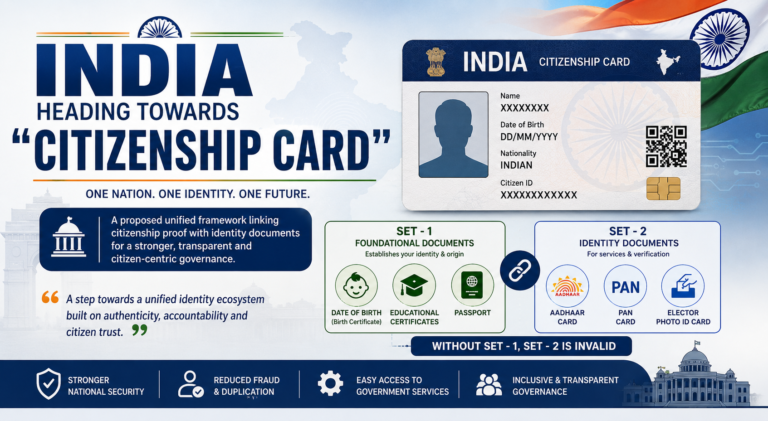
India Heading Towards a “India Citizenship Card” in the Near Future?
Is India Moving Towards a Citizenship Card? Understanding the Debate

A nationwide debate has emerged after recent government clarifications and court observations highlighted an important legal distinction: identity documents are not necessarily proof of citizenship.
The discussion intensified after the Ministry of External Affairs reiterated that an Indian passport is primarily a travel document and not, by itself, conclusive legal proof of citizenship. Around the same time, courts observed that Aadhaar, PAN Card and Voter ID also cannot independently establish citizenship in legal disputes.
The renewed debate has led many policy experts to ask:
Is India gradually moving towards introducing a National Citizenship Card?
While the Government of India has not announced any nationwide rollout of a Citizenship Card, existing legal provisions already permit the creation of a National Identity Card linked to citizenship if implemented in the future.
Today, Indians typically possess multiple government-issued documents.
However, these documents serve different legal purposes.
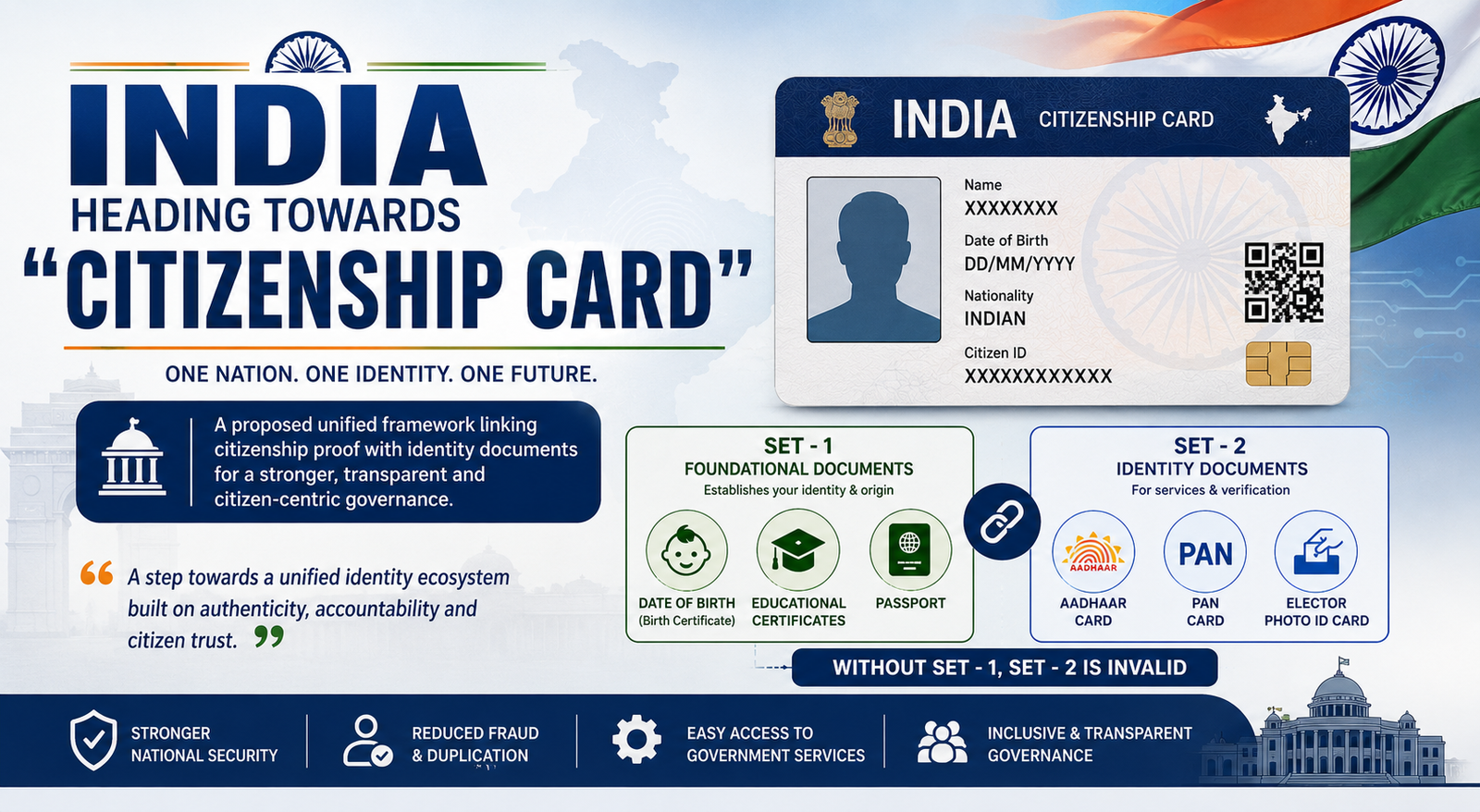
These documents establish a person’s origin, birth details and educational history.
These documents help establish a person’s identity timeline and are often relied upon when citizenship is examined under the Citizenship Act.
These documents enable citizens to access government services and financial systems.
These are essential for daily governance, taxation, banking and elections.
However, individually they are not conclusive legal proof of Indian citizenship.
Many citizens assume that possessing an Aadhaar Card or Passport automatically proves citizenship.
Legally, the position is more nuanced.
For example:
Each serves an important purpose, but none is designed as a universal citizenship certificate under current law.
Policy experts have suggested that India could eventually adopt a structured documentation framework in which foundational records support all subsequent identity documents.
A conceptual model often discussed is:
✓ Birth Certificate
✓ Educational Records
✓ Passport (where available)
These establish the individual’s legal identity history.
↓
✓ Aadhaar
✓ PAN
✓ Voter ID
✓ Government welfare databases
These are then linked to verified foundational records.
Such a framework could simplify verification, reduce duplication across departments and strengthen identity governance. However, this is currently a policy discussion—not an announced government policy.
Interestingly, India’s legal framework already contains a provision that often goes unnoticed.
The Citizenship Act, 1955 (as amended in 2004), empowers the Central Government to compulsorily register citizens and issue a National Identity Card.
However, this provision has not yet been implemented nationwide.
This has prompted renewed discussions on whether the time has come to operationalize such a system.
Supporters argue that a single citizenship document could:
Countries such as Singapore, Estonia and several European nations already operate centralized citizen identity systems.
Any move toward a Citizenship Card would also require safeguards.
Public policy experts point to important questions:
Balancing administrative efficiency with citizens’ rights would be essential to any future implementation.
As of today, India does not have a universal Citizenship Card, and the Government has not announced a nationwide rollout of one.
What has changed is the public understanding that commonly held documents – including Aadhaar, PAN, Voter ID and even a Passport—serve different legal purposes and are not, by themselves, conclusive proof of citizenship.
Recent legal developments and parliamentary discussions have reignited an important policy conversation: whether India should eventually introduce a single, standardized citizenship document backed by foundational records.
If such a reform is pursued in the future, it could become one of the most significant identity governance reforms since the introduction of Aadhaar. For now, however, it remains a subject of legal and policy debate rather than an approved national programme.