Malavika Hegde: Architect of Resurgence, Reviving Cafe Coffee Day’s Legacy
Discover how Malavika Hegde rescued Cafe Coffee Day from a massive debt crisis after the death of founder V.G. Siddhartha, reducing liabilities, restoring stability, and preserving one of India’s most beloved coffee brands.
How One Woman Stepped Into a Storm and Saved India’s Most Loved Coffee Brand
When people think of Cafe Coffee Day (CCD), they often remember the iconic slogan, “A lot can happen over coffee.” For millions of Indians, CCD was more than a coffee chain. It was where friendships were forged, business ideas were born, college memories were created, and countless first dates unfolded.
But in 2019, the future of this beloved brand appeared uncertain.
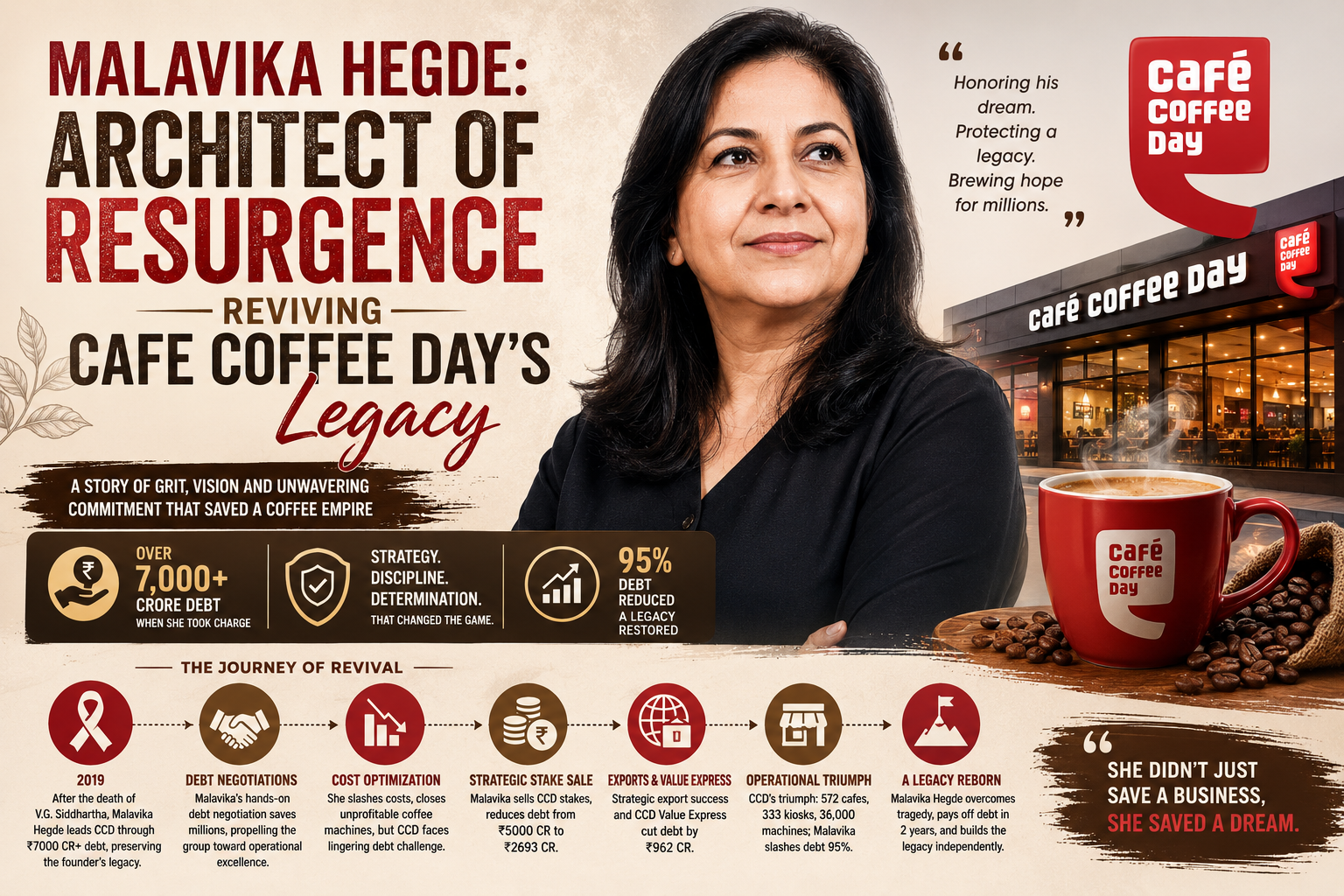
The tragic death of founder V.G. Siddhartha sent shockwaves across India’s business community. Alongside the emotional loss came an even bigger challenge-a debt burden exceeding ₹7,000 crore that threatened the survival of the entire Coffee Day Group.
At a time when many believed the company could collapse under financial pressure, one person stepped forward to shoulder the responsibility.
That person was Malavika Hegde.
Without seeking the spotlight, she embarked on one of the most remarkable corporate turnaround stories in modern Indian business history. Through determination, financial discipline, strategic decision-making, and unwavering commitment to preserving Siddhartha’s legacy, Malavika Hegde transformed a crisis into a story of resilience.
Today, her leadership is widely regarded as the reason Cafe Coffee Day continues to exist and thrive.
A Legacy Built on Coffee and Dreams
Before understanding Malavika Hegde’s role, it is important to appreciate the scale of what was at stake.
Founded by V.G. Siddhartha in 1996, Cafe Coffee Day revolutionized India’s café culture. Long before international coffee chains entered the Indian market, CCD had become a household name.
The company built a vast ecosystem that extended beyond cafés into coffee plantations, exports, vending machines, technology parks, logistics, and hospitality.
At its peak, Coffee Day represented one of India’s most admired entrepreneurial success stories.
However, rapid expansion and substantial borrowings created financial pressures that became increasingly difficult to manage.
Then came the tragedy that changed everything.
The Turning Point: July 2019
The sudden passing of V.G. Siddhartha left behind more than grief.
The company faced enormous debt obligations, anxious lenders, uncertain investors, concerned employees, and questions about its future.
The entire Coffee Day Group stood at a crossroads.
Many observers doubted whether the business could survive.
For Malavika Hegde, this was not merely a corporate challenge.
It was personal.
She had lost her husband, her family had suffered a devastating tragedy, and she was now confronted with the responsibility of protecting thousands of jobs and preserving a brand loved by millions.
Rather than stepping away from the crisis, she chose to confront it directly.
That decision would define her legacy.
Taking Charge During the Darkest Hour
Malavika Hegde assumed leadership responsibilities at a time when confidence in the company was fragile.
Creditors wanted clarity.
Employees wanted reassurance.
Customers wanted continuity.
The market wanted answers.
The situation demanded more than symbolic leadership.
It required decisive action.
Malavika began by focusing on the most urgent challenge-debt reduction.
Her objective was straightforward but extraordinarily difficult: stabilize the business, rebuild trust, and gradually reduce liabilities without destroying the company’s core operations.
It was a balancing act that required patience, negotiation skills, and strategic thinking.
Fighting a Debt Mountain of Over ₹7,000 Crore
One of the most significant challenges facing the Coffee Day Group was its debt burden.
The liabilities had reached levels that threatened the company’s future.
Many businesses facing such circumstances choose bankruptcy protection, aggressive restructuring, or liquidation of assets.
Malavika pursued a different path.
She initiated extensive discussions with lenders, financial institutions, and stakeholders.
Her hands-on approach became one of the defining features of her leadership.
Rather than relying solely on advisors, she actively participated in negotiations and debt resolution efforts.
These conversations helped build confidence among creditors and opened pathways toward sustainable solutions.
The process was neither quick nor easy.
Every reduction in debt required careful planning and difficult decisions.
Yet the results gradually began to emerge.
Operational Excellence Becomes the Focus
As debt negotiations progressed, Malavika recognized that financial recovery alone would not be enough.
The business itself needed to become stronger and more efficient.
She initiated measures aimed at improving operational performance across the group.
Cost management became a key priority.
Resources were allocated more carefully.
Efficiency improvements were implemented across various business units.
The objective was clear: every rupee saved could contribute to reducing debt and strengthening the company’s financial position.
These efforts helped improve cash flow and created a foundation for long-term sustainability.
Difficult Decisions for Long-Term Survival
Turnaround stories often require difficult choices.
Malavika understood that preserving the entire business ecosystem was impossible without addressing underperforming operations.
As part of the restructuring process, the company reviewed several business segments and rationalized costs.
Certain unprofitable coffee machine operations and non-core activities were scaled down or restructured.
Such decisions are rarely popular.
However, successful leaders understand that protecting the future sometimes requires sacrificing short-term comfort.
By focusing on profitability and efficiency, Malavika helped ensure that CCD could continue serving customers while reducing financial stress.
Her approach demonstrated a willingness to make tough decisions when necessary.
Asset Monetization and Strategic Sales
One of the most effective tools in the turnaround strategy involved asset monetization.
The company evaluated investments and holdings that could be sold to reduce debt.
Several strategic stake sales and asset transactions generated substantial funds.
These proceeds were used primarily to repay lenders and improve the company’s balance sheet.
The results were significant.
Debt levels began to decline steadily.
What once appeared to be an overwhelming burden gradually became manageable.
Each successful transaction strengthened market confidence and reinforced the belief that the turnaround plan was working.
For stakeholders who had feared the worst, these developments offered renewed hope.
Reducing Debt from ₹5,000 Crore to ₹2,693 Crore
Among the most important milestones in the recovery journey was the substantial reduction in debt.
Through a combination of negotiations, asset sales, operational improvements, and disciplined financial management, the company succeeded in lowering liabilities dramatically.
The reduction from approximately ₹5,000 crore to ₹2,693 crore represented more than a financial achievement.
It symbolized a return of confidence.
Investors saw progress.
Creditors saw commitment.
Employees saw stability.
Customers saw continuity.
The turnaround was no longer theoretical.
It was becoming measurable.
Each reduction in debt brought the company one step closer to sustainable recovery.
She recognized the importance of strengthening revenue streams.
Coffee exports emerged as an important growth area.
India’s coffee industry enjoys a strong reputation internationally, and the Coffee Day Group’s plantation assets provided significant opportunities.
The company also focused on expanding and optimizing its Value Express vending machine business.
These initiatives helped improve operational performance and contributed to debt reduction efforts.
Reports indicated that such strategic measures played a role in reducing liabilities by hundreds of crores.
The lesson was simple yet powerful.
A successful turnaround requires not only cutting costs but also strengthening sources of revenue.
Preserving the Brand That India Loves
Throughout the crisis, one principle remained constant.
Malavika Hegde was determined to protect the Cafe Coffee Day brand.
Many struggling companies lose sight of customer experience while focusing exclusively on finances.
CCD took a different route.
The company continued serving customers across the country.
Stores remained operational.
The brand retained its emotional connection with consumers.
This continuity proved invaluable.
Generations of Indians had grown up with Cafe Coffee Day.
The brand represented familiarity, comfort, and nostalgia.
By preserving that relationship, Malavika ensured that CCD remained relevant even during difficult times.
A Network That Continues to Serve Millions
Today, Cafe Coffee Day remains one of India’s largest café networks.
The business operates hundreds of cafés across the country, along with extensive kiosk and vending machine operations.
Its presence includes approximately 572 cafés, 333 kiosks, and tens of thousands of coffee vending machines serving offices, institutions, and commercial establishments.
These numbers demonstrate that despite the challenges, the brand continues to maintain significant reach.
Every café that remains open represents jobs protected, customers served, and a legacy preserved.
For many observers, this alone stands as a testament to Malavika Hegde’s leadership.
Slashing Debt by Nearly 95 Percent
Perhaps the most remarkable aspect of the turnaround story is the scale of debt reduction achieved over time.
Through disciplined execution, strategic transactions, and sustained operational improvements, the company succeeded in reducing a substantial portion of its liabilities.
Reports over the years have highlighted how the debt burden was reduced dramatically compared to the levels that existed following Siddhartha’s passing.
The achievement is particularly impressive because it occurred during an era marked by unprecedented disruptions, including the COVID-19 pandemic.
The hospitality and café industry faced severe challenges during lockdowns and restrictions.
Yet CCD continued moving forward.
That resilience reflected the strength of the turnaround strategy.
Leadership Defined by Quiet Strength
Unlike many corporate leaders, Malavika Hegde rarely seeks media attention.
Her leadership style is characterized by calm decision-making, humility, and focus.
She allowed results to speak louder than headlines.
This quiet strength became one of her greatest assets.
At a time when public scrutiny was intense, she concentrated on solving problems rather than managing perceptions.
Her approach earned respect across business circles.
Industry observers increasingly began describing her efforts as one of India’s most significant corporate revival stories.
Overcoming Personal Tragedy
Behind every business turnaround lies a human story.
In Malavika Hegde’s case, the emotional dimension cannot be overlooked.
She was navigating profound personal loss while simultaneously carrying the responsibility of a large corporate group.
Few leaders face such circumstances.
Yet she transformed grief into purpose.
Instead of allowing tragedy to define the future, she focused on honoring the vision that V.G. Siddhartha had spent decades building.
Her efforts ensured that his entrepreneurial legacy would continue.
This aspect of her journey resonates deeply because it demonstrates extraordinary courage.
The story is not only about debt reduction or financial recovery.
It is about perseverance in the face of adversity.
Lessons for Entrepreneurs
Malavika Hegde’s journey offers valuable lessons for business leaders.
First, crises require action, not panic. Calm decision-making often produces better outcomes than reactive measures.
Second, transparency builds trust. Her engagement with lenders and stakeholders helped restore confidence.
Third, difficult decisions are unavoidable. Sustainable recovery frequently requires restructuring and operational discipline.
Fourth, preserving core strengths matters. While reducing costs, she protected CCD’s brand identity and customer relationships.
Finally, resilience can transform seemingly impossible situations into success stories.
These lessons extend far beyond the coffee industry.
They are relevant to every entrepreneur navigating uncertainty.
The Future of Cafe Coffee Day
Today, Cafe Coffee Day stands as a symbol of resilience.
The company continues serving customers while pursuing operational efficiency and sustainable growth.
Challenges remain, as they do for every business.
However, the existential threat that once loomed over the company has significantly diminished.
Much of that progress can be attributed to Malavika Hegde’s leadership.
Her ability to stabilize the business, reduce debt, maintain operations, and preserve stakeholder confidence has become a case study in corporate recovery.
A Legacy Reimagined
When history reflects on the story of Cafe Coffee Day, V.G. Siddhartha will rightly be remembered as the visionary who created India’s café culture.
But alongside his name, another deserves recognition.
Malavika Hegde.
She did not build the company from scratch.
Instead, she accomplished something equally extraordinary.
She saved it.
At a moment when uncertainty threatened to erase decades of hard work, she stepped forward and led with courage, discipline, and determination.
Her journey proves that leadership is often tested not during times of success, but during moments of crisis.
Today, as customers continue gathering over cups of coffee at CCD outlets across India, they are witnessing the outcome of one woman’s unwavering commitment to preserving a dream.
Malavika Hegde’s story is more than a business turnaround. It is a story of resilience, responsibility, and revival-a powerful reminder that even in the darkest moments, determined leadership can create a new beginning.
AI Conversationalist, Global Marketer, TEDx Speaker, Member-Board Of Studies-CDSW, AI Governance, Mentor Onboarded CCMB-Atal Incubation Center, Entrepreneurship Coach