He Didn’t Sell a Drink-He Sold Childhood: How Areez Khambatta Built Rasna Into India’s Most Loved Beverage Story
Discover how Padma Shri awardee Areez Khambatta transformed Rasna from a simple beverage idea into one of India’s most iconic and globally recognized drink brands through innovation, affordability and unforgettable marketing.
For millions of Indians, summer vacations had a signature ritual-steel glasses on dining tables, ice cubes melting slowly, cousins gathering around, and a familiar line echoing through television screens:
“I Love You Rasna.”
Long before modern consumer startups, digital marketing campaigns, and billion-dollar valuations, one entrepreneur understood something powerful:
People do not only buy products. They buy emotion, affordability and belonging.
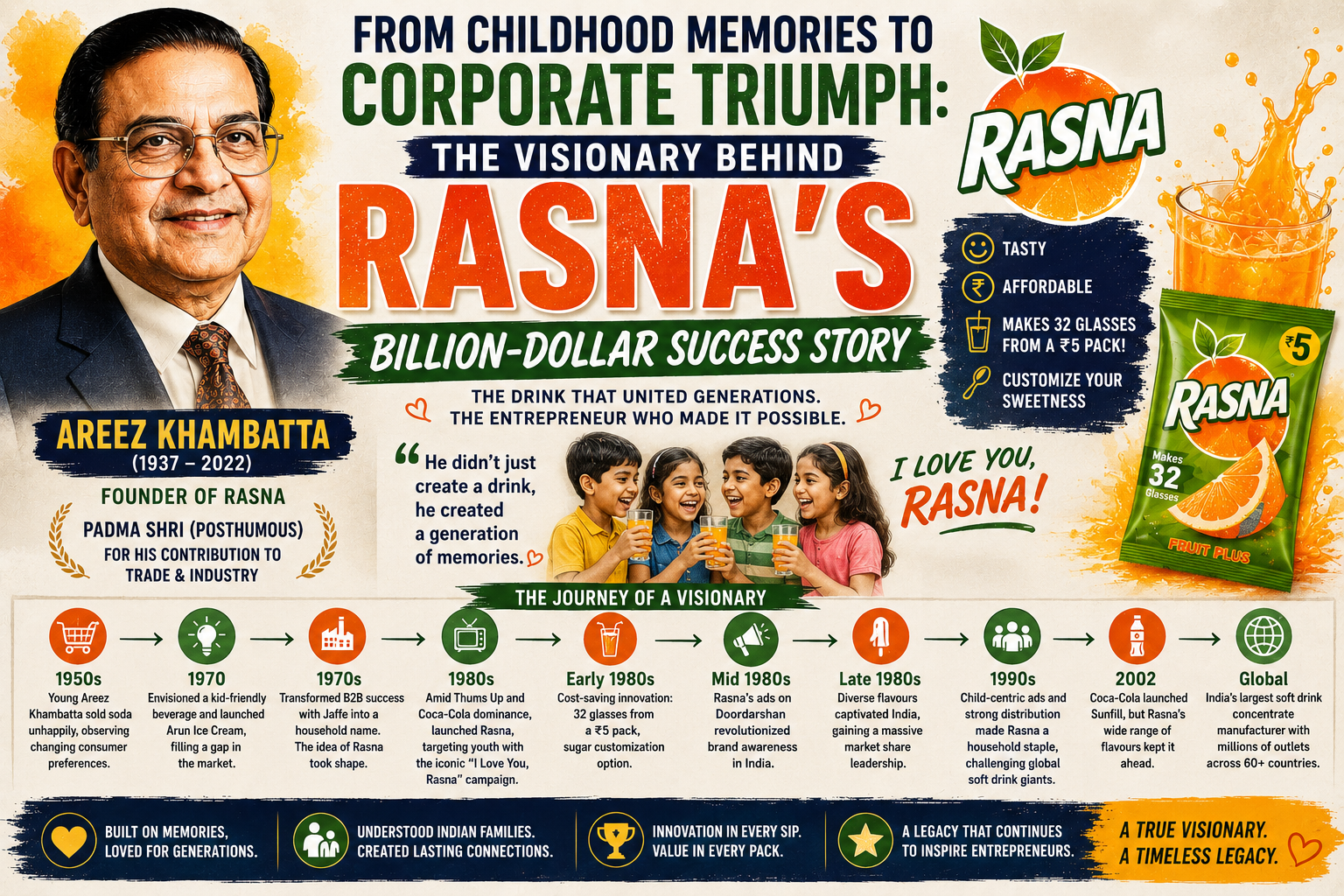
That entrepreneur was Areez Pirojshaw Khambatta-the visionary who transformed a modest beverage business into one of India’s most iconic consumer brands and later earned the Padma Shri (Posthumous) for his contribution to trade and industry.
This is the story of how one man turned a simple beverage concentrate into a household emotion.
Before Rasna, There Was Observation
Every iconic business starts with one question.
Areez Khambatta’s question was simple:
Why should refreshment remain expensive?
Born in 1937 and later graduating in chemistry from Gujarat College, Areez joined his family business in 1962. The business originally focused on beverage concentrates and industrial supply rather than consumer branding.
India was changing.
Consumption patterns were changing.
Families wanted affordability.
Children wanted excitement.
But beverage choices remained limited.
Khambatta noticed the gap.
And he decided to build for the Indian family-not the premium consumer.
The Birth of an Idea Hidden Inside Jaffe
Before Rasna became famous, there was another brand.
It was called Jaffe.
Created in the 1970s, Jaffe began as a fruit-based concentrate business and served as the foundation for what would later become Rasna.
At that stage, it wasn’t a national phenomenon.
But Khambatta noticed something important.
Families liked the idea of making drinks at home.
It was economical.
It was flexible.
And children loved flavor variety.
That insight led to a transformation.
Jaffe would evolve.
And India would meet Rasna.
Rasna Was Never Competing With Soft Drinks
One of the most misunderstood parts of Rasna’s journey is that it wasn’t trying to beat established global beverage giants directly.
It created a different category.
Instead of selling ready-to-drink bottles-
Rasna sold possibility.
One small concentrate pack.
Multiple glasses.
Affordable for families.
Customizable sweetness.
Higher perceived value.
It was a consumer innovation disguised as a beverage.
That strategy became revolutionary.
The Product That Changed Indian Summers
By the late 1970s and early 1980s, Rasna entered households across India.
The concept was simple.
Mix.
Stir.
Serve.
Families could make multiple glasses from one pack.
Over time, Rasna’s affordable concentrate became known for exceptional value—famously marketed as a ₹5 pack that could produce around 32 glasses of drink.
The economics worked.
But economics alone never creates emotional brands.
Something bigger was coming.
The Advertisement That Became Indian Pop Culture
Some advertisements sell products.
Others enter collective memory.
Khambatta and his team created one of India’s most memorable brand campaigns:
“I Love You Rasna.”
It was simple.
Childlike.
Warm.
And unforgettable.
The campaign turned Rasna from a beverage into an emotional identity.
Children repeated it.
Parents remembered it.
Retailers benefited from it.
Decades later, the line still remains one of India’s strongest examples of advertising recall.
Winning Through Affordability, Not Advertising Budgets
At a time when large beverage brands relied on scale and distribution muscle, Rasna focused on affordability.
Khambatta understood middle-class psychology.
Families wanted value.
Parents wanted control.
Children wanted fun.
Rasna delivered all three.
One pack became dozens of glasses.
That pricing innovation dramatically expanded accessibility.
Instead of selling luxury-
Rasna sold participation.
Understanding Children Better Than Competitors
Many brands targeted adults.
Rasna targeted family decision-making.
Children became emotional ambassadors.
Parents became buyers.
That combination created remarkable brand loyalty.
Colorful flavours.
Friendly communication.
Strong recall.
Affordable pricing.
Rasna became less of a product and more of a household tradition.
Expanding Beyond India
Once Rasna became dominant domestically, expansion became the next ambition.
The company scaled distribution and entered international markets.
Over time, Rasna grew to become one of the world’s largest soft drink concentrate manufacturers and expanded across more than 60 countries while building distribution across millions of retail touchpoints.
This wasn’t merely export growth.
It was Indian brand confidence.
The Quiet Genius Behind Rasna’s Growth
Areez Khambatta was never known for excessive public visibility.
His leadership style emphasized execution.
His strengths included:
Consumer understanding
Category creation
Cost discipline
Long-term brand building
Distribution thinking
He understood that consumer businesses are built over decades.
Not seasons.
Competition Arrived-But Rasna Stayed Relevant
Every successful brand eventually faces challengers.
Global beverage giants expanded.
New products entered.
Consumer habits evolved.
Yet Rasna remained culturally relevant.
Why?
Because emotional memory is difficult to replace.
People did not remember Rasna only as a drink.
They remembered where they drank it.
Who made it.
And who they shared it with.
That emotional equity became the brand’s moat.
From Businessman to Nation Builder
Khambatta’s impact extended beyond commerce.
He led social initiatives through trusts and philanthropic work.
He served in community leadership roles and supported causes linked to healthcare, education and public welfare through associated foundations.
For him, business and contribution were connected.
Recognition That Arrived as Legacy
In November 2022, India lost Areez Khambatta at the age of 85.
But his story did not end there.
In 2023, he was posthumously awarded the Padma Shri for his contribution to trade and industry. The award was accepted by his family.
It became recognition not only for building a business-
but for creating a brand woven into Indian life.
What Entrepreneurs Can Learn From Rasna
Modern founders often chase speed.
Khambatta built memory.
His lessons remain timeless:
Build for real people. Make products affordable. Create emotional recall. Think distribution before scale. Turn customers into storytellers.
Rasna did not become iconic because it was expensive.
It became iconic because it became accessible.
Why Rasna Still Matters
Today’s startup world talks about customer acquisition and retention.
Rasna achieved both decades earlier.
Its formula was remarkably simple:
Understand families.
Deliver value.
Create joy.
Repeat.
That philosophy transformed a beverage concentrate into a billion-dollar brand story.
A Glass Full of More Than a Drink
Some entrepreneurs create products.
Some create industries.
And some create memories that survive generations.
Areez Khambatta belonged to the third category.
He turned a simple idea into a national emotion.
He proved Indian brands could compete globally.
And he reminded entrepreneurs that the strongest brands are rarely built in boardrooms-
AI Conversationalist, Global Marketer, TEDx Speaker, Member-Board Of Studies-CDSW, AI Governance, Mentor Onboarded CCMB-Atal Incubation Center, Entrepreneurship Coach