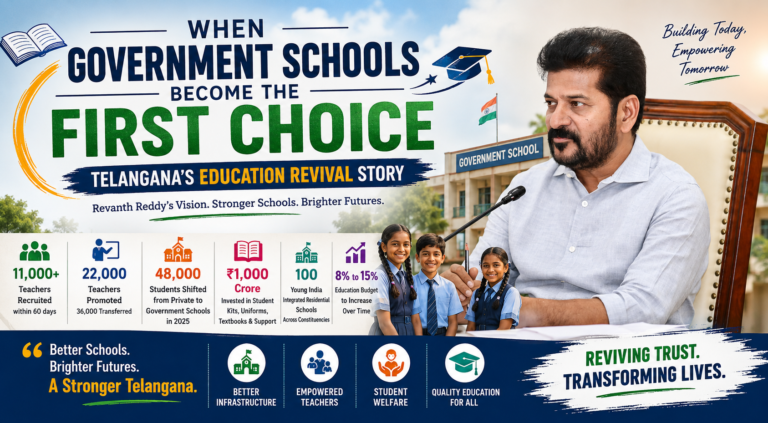
When Government Schools Become the First Choice: Telangana’s Education Revival Story
Telangana’s government schools are witnessing a remarkable revival under Chief Minister Revanth Reddy. From teacher recruitment and infrastructure upgrades to student welfare initiatives, the state’s education reforms are driving enrolment growth and restoring public confidence.
For years, government schools across India have faced a common challenge. Families increasingly preferred private institutions, believing they offered better infrastructure, stronger academic outcomes, and greater opportunities for their children. Telangana was no exception. Declining enrolment in public schools had become a growing concern, raising questions about accessibility, quality, and the future of government-funded education.
Today, however, the narrative is beginning to change. Under the leadership of Chief Minister A. Revanth Reddy, Telangana has embarked on one of its most ambitious education reform drives in recent memory. What started as a policy intervention is now being viewed by many education experts and administrators as a comprehensive attempt to rebuild public trust in government schools.
The state government’s strategy extends beyond constructing classrooms or distributing welfare benefits. Instead, it combines infrastructure development, teacher empowerment, student welfare, administrative reforms, and long-term institutional planning. Together, these measures are helping government schools regain relevance and, increasingly, attract students who had previously moved to private institutions.
A Shift in Public Confidence
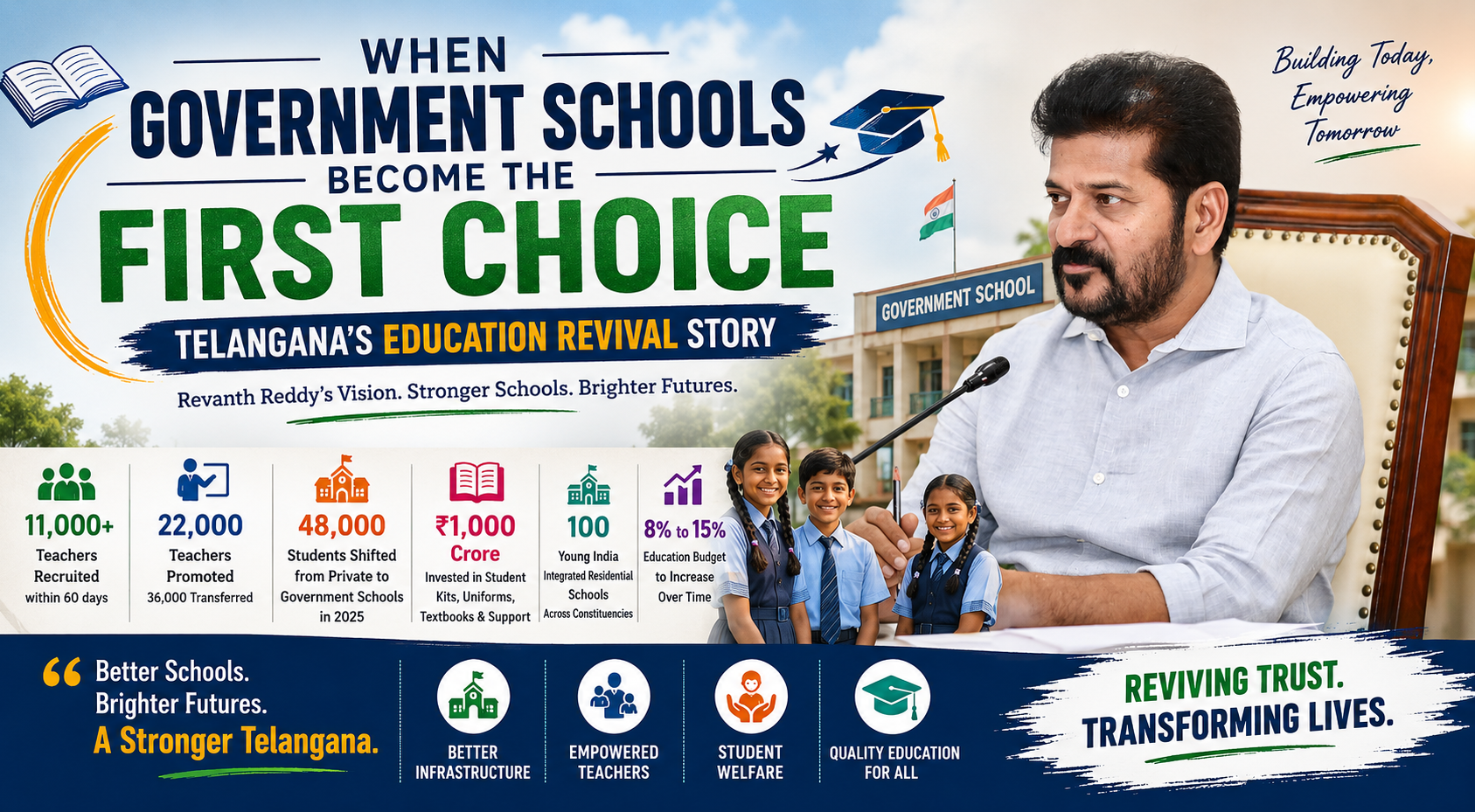
One of the most visible outcomes of Telangana’s education reforms has been the rise in enrolment in government schools. Education officials have reported that approximately 48,000 students shifted from private schools to government institutions during 2025, a trend that reflects growing confidence among parents.
While public discussions and political speeches have often cited enrolment gains approaching one lakh students across the broader government education system, independently verified data currently confirms the movement of around 48,000 students from private to government schools. Even this figure is significant because it signals a reversal of a long-standing trend that had seen public schools steadily losing students.
Parents typically make schooling decisions based on quality, affordability, safety, and future opportunities. When thousands of families voluntarily choose government schools over private alternatives, it suggests that tangible improvements are becoming visible at the grassroots level.
Education observers note that public trust cannot be restored through announcements alone. It requires visible change within classrooms, campuses, and learning environments. Telangana’s recent initiatives appear to be addressing precisely these concerns.
The Largest Teacher Recruitment Drive in Years
A school system is only as strong as its teachers. Recognizing this reality, the Telangana government undertook one of the most significant teacher recruitment efforts in the state’s recent history.
More than 11,000 teachers were recruited within a span of 60 days, filling long-pending vacancies that had affected learning outcomes in many schools. The move not only reduced staffing shortages but also ensured that students had greater access to qualified educators across urban and rural regions.
For many schools, particularly those located in remote areas, teacher shortages had become a major obstacle to delivering quality education. Multi-grade teaching, where a single teacher handles multiple classes simultaneously, often affected learning effectiveness. The recruitment drive is expected to alleviate many of these challenges and improve student-teacher ratios.
Education department officials believe that strengthening the teaching workforce is essential for achieving sustainable improvements in learning outcomes. Without sufficient teachers, infrastructure investments alone cannot transform educational quality.
Empowering Teachers Through Promotions and Transfers
Beyond recruitment, the government has also focused on improving morale within the teaching community. More than 22,000 teachers received promotions, while approximately 36,000 transfers were implemented to address administrative and operational requirements.
Teacher promotions are often viewed as an important recognition of professional growth and service. By addressing pending promotions, the government has attempted to create a more motivated workforce while improving career progression opportunities for educators.
Similarly, the transfer process was undertaken to ensure better deployment of teachers according to institutional needs. Balanced staffing across schools can play a critical role in maintaining educational standards and ensuring that underserved regions receive adequate teaching resources.
Educational administrators argue that motivated teachers are among the most influential factors in student success. By focusing on teacher welfare alongside student welfare, the government is attempting to strengthen the entire education ecosystem.
Investing in Students Beyond the Classroom
Education is influenced by far more than textbooks and examinations. Student welfare plays a major role in attendance, retention, and academic performance. Telangana’s reform agenda reflects this understanding through a series of welfare-focused interventions.
The government allocated approximately ₹1,000 crore for student kits, uniforms, textbooks, and related educational support. These provisions help reduce financial burdens on families while ensuring that students have access to essential learning materials from the beginning of the academic year.
For economically weaker households, educational expenses can often become a barrier to continuous schooling. Uniforms, books, and other supplies represent recurring costs that affect family budgets. By addressing these expenses directly, the state aims to improve educational accessibility and reduce dropout risks.
Nutrition programs have also received attention under the reform framework. Educational research consistently demonstrates a strong relationship between nutrition and academic performance. Better nutrition contributes to improved concentration, attendance, and overall student well-being.
Such welfare measures may appear simple on the surface, but collectively they create conditions that support sustained learning and participation.
Building an Integrated Learning Journey
Another significant component of Telangana’s education strategy is the introduction of Nursery-to-Class 12 continuity within the public education system.
Traditionally, students often transition between institutions at different educational stages, creating disruptions in learning continuity. By establishing a more integrated educational pathway, policymakers aim to provide a seamless academic experience from early childhood education through higher secondary schooling.
This model allows students to remain within a consistent learning environment while benefiting from structured academic progression. It also enables educational institutions to better monitor student development over longer periods.
Experts believe that continuity can improve retention rates and contribute to stronger educational outcomes. Students are more likely to remain engaged when transitions between educational stages are smoother and better coordinated.
The initiative reflects a broader shift from isolated educational interventions toward systemic planning and long-term institutional development.
The Vision Behind Young India Integrated Residential Schools
Among the most ambitious elements of the reform agenda is the establishment of 100 Young India Integrated Residential Schools across constituencies in Telangana.
These institutions are envisioned as modern educational campuses capable of delivering high-quality education alongside residential facilities. The objective is to provide students from diverse socio-economic backgrounds with access to advanced learning environments, modern infrastructure, and comprehensive academic support.
The concept represents a significant investment in future educational capacity. Residential schools can be particularly beneficial for students from rural and underserved regions where access to quality educational facilities may be limited.
Government officials have described these schools as institutions designed to nurture future leaders, innovators, and skilled professionals. Their establishment forms part of a broader effort to create aspirational public educational institutions capable of competing with leading private schools.
If implemented successfully, these schools could become flagship models for public education not only within Telangana but across India.
Infrastructure as a Foundation for Learning
Educational reform cannot succeed without adequate physical infrastructure. Telangana’s education transformation includes substantial investments in modernizing school facilities and creating better learning environments.
Improved classrooms, upgraded campuses, sanitation facilities, digital resources, and modern educational equipment are all part of the broader infrastructure agenda. Such improvements are critical because learning outcomes are often influenced by the quality of the environment in which students study.
Parents visiting government schools increasingly encounter cleaner campuses, improved facilities, and better-equipped classrooms. These visible changes contribute significantly to restoring confidence in public education.
Infrastructure development also supports teacher effectiveness. Educators are better positioned to deliver engaging lessons when schools possess adequate resources and modern teaching tools.
The emphasis on infrastructure demonstrates recognition that quality education requires both human and physical capital.
Increasing the Education Budget
Perhaps one of the strongest indicators of long-term commitment is the government’s proposal to increase education spending from approximately 8 percent to 15 percent of the state budget over time.
Budget allocation often reflects policy priorities. By committing to a substantial increase in education expenditure, the Telangana government is signaling that educational development occupies a central place in its broader governance agenda.
Higher investments can support teacher recruitment, infrastructure projects, technological integration, curriculum enhancement, and student welfare initiatives. More importantly, sustained funding provides stability for long-term educational planning.
Education economists frequently emphasize that meaningful reform requires consistent financial support rather than one-time interventions. Telangana’s budgetary commitment suggests an effort to institutionalize educational transformation rather than pursue short-term improvements.
Challenges That Still Remain
Despite encouraging progress, challenges remain. Educational transformation is a long-term process, and sustained success will depend on implementation quality, accountability, and measurable learning outcomes.
Enrolment growth is an important indicator, but educational quality must remain the ultimate benchmark. Improvements in literacy, numeracy, critical thinking, and employability will determine whether reforms achieve their intended objectives.
Monitoring mechanisms, teacher training programs, curriculum modernization, and technology integration will continue to play important roles in the years ahead. Policymakers must also ensure that gains are distributed equitably across urban and rural regions.
Experts caution that public confidence can be rebuilt relatively quickly but can also decline if standards are not maintained. Continued investment and oversight will therefore be essential.
A New Chapter for Public Education
Telangana’s ongoing education reforms represent more than administrative changes. They reflect a broader effort to redefine the role of government schools in a rapidly evolving society. By investing simultaneously in teachers, students, infrastructure, and institutional development, the state is attempting to create a public education system that families actively choose rather than reluctantly accept.
The reported movement of tens of thousands of students from private schools to government institutions offers an early indication that the strategy may be gaining traction. While challenges remain, the reforms have already sparked conversations about what is possible when public education receives focused political attention and sustained investment.
For Telangana, the revival of government schools is not merely an educational story. It is a story about restoring confidence in public institutions, expanding opportunities for future generations, and ensuring that quality education remains accessible regardless of economic background.
As the reforms continue to unfold, educators, policymakers, and parents across the country will be watching closely. The lessons emerging from Telangana may well influence the future direction of public education in India.
AI Conversationalist, Global Marketer, TEDx Speaker, Member-Board Of Studies-CDSW, AI Governance, Mentor Onboarded CCMB-Atal Incubation Center, Entrepreneurship Coach