Beyond Welfare Politics: How Praja Palana Is Redefining Telangana’s Development Story Through Jobs, Growth and Inclusive Governance
Explore how Telangana's Praja Palana governance model under Chief Minister A. Revanth Reddy is driving welfare delivery, employment generation, farmer empowerment, infrastructure growth, social justice, and economic transformation across the state.
From fulfilling electoral commitments to building a long-term governance framework, Telangana’s evolving Praja Palana model seeks to connect welfare, economic expansion, infrastructure, social justice, and citizen empowerment into a single development narrative.
Governments are often judged by promises made during election campaigns. Great governments, however, are ultimately remembered for promises fulfilled and institutions strengthened.
Over the last two and a half years, Telangana has witnessed a significant governance transition. What began as an electoral mandate for change has increasingly evolved into a broader governance framework centered on welfare delivery, employment creation, farmer empowerment, infrastructure expansion, and social inclusion.
At the heart of this transformation is the concept of “Praja Palana”—literally meaning governance for the people.
Presented by the Telangana Congress government under the leadership of Chief Minister A. Revanth Reddy, Praja Palana is being positioned not merely as a collection of welfare schemes but as an integrated governance model designed to connect economic growth with social justice.
Supporters describe it as an attempt to balance immediate citizen needs with long-term developmental priorities. Critics continue to evaluate its implementation and sustainability. Yet there is little disagreement that the scale and speed of policy interventions undertaken between December 2023 and June 2026 have significantly influenced Telangana’s public discourse.
From employment generation and agricultural relief to healthcare expansion and infrastructure investments, the government’s agenda has touched multiple sectors simultaneously.
The larger question now is whether Praja Palana can evolve from a governance slogan into a lasting development model.
A Governance Philosophy Rooted in Delivery
Political narratives often revolve around future promises.
Praja Palana seeks to shift the focus toward implementation.
The government has consistently emphasized that governance should be measured by outcomes that directly impact people’s lives. This philosophy is reflected in policies spanning employment, healthcare, housing, agriculture, education, and public services.
Rather than viewing welfare and economic development as competing priorities, the administration has attempted to position them as complementary pillars.
The underlying argument is simple: economic growth becomes stronger when citizens have access to opportunities, security, and public services.
This approach has shaped many of the government’s flagship initiatives.
Employment as a Confidence Builder
Perhaps one of the most significant indicators frequently highlighted by the government is employment generation within the public sector.
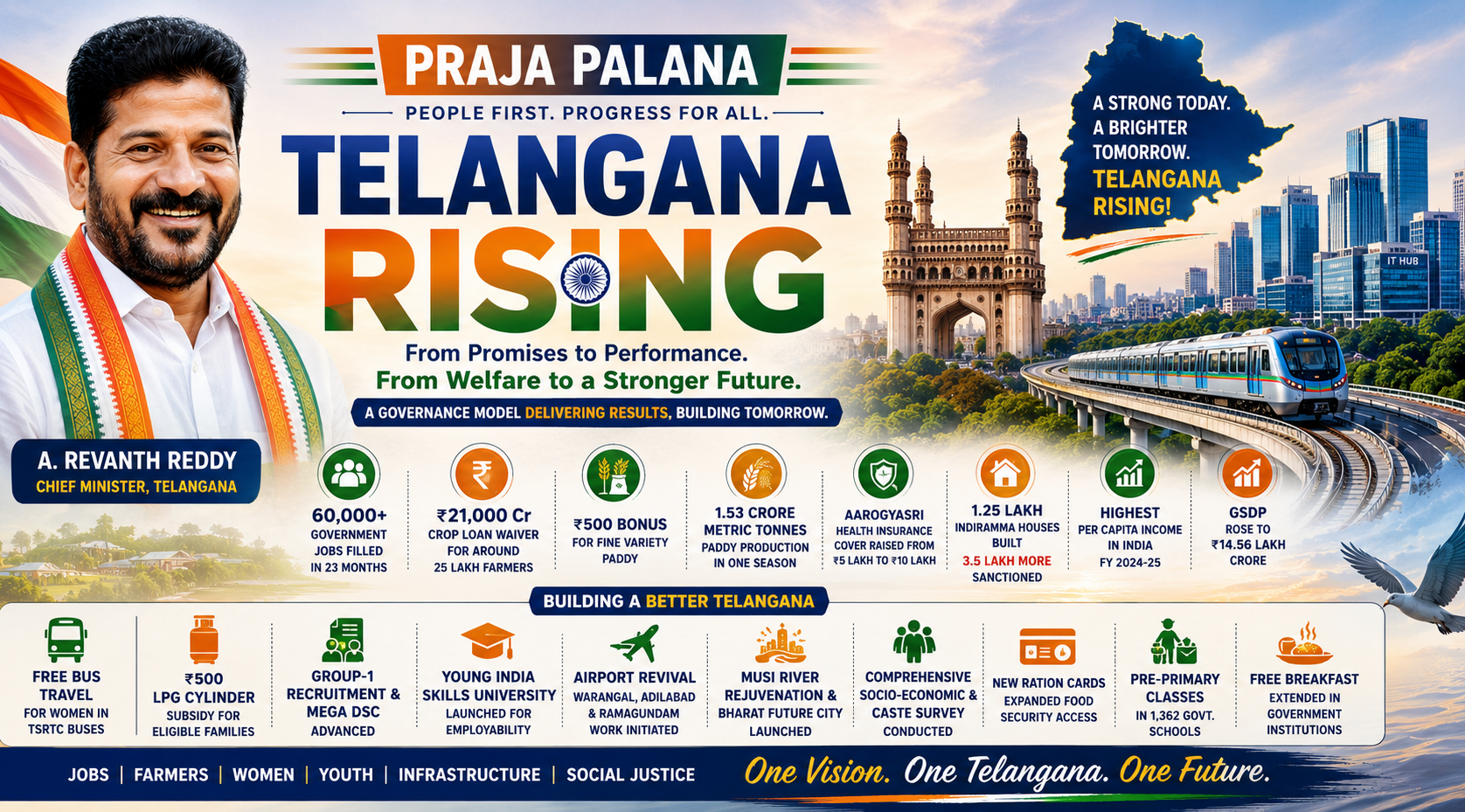
More than 60,000 government posts have reportedly been filled within 23 months.
For thousands of young aspirants across Telangana, government recruitment had long represented both economic security and social mobility.
The filling of vacancies is therefore viewed not only as an administrative exercise but also as a confidence-building measure.
Large-scale recruitment sends a signal that institutional capacity is being strengthened while simultaneously addressing youth aspirations.
The advancement of Group-1 recruitment processes and the Mega DSC initiative further reinforces this emphasis on employment opportunities.
For many candidates preparing for years to secure government jobs, these developments represent more than statistics—they symbolize access to stability and upward mobility.
Putting Farmers at the Center of Economic Policy
Agriculture continues to remain one of Telangana’s most important economic sectors.
Recognizing the central role of farmers in the state’s economy, the government has introduced several measures designed to ease financial pressures and improve agricultural outcomes.
Among the most notable interventions is the crop loan waiver program.
Approximately ₹21,000 crore has reportedly been delivered toward waiving crop loans benefiting nearly 25 lakh farmers.
For many rural families, debt relief offers immediate financial breathing room and the ability to reinvest in future cultivation cycles.
In addition to loan waivers, the government introduced a ₹500 bonus for fine variety paddy.
The initiative seeks to encourage quality production while improving farmer incomes.
The agricultural sector has also recorded significant production achievements.
One season alone witnessed paddy production of approximately 1.53 crore metric tonnes, reflecting the scale and importance of farming within Telangana’s development framework.
Together, these measures aim to strengthen rural prosperity while supporting food security and agricultural growth.
Expanding the Safety Net Through Healthcare
Healthcare remains one of the most important indicators of governance effectiveness.
Medical emergencies often push families into financial distress, particularly among lower-income households.
To address this challenge, Telangana expanded Aarogyasri health insurance coverage from ₹5 lakh to ₹10 lakh.
The increase significantly broadens financial protection available to eligible beneficiaries.
For families facing expensive medical procedures, enhanced coverage can make the difference between receiving timely treatment and postponing critical healthcare decisions.
The move also reflects a broader trend in governance where healthcare is increasingly viewed not merely as a service but as a fundamental component of social security.
By expanding coverage, the government seeks to reduce economic vulnerability while improving healthcare access.
Housing as a Measure of Dignity
Development is often measured through large infrastructure projects.
Yet for millions of families, the most meaningful form of development is access to a secure home.
Recognizing this reality, the government has prioritized housing under the Indiramma Housing initiative.
Approximately 1.25 lakh houses have reportedly been constructed, while an additional 3.5 lakh homes have received sanction.
Housing programs deliver benefits that extend beyond shelter.
They improve living standards, support family stability, enhance social security, and contribute to local economic activity.
The scale of the housing effort reflects an understanding that development must be visible not only in cities but also in individual households.
Economic Indicators Signal Momentum
A strong welfare agenda requires a robust economic foundation.
Without economic growth, sustaining large-scale social programs becomes increasingly difficult.
The Telangana government frequently points to the state’s economic performance as evidence that welfare and growth can coexist.
According to official figures, Telangana recorded the highest per capita income in India during FY 2024-25.
This milestone reinforces the state’s position among the country’s leading economic performers.
Meanwhile, Gross State Domestic Product (GSDP) reportedly rose to ₹14.56 lakh crore.
These indicators suggest continued economic momentum despite broader national and global uncertainties.
Supporters argue that strong economic performance creates fiscal space for social investments while attracting additional private-sector participation.
Empowering Women Through Mobility
One of the most widely discussed initiatives under the current administration has been free bus travel for women in TSRTC services.
Mobility plays a critical role in expanding economic and social opportunities.
Affordable transportation influences employment participation, educational access, healthcare utilization, and overall quality of life.
For many women, the policy has reduced travel costs while increasing independence and accessibility.
The broader significance of the initiative lies in its recognition that empowerment often begins with practical interventions.
When mobility barriers are reduced, opportunities expand.
The scheme has therefore become both a welfare measure and a social inclusion initiative.
Reducing Household Financial Pressures
Rising living costs remain a concern for families across India.
In response, Telangana introduced subsidized LPG cylinders priced at ₹500 for eligible households.
Cooking fuel expenses represent a recurring burden for many low- and middle-income families.
Reducing these costs helps improve household financial resilience while supporting cleaner energy adoption.
Although such measures require significant public expenditure, supporters argue that targeted subsidies can generate meaningful improvements in household welfare.
The initiative reflects the government’s broader emphasis on easing everyday financial pressures.
Investing in Future-Ready Skills
Economic growth increasingly depends on human capital.
Recognizing this reality, Telangana launched the Young India Skills University.
The institution seeks to bridge gaps between education and employment by aligning training with evolving industry needs.
As technologies reshape labor markets, employability has become a major concern for both policymakers and businesses.
Skills development initiatives aim to prepare young people for emerging opportunities across sectors.
The university represents an effort to create a workforce capable of meeting future economic demands while reducing skill mismatches.
In the long term, such investments may prove as important as physical infrastructure projects.
Infrastructure for the Next Generation
Infrastructure development remains a central component of Telangana’s growth strategy.
Several major initiatives have been launched or accelerated to improve connectivity and support economic expansion.
Airport revival efforts in Warangal, Adilabad, and Ramagundam are expected to strengthen regional accessibility and unlock new investment opportunities.
Improved air connectivity often serves as a catalyst for tourism, business activity, and industrial growth.
Similarly, ambitious urban projects such as the Musi River Rejuvenation initiative seek to combine environmental restoration with urban transformation.
The Bharat Future City concept represents another attempt to position Telangana as a hub for next-generation urban development.
Together, these projects reflect a long-term vision extending beyond immediate political cycles.
Expanding Social Inclusion Through Data
One of the administration’s notable initiatives has been the comprehensive socio-economic and caste survey.
Supporters argue that effective policymaking requires accurate and updated data.
Understanding demographic realities helps governments design targeted interventions and allocate resources more efficiently.
The survey aims to provide deeper insights into social and economic conditions across communities.
Whether in welfare delivery, educational planning, or employment programs, data-driven governance is increasingly viewed as essential for improving outcomes.
The exercise reflects a broader commitment to evidence-based decision-making.
Strengthening Food Security
Food security remains a foundational component of social welfare.
The expansion of new ration cards has brought additional households into the public distribution system.
Access to subsidized food grains can significantly reduce economic vulnerability, particularly among lower-income families.
The initiative complements broader efforts aimed at strengthening social protection mechanisms.
By expanding eligibility and improving access, the government seeks to ensure that welfare benefits reach intended beneficiaries more effectively.
Reimagining Public Education
Education continues to be one of the most powerful instruments of social mobility.
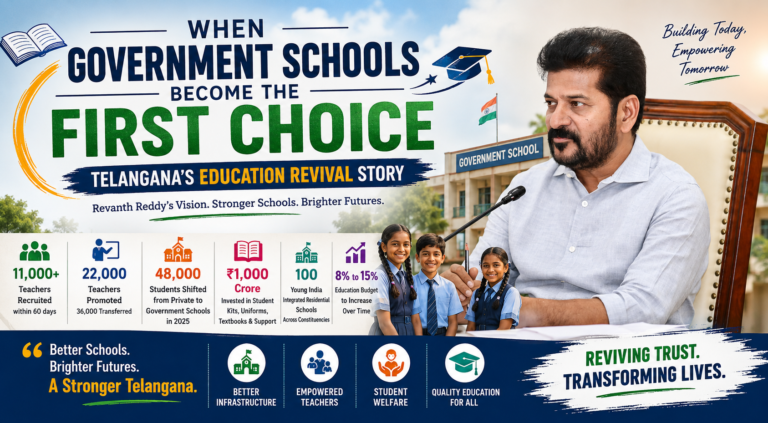
Recognizing the importance of early childhood learning, Telangana introduced pre-primary classes in 1,362 government schools.
Research consistently demonstrates that foundational education plays a critical role in long-term academic outcomes.
By strengthening early learning opportunities, the state aims to improve educational trajectories from the very beginning.
In parallel, the extension of free breakfast programs in government institutions addresses nutritional needs that directly affect student performance and attendance.
Together, these initiatives represent a holistic approach to educational development.
Connecting Welfare with Long-Term Development
Perhaps the most distinctive aspect of Praja Palana is its attempt to integrate diverse policy domains into a single governance narrative.
Rather than treating welfare, employment, agriculture, infrastructure, education, and healthcare as isolated sectors, the model presents them as interconnected elements of development.
The logic is straightforward.
A farmer benefiting from debt relief can invest more confidently.
A student receiving nutritional support may perform better academically.
A young graduate equipped with industry-relevant skills becomes more employable.
A woman with access to free transportation gains greater mobility.
A family protected by health insurance faces less financial risk.
When these outcomes occur simultaneously, they can reinforce one another.
This interconnected perspective forms the philosophical foundation of Praja Palana.
Challenges and Expectations Ahead
Like any large-scale governance model, Praja Palana faces important challenges.
Infrastructure projects must be completed efficiently.
Employment generation must keep pace with demographic realities.
Economic growth must remain inclusive.
Citizens will ultimately evaluate success not by announcements but by long-term outcomes.
The government’s ability to balance welfare commitments with economic sustainability will therefore remain a key area of public scrutiny.
Yet the ambition of the model is undeniable.
It seeks to redefine governance as a continuous process of delivery, inclusion, and institutional strengthening.
A New Chapter in Telangana’s Development Journey
As Telangana moves toward the next phase of its growth story, Praja Palana represents more than a policy framework.
It symbolizes an effort to connect governance with everyday life.
The administration’s broader message is that welfare, jobs, farming, infrastructure, social justice, and economic growth are not separate priorities but interconnected goals.
Whether viewed as a political philosophy, a governance strategy, or a development experiment, Praja Palana has become a central feature of Telangana’s contemporary narrative.
The coming years will determine how deeply its principles become embedded within the state’s institutions.
For now, it stands as an ambitious attempt to move beyond promise-making and toward measurable delivery-an effort to build a Telangana where growth and inclusion advance together.
And in that aspiration lies the true test of governance: not merely creating policies, but creating possibilities.
AI Conversationalist, Global Marketer, TEDx Speaker, Member-Board Of Studies-CDSW, AI Governance, Mentor Onboarded CCMB-Atal Incubation Center, Entrepreneurship Coach