From Tech Alternative to Global Magnet: How Hyderabad Became the First Choice for Multinational Capability Centers
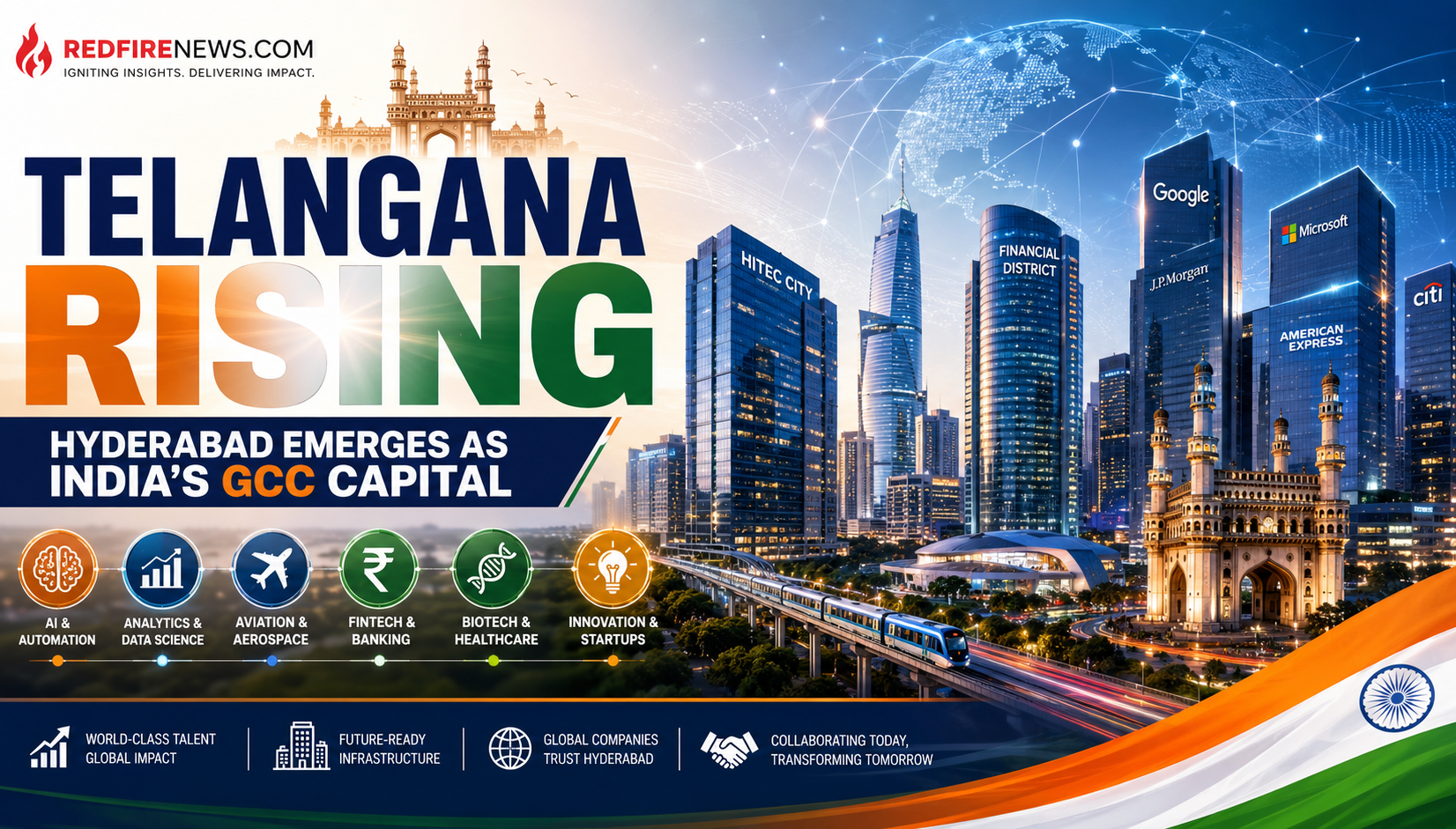
India's GCC landscape is undergoing a major shift as 17 new Global Capability Centers were announced in 2026, with Hyderabad emerging as the preferred destination. Discover why multinational companies are betting big on Telangana's talent, infrastructure, and business ecosystem.
A decade ago, Hyderabad was competing for attention. Today, it is commanding it. As global corporations rethink where to build their next capability centers, Telangana’s capital is rapidly emerging as India’s most compelling destination for growth, talent, and transformation.
For years, the conversation around India’s Global Capability Center (GCC) ecosystem followed a predictable script.
A multinational company wanted to establish a technology center in India.
The board approved the plan.
Consultants prepared reports.
Executives conducted site visits.
And almost inevitably, Bengaluru emerged as the preferred destination.
The city built a formidable reputation over decades as India’s technology capital. It attracted global technology firms, nurtured startups, developed engineering talent, and became synonymous with innovation.
That formula remained largely unchanged for years.
But 2026 may be remembered as the year the script began to change.
According to AIM Research’s “India’s GCC Wave 2026” report, 17 major multinational corporations announced new Global Capability Centers in India between January and May 2026 alone.
The list includes some of the world’s most respected enterprises.
UBS plans to create approximately 2,000 jobs.
Heineken is expected to add up to 1,600 positions.
Southwest Airlines is building a center expected to support around 1,000 jobs.
Global names such as Western Union, Zurich Insurance, Regeneron, Lonza, and several others are also expanding their India presence through GCC investments.
Yet beyond the impressive numbers lies a more important story.
A majority of these companies have selected Hyderabad as their preferred destination.
While Bengaluru continues to attract strategic investments, Hyderabad appears to be emerging as the city winning the next generation of GCC expansion.
The implications extend far beyond office space demand.
This shift reflects changing corporate priorities, evolving talent strategies, infrastructure considerations, and the emergence of a new economic geography within India’s knowledge economy.
The question is no longer whether Hyderabad can compete with Bengaluru.
The question increasingly becoming relevant is whether Hyderabad has become the default choice for large-scale multinational capability centers.
Understanding the New GCC Economy
Global Capability Centers have evolved significantly over the last two decades.
Initially viewed as cost-saving back-office operations, GCCs today perform some of the most critical functions within multinational organizations.
As corporations become increasingly digital, GCCs are becoming central to innovation, operational efficiency, and competitive advantage.
India has emerged as the global leader in this space due to its talent base, technology ecosystem, and operational scale.
The country’s GCC sector now employs hundreds of thousands of professionals and contributes significantly to economic activity.
What is changing in 2026 is not India’s attractiveness.
What is changing is the preferred city within India.
The Hyderabad Acceleration
A decade ago, Hyderabad was often viewed as a strong alternative to Bengaluru.
Today, it is increasingly being viewed as a primary choice.
This transition did not happen overnight.
It is the result of consistent investments in infrastructure, business-friendly policies, talent development, urban planning, and industry diversification.
What makes Hyderabad’s recent success particularly noteworthy is the nature of the companies choosing the city.
These are not exclusively software firms.
Many belong to industries traditionally outside the technology sector.
That distinction matters.
Because it signals a broader economic evolution.
The Rise of the Non-Tech GCC
One of the most fascinating aspects of the 2026 GCC wave is the diversity of sectors represented.
Heineken operates in consumer goods.
Southwest Airlines belongs to aviation.
Lonza is a global life sciences company.
Zurich Insurance operates in financial services.
Regeneron is a biotechnology leader.
These organizations require far more than software engineers.
They need finance professionals.
Operations experts.
Supply chain specialists.
Healthcare analysts.
Business transformation leaders.
Customer experience professionals.
Data scientists.
Compliance experts.
Research specialists.
The traditional definition of a GCC has expanded dramatically.
Companies increasingly seek cities capable of supporting multidisciplinary talent pools rather than purely technology-focused ecosystems.
Hyderabad appears particularly well-positioned for this shift.
Its strong presence across information technology, pharmaceuticals, life sciences, financial services, manufacturing, and business operations creates a diversified ecosystem that appeals to multinational corporations.
The city offers a rare combination of breadth and depth.
That versatility is becoming a competitive advantage.
Infrastructure Is Becoming a Deciding Factor
For years, talent availability dominated location decisions.
Today, infrastructure quality has become equally important.
Global executives increasingly evaluate employee experience, commuting efficiency, business continuity, and quality of life when selecting GCC locations.
A world-class capability center loses some of its attractiveness if employees spend excessive time navigating traffic congestion.
Senior leadership teams increasingly factor these realities into decision-making.
Hyderabad’s infrastructure story has become one of its strongest selling points.
Wide roads.
Planned business districts.
Integrated technology corridors.
Modern airport connectivity.
Expanding metro networks.
Improved urban mobility.
These factors contribute to a more predictable operating environment.
For multinational corporations planning investments worth hundreds of millions of dollars, predictability matters.
Infrastructure is no longer a secondary consideration.
It has become a strategic differentiator.
The Talent Economics Equation
Talent remains the foundation of every GCC investment decision.
India’s competitive advantage has always rested on its ability to produce highly skilled professionals at scale.
However, talent economics are evolving.
As technology ecosystems mature, competition for skilled professionals intensifies.
This dynamic has become particularly visible in Bengaluru.
While the city remains India’s undisputed leader in deep technology and startup innovation, the sheer concentration of employers has created intense competition for talent.
High attrition rates.
Aggressive counteroffers.
Escalating compensation expectations.
Recruitment complexity.
These realities increase operating costs for employers.
Hyderabad offers a different equation.
Companies often report lower attrition rates, broader talent availability, and more manageable compensation structures.
Industry observers frequently estimate that organizations can achieve meaningful cost efficiencies while maintaining access to high-quality talent.
For large-scale GCCs employing thousands of professionals, even modest cost advantages translate into substantial long-term savings.
The result is a compelling value proposition.
Why Fortune 500 Companies Are Paying Attention
Corporate site selection decisions are rarely emotional.
They are driven by data.
Risk assessments.
Financial modeling.
Talent forecasts.
Infrastructure evaluations.
And long-term growth strategies.
When multiple Fortune 500 companies independently arrive at similar conclusions, the trend deserves attention.
Hyderabad’s emergence as a preferred GCC destination reflects years of accumulated credibility.
Companies are increasingly confident that the city can support not only current requirements but also future expansion plans.
This confidence extends beyond hiring.
It encompasses leadership availability.
Educational partnerships.
Innovation ecosystems.
Real estate capacity.
Regulatory support.
And quality of life considerations.
Together, these elements create an environment conducive to sustainable growth.
Real Estate’s Next Big Opportunity
The GCC boom is not only reshaping employment markets.
It is also transforming commercial real estate.
Every major capability center requires office infrastructure.
Large-scale GCCs often occupy hundreds of thousands of square feet.
Some require entire campuses.
Others drive demand for premium residential developments, retail ecosystems, hospitality services, and transportation infrastructure.
Hyderabad’s commercial property sector is therefore positioned to benefit significantly from continued GCC expansion.
Developers increasingly view multinational capability centers as long-term anchor tenants.
Unlike speculative demand, GCC investments tend to be stable and expansion-oriented.
This creates a virtuous cycle.
More GCCs generate more employment.
More employment creates more housing demand.
More housing supports retail growth.
Retail growth enhances quality of life.
And improved quality of life attracts additional investment.
The economic multiplier effect is substantial.
Beyond Cost: Building an Innovation Ecosystem
One misconception about GCC expansion is that companies are motivated solely by cost savings.
They want locations capable of contributing intellectual value, not merely operational efficiency.
Hyderabad has invested heavily in positioning itself as an innovation ecosystem rather than a low-cost outsourcing destination.
Research institutions.
Technology accelerators.
Startup ecosystems.
Industry partnerships.
Life sciences clusters.
Artificial intelligence initiatives.
These assets contribute to a more sophisticated value proposition.
Global corporations increasingly want their GCCs to participate in product development, advanced analytics, research, and strategic decision-making.
Hyderabad’s ecosystem supports that ambition.
Telangana’s Role in the Transformation
No city’s economic transformation occurs in isolation.
Public policy plays a critical role.
Telangana’s leadership has consistently prioritized investment attraction, infrastructure development, industry engagement, and ease of doing business.
Over the years, the state has cultivated a reputation for responsiveness and proactive governance.
This reputation matters when multinational corporations evaluate investment destinations.
Business leaders seek environments where administrative processes are efficient and policy frameworks remain predictable.
Telangana’s approach has helped reinforce investor confidence while accelerating ecosystem development.
The GCC surge reflects not only Hyderabad’s strengths but also broader institutional efforts supporting economic growth.
Bengaluru Remains Powerful-But the Market Has Changed
Declaring Bengaluru’s decline would be inaccurate.
The city remains India’s premier technology hub.
Its startup ecosystem is unmatched.
Its engineering depth remains extraordinary.
Its innovation credentials are globally recognized.
However, markets evolve.
Success creates new challenges.
Scale introduces complexity.
As organizations diversify location strategies, alternative hubs gain opportunities.
The emerging narrative is therefore not Bengaluru versus Hyderabad.
It is about specialization and evolving corporate preferences.
Bengaluru continues to dominate deep technology and startup ecosystems.
Hyderabad increasingly leads in large-scale enterprise GCC expansion.
Both cities play critical roles within India’s innovation economy.
The difference is that Hyderabad’s momentum is accelerating rapidly.
The Workforce Implications
The GCC boom has profound implications for professionals.
As multinational investments increase, demand for skilled talent expands across multiple disciplines.
Technology professionals will benefit.
So will finance specialists.
Data analysts.
Business consultants.
Healthcare experts.
Supply chain managers.
Cybersecurity professionals.
Human resource leaders.
Legal specialists.
Project managers.
The next generation of GCCs requires multidisciplinary expertise.
This creates opportunities for students, professionals, and educational institutions alike.
Universities and training organizations may increasingly align curricula with emerging industry demands.
The result could be stronger employability outcomes and broader career pathways.
Hyderabad’s Defining Moment
Cities experience defining moments in their development.
Moments when incremental progress becomes visible transformation.
For Hyderabad, 2026 may represent such a moment.
The concentration of GCC announcements suggests that multinational corporations increasingly view the city as a strategic destination rather than an alternative option.
This distinction is important.
Being considered is valuable.
Being chosen repeatedly is transformative.
The recent wave of investments indicates that Hyderabad has crossed a psychological threshold in the minds of global decision-makers.
The city is no longer competing for relevance.
It is competing for leadership.
The Future of India’s GCC Landscape
The broader GCC sector is expected to continue expanding as global companies pursue digital transformation, operational resilience, and innovation-driven growth.
India remains uniquely positioned to benefit from these trends.
Within India, competition among cities will intensify.
Infrastructure quality.
Talent availability.
Policy support.
Quality of life.
Innovation ecosystems.
These factors will increasingly determine winners and losers.
At present, Hyderabad appears exceptionally well-positioned.
Its combination of economic momentum, diversified industry strengths, infrastructure advantages, and talent accessibility creates a powerful growth platform.
A New Corporate Map Is Emerging
The significance of the 2026 GCC wave extends beyond statistics.
It signals a shift in perception.
For years, multinational corporations followed a familiar playbook when entering India.
Today, that playbook is being rewritten.
The emerging corporate map looks different.
And at the center of that map stands Hyderabad.
The city that was once viewed as an alternative has become a preferred destination.
The ecosystem that once competed for attention now commands it.
And the growth story that began with technology is evolving into something much larger-a globally connected hub for innovation, enterprise capability, and economic transformation.
If current trends continue, the question facing multinational corporations may no longer be whether to choose Hyderabad.
Instead, it may be how quickly they can establish a presence before everyone else arrives.
That is the clearest sign yet that a new chapter in India’s GCC story has begun-and Hyderabad is writing much of it.
AI Conversationalist, Global Marketer, TEDx Speaker, Member-Board Of Studies-CDSW, AI Governance, Mentor Onboarded CCMB-Atal Incubation Center, Entrepreneurship Coach