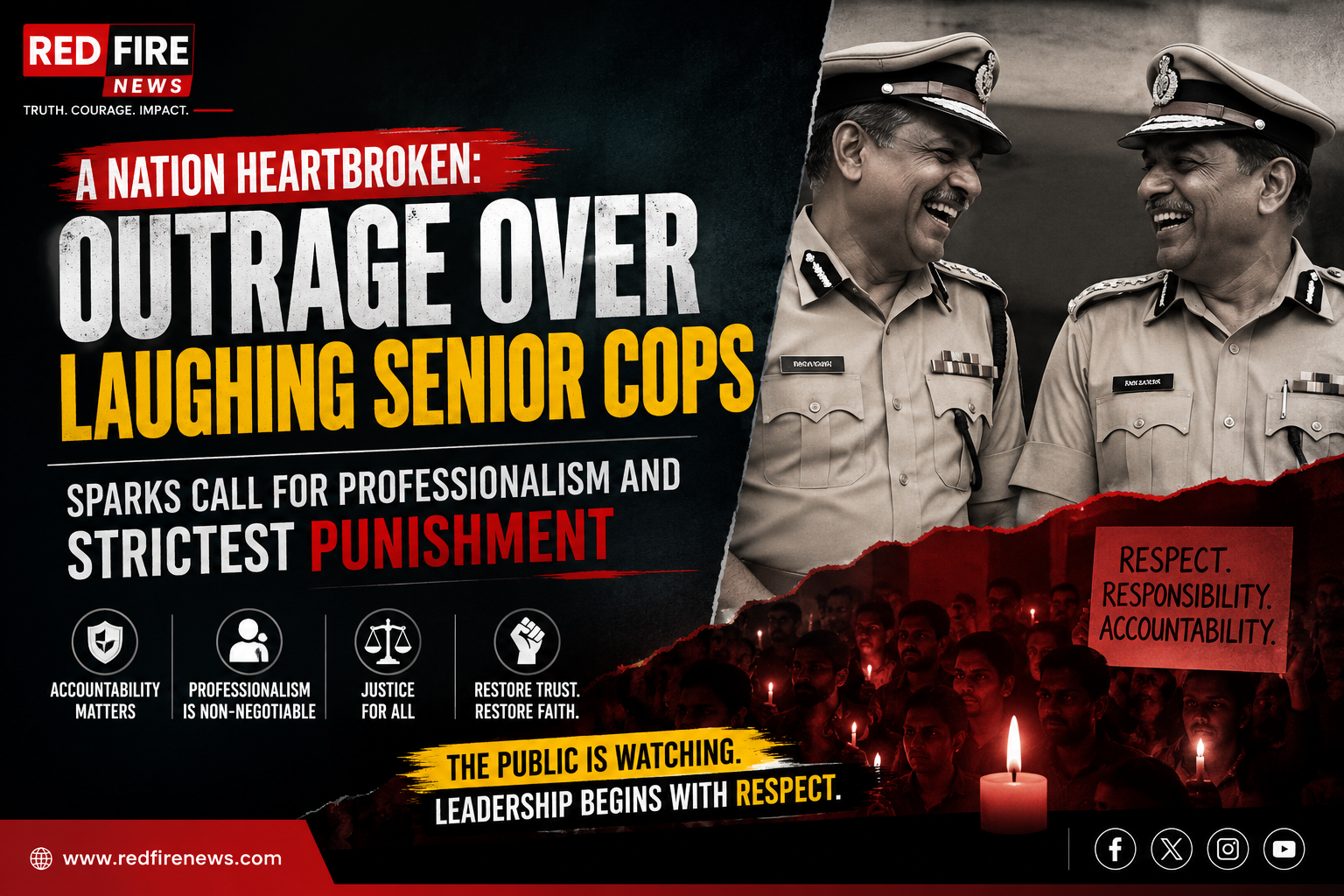
A Nation Heartbroken: Outrage Over Laughing Senior Cops Sparks Call for Professionalism and Strictest Punishment
Public anger erupts after visuals of senior police officials appearing to laugh during a sensitive moment spark nationwide debate on professionalism, accountability, ethics, and public trust in law enforcement.
In moments of public grief, symbols matter. Expressions matter. Conduct matters. Institutions are not judged only by their decisions but by the way those decisions are carried and communicated. Across the country, an intense wave of anger and disappointment has emerged after visuals circulated showing senior police officials appearing to laugh during what many citizens considered a solemn and emotionally charged situation.
The reaction was immediate and emotional. For countless people watching, the issue was not merely about a smile, a conversation, or a few seconds captured on camera-it became something much larger. It became a question of whether institutions entrusted with protecting people fully understand the weight of public pain.
As the footage spread and public discussion intensified, citizens, commentators, legal observers, and former officials began raising difficult questions: What standards should apply to senior public officers? Is professionalism only about procedure, or does it also include visible sensitivity? And when conduct appears detached from public emotion, should accountability extend beyond explanations?
This moment has triggered a broader national conversation that reaches far beyond one incident.
When Public Emotion Meets Institutional Conduct
Police officers occupy one of the most visible and emotionally demanding roles in public life. They arrive at scenes of tragedy, stand before grieving families, manage conflict, communicate difficult updates, and often represent the state during moments of collective distress.
Because of that role, public expectations are unusually high.
Citizens do not simply expect officers to enforce rules; they expect them to embody seriousness, restraint, empathy, and discipline—especially at senior levels where symbolic leadership carries immense weight.
When images or videos appear inconsistent with those expectations, reactions can become intense.
Many people who viewed the circulating visuals expressed that their frustration was not necessarily about proving intent. Rather, they questioned the optics and timing. To ordinary citizens experiencing anger, grief, or concern, visible laughter-even if unrelated to the surrounding circumstances-can appear insensitive.
That perception alone can damage trust.
The Power of Optics in Public Service
Public institutions often remind citizens not to rush to judgment based on partial clips or incomplete context. That principle matters. Short videos can misrepresent events, remove context, or exaggerate impressions.
Yet another principle is equally important: public officials are expected to understand how their conduct appears.
In leadership positions, perception becomes part of responsibility.
Senior officers are trained not only to manage operations but also to project calm, confidence, and respect under scrutiny. Cameras today are everywhere. Every expression may become public record.
The challenge is not to demand robotic behavior from public servants. Police personnel are human beings, and moments captured on camera do not always reflect intention.
But leadership positions carry a different burden.
People expect emotional discipline.
That expectation becomes stronger during incidents involving public suffering, tragedy, controversy, or loss.
Why Citizens Are Calling for the Strictest Action
Public anger has translated into growing calls for strong disciplinary action.
For many voices across the debate, strict consequences are being framed not as revenge but as a signal.
The argument is straightforward: if ordinary frontline officers are expected to maintain decorum under pressure, senior leadership should be held to an even higher standard.
Supporters of strict action argue that accountability serves three purposes:
First, restoring public trust. When confidence in institutions weakens, visible accountability reassures citizens that standards apply equally across ranks.
Second, reinforcing internal discipline. Senior leadership sets the behavioral culture of entire departments.
Third, protecting institutional credibility. Swift action can prevent one incident from defining an entire force.
However, others urge caution.
They argue that disciplinary decisions should rely on verified facts rather than emotional momentum generated by viral content.
This tension-between public emotion and procedural fairness-is at the center of the current debate.
The Larger Issue: Professionalism Beyond Rules
Professionalism in policing is often misunderstood.
It is not limited to uniforms, punctuality, investigations, or operational success.
Modern policing increasingly emphasizes what experts sometimes describe as “procedural legitimacy”—the idea that people trust institutions not only because of outcomes but because of how they are treated and what they observe.
Visible professionalism includes:
Respectful public conduct
Situational awareness
Emotional restraint
Responsible communication
Sensitivity during crisis situations
Accountability after mistakes
In this context, public criticism is not simply about one expression caught on camera.
It reflects deeper expectations about how authority should behave.
Citizens want to feel that institutions recognize their emotions.
Social Media and the Speed of Public Judgment
The current controversy also highlights how rapidly public perception now forms.
A single video clip can travel nationwide in minutes.
Public sentiment develops instantly.
Explanations often arrive later.
This reality creates challenges for institutions and citizens alike.
On one hand, social media increases transparency and ensures public officials remain answerable.
On the other hand, viral outrage can sometimes reduce complex events into symbolic moments.
That creates pressure on authorities to respond quickly while still protecting due process.
Experts increasingly note that public communication must become part of crisis management itself.
Silence often creates suspicion.
Clear explanations can reduce speculation.
But explanations alone rarely succeed if people believe emotional expectations were ignored.
Trust: The Most Difficult Thing to Rebuild
Trust is unusual.
It builds slowly and weakens quickly.
Police departments around the world invest years developing community relationships, improving training, increasing transparency, and encouraging public cooperation.
One highly visible moment can suddenly overshadow years of effort.
That is why institutional responses matter.
People are not only observing the original incident.
They are watching what happens next.
Will there be an inquiry?
Will standards be clarified?
Will leadership acknowledge public concern?
Will communication be transparent?
Those responses often shape public opinion more than the incident itself.
What Accountability Could Look Like
Calls for accountability do not always mean the same thing.
Possible institutional responses generally fall across several levels:
Fact verification: Review complete footage, establish timeline, and understand context.
Administrative review: Determine whether conduct breached professional standards.
Public communication: Explain findings clearly and avoid defensive messaging.
Training reforms: Strengthen leadership and public engagement protocols.
Disciplinary measures where warranted: Apply consequences proportionate to findings.
Accountability gains legitimacy when it is both firm and fair.
People want seriousness-not symbolism alone.
A Moment for Reflection Across Public Institutions
This conversation extends beyond policing.
Every institution that serves the public-government agencies, emergency responders, civic bodies, and leadership offices-faces similar expectations.
Authority today is constantly visible.
Professional excellence now includes emotional intelligence.
Citizens increasingly expect leaders to understand not just what they do, but how their actions are perceived.
That expectation may feel demanding.
But it reflects a broader shift in democratic culture: people want institutions that appear connected to human realities.
Respect cannot be assumed.
It must be demonstrated.
Public Anger Often Carries a Message
Public outrage is frequently dismissed as emotional reaction.
But underneath anger there is often a message.
In this case, the message appears to be clear:
People want seriousness from those entrusted with public responsibility.
They want visible respect during moments of grief.
They want accountability when standards appear to slip.
And they want institutions to show that trust still matters.
The debate surrounding the visuals of laughing senior officials may eventually fade from headlines.
But the larger question will remain.
What does professionalism truly mean in public service?
For many citizens watching this moment unfold, the answer seems increasingly simple:Competence earns respect. Empathy earns trust. And leadership requires both.
AI Conversationalist, Global Marketer, TEDx Speaker, Member-Board Of Studies-CDSW, AI Governance, Mentor Onboarded CCMB-Atal Incubation Center, Entrepreneurship Coach