From Satire to Political Signal: Why India’s Viral “Cockroach Janta Party” Is Suddenly Making National Leaders Nervous
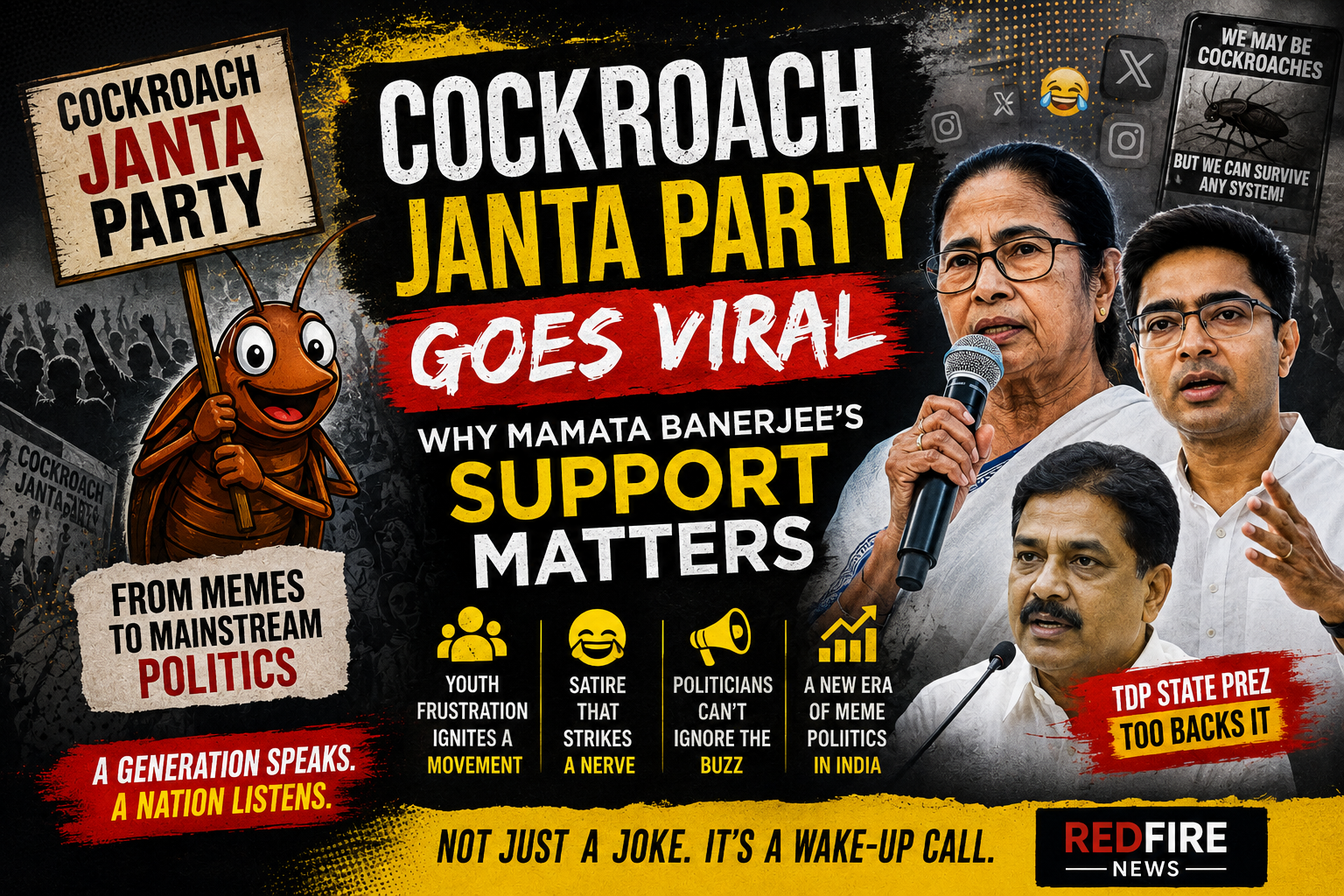
India’s viral Cockroach Janta Party has transformed from an internet joke into a major political talking point. With Mamata Banerjee, Abhishek Banerjee, and even NDA allies reacting to the satirical movement, India’s youth-driven meme politics is entering a new era.
India has seen strange political moments before. But few have exploded online as dramatically – or as unexpectedly – as the rise of the “Cockroach Janta Party” (CJP).
What started as a sarcastic internet movement has now become a full-scale political talking point. Major opposition leaders are openly referencing it, millions of young Indians are sharing its memes, and even ruling alliance leaders are being forced to respond to its growing popularity.
This week, the movement crossed another milestone after Mamata Banerjee and Abhishek Banerjee publicly expressed support for the satirical digital collective. The development pushed what many initially dismissed as an internet joke into the center of India’s political conversation.
But beneath the memes, hashtags, and viral posts lies something far more serious: a generation of frustrated young Indians using humour as a form of political resistance.
How the “Cockroach” Movement Began
The movement traces its origins to comments allegedly interpreted as comparing unemployed youth to “cockroaches” during an online political controversy involving remarks attributed to Chief Justice of India Surya Kant. The phrase triggered outrage across social media platforms, especially among students and job-seeking youth already angry over unemployment, exam leaks, and economic pressure.
Soon after, Boston-based Indian founder Abhijeet Dipke launched the Cockroach Janta Party – not as a conventional political organisation, but as a digital satire movement.
Its messaging was intentionally absurd.
According to reports, membership requirements jokingly included being “chronically online,” “lazy,” and having the “ability to rant professionally.”
But the satire struck a nerve.
Within days, the movement exploded across X, Instagram, and YouTube. Young Indians flooded timelines with cockroach-themed political memes, parody campaign posters, and anti-establishment jokes targeting unemployment, education failures, inflation, and the pressure cooker environment facing Gen Z.
The internet had found its newest protest symbol.
Why the Movement Went Viral
India’s youth population is digitally hyperactive, politically aware, and increasingly frustrated.
The rise of the Cockroach Janta Party did not happen in isolation. It arrived at a moment when many young Indians feel trapped between rising expectations and shrinking opportunities.
Competitive exams are becoming more brutal every year. Government job vacancies remain limited. Private sector instability continues growing. Gig economy jobs are exhausting millions. And social media has become the primary outlet for anger.
CJP cleverly transformed that frustration into humour.
Instead of giving speeches, it used memes. Instead of manifestos, it used sarcasm. Instead of ideology, it used internet culture.
That formula made it instantly relatable.
Unlike traditional political parties that often speak in formal language and controlled narratives, the Cockroach Janta Party communicates like frustrated young Indians actually talk online.
And that authenticity made it dangerous.
Mamata Banerjee’s Surprise Endorsement
The movement reached a new political level after Trinamool Congress MP Derek O’Brien posted on X that both Mamata Banerjee and Abhishek Banerjee had expressed “fondness and full support for Cockroaches.”
The statement immediately went viral.
For many observers, the endorsement was more than just a joke. It was a political signal.
Following the dramatic 2026 West Bengal Assembly elections, where the BJP secured a historic victory and Mamata Banerjee’s long rule ended, the Trinamool Congress appears to be searching for ways to reconnect with digitally active youth voters.
Supporting an anti-establishment online movement allows opposition parties to position themselves closer to youth anger without directly leading the protest themselves.
It also helps them tap into meme culture – a space where traditional politicians often struggle to remain relevant.
In modern politics, perception moves faster than policy.
And online symbolism matters.
Even BJP Allies Are Acknowledging It
Perhaps the most surprising part of the controversy is that even leaders connected to the BJP-led NDA are speaking cautiously about the movement.
According to reports, Telugu Desam Party Andhra Pradesh state president Palla Srinivasa Rao said the issue should not be viewed only politically but through the emotions and frustrations of young people.
That statement is significant.
It suggests political parties across ideological lines understand that dismissing online youth anger entirely could backfire.
India’s political ecosystem is changing rapidly. Young voters are no longer consuming politics only through television debates or newspaper editorials. They are forming opinions through reels, memes, influencers, livestreams, satire accounts, and digital communities.
Movements that begin online can suddenly shape mainstream narratives.
Why Governments Are Nervous About Digital Satire
The Cockroach Janta Party may appear unserious on the surface, but history shows satire can become politically powerful very quickly.
Satire removes fear.
People who may hesitate to attend political rallies or openly criticise governments often feel safer participating through humour.
Memes allow criticism to spread faster than formal political messaging.
That is why governments around the world increasingly monitor digital satire movements closely.
According to reports, several CJP social media accounts became inaccessible in India, while founder Abhijeet Dipke claimed backup accounts were taken down and his Instagram account was hacked.
Whether those actions were technical, administrative, or targeted remains unclear. But the controversy only amplified the movement further.
On the internet, suppression often creates curiosity.
And curiosity creates virality.
The Rise of Meme Politics in India
India is now entering an era where meme politics may become as influential as traditional campaigning.
Political communication is no longer controlled solely by television studios, party spokespersons, or newspaper columns.
Now:
a meme can shape public opinion,
a parody account can influence narratives,
a viral reel can damage reputations,
and an anonymous digital community can dominate national conversations.
The Cockroach Janta Party represents a new kind of decentralised political energy.
It has no clear electoral structure. No official headquarters. No traditional campaign machinery.
Yet it has achieved what many registered political parties fail to accomplish: cultural relevance.
That should worry every major political party in India.
Is This Just a Joke – Or Something Bigger?
That is the question everyone is now asking.
Some analysts believe the movement will fade within weeks, becoming another short-lived internet trend.
Others think it reflects something much deeper: a growing disconnect between India’s institutions and its younger generation.
The movement’s core issues – unemployment, exam pressure, economic anxiety, digital censorship, and frustration with political elites – are very real.
The jokes are funny.
But the anger underneath them is not.
A Generation That Feels Ignored
Perhaps the biggest reason behind CJP’s popularity is emotional exhaustion.
Many young Indians feel unheard.
They are told to work harder, compete harder, study longer, and stay patient – even while opportunities become more uncertain.
Meanwhile, social media constantly exposes inequality, privilege, and political theatre in real time.
This creates a dangerous emotional mix: frustration + internet culture + political distrust.
The Cockroach Janta Party weaponised that frustration through humour.
And suddenly millions of young people felt seen.
What Happens Next?
No one knows whether the movement will evolve into something larger or disappear as internet cycles move on.
But one thing is already clear:
India’s political establishment can no longer ignore digital youth culture.
The era where political power flowed only from rallies, newspapers, and television is ending.
Today, political influence can emerge from memes, satire pages, Discord groups, livestreams, and anonymous internet communities.
The Cockroach Janta Party may not contest elections.
But it has already achieved something powerful:
It forced India’s political class to pay attention.
And in modern politics, attention itself is power.






Excellent Prespective