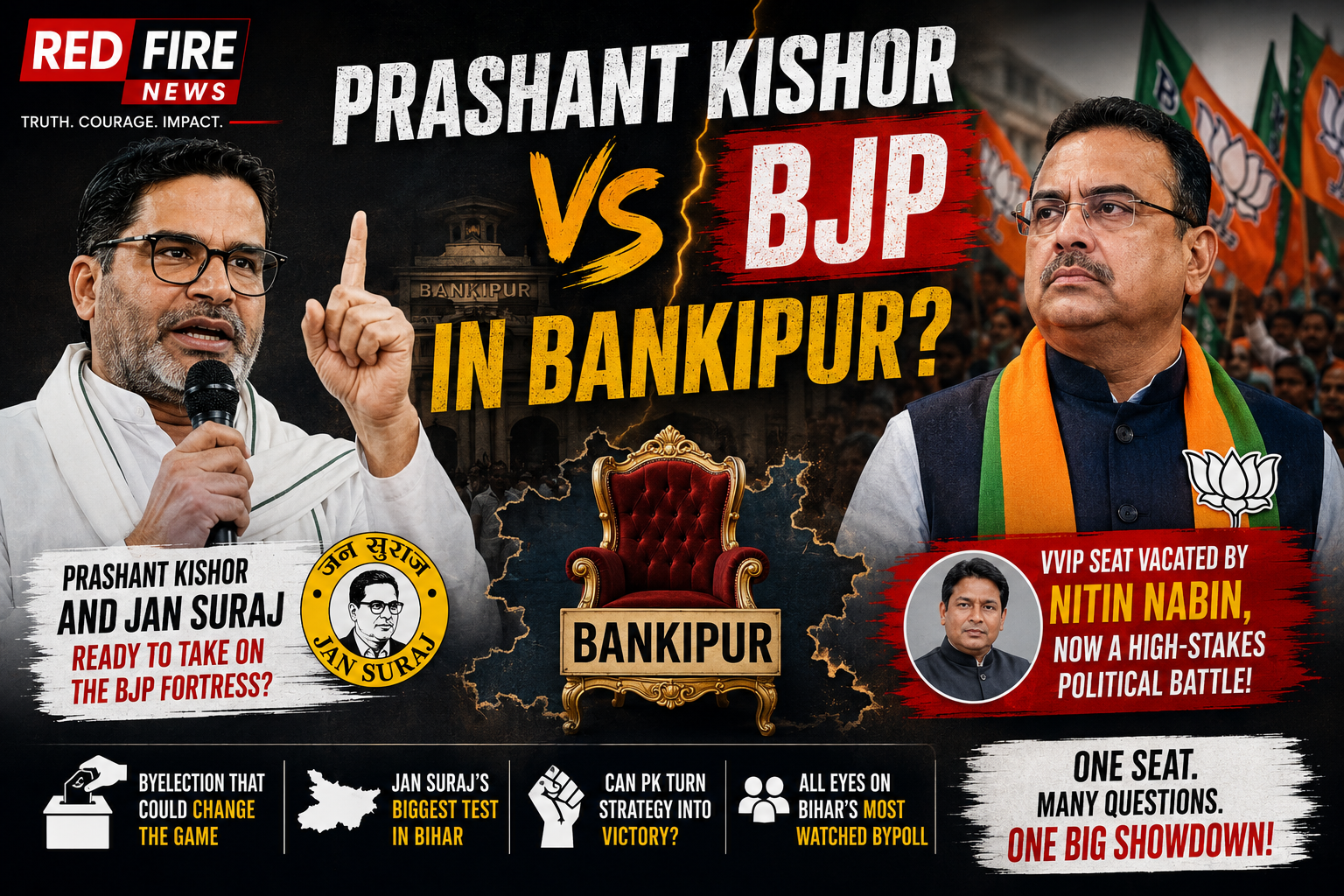
The Strategist Steps Into the Arena: Can Prashant Kishor Turn Bankipur Into Bihar’s Most Unexpected Political Upset?
With Jan Suraaj preparing to contest the Bankipur bypoll after Nitin Nabin vacated the seat, all eyes are on whether Prashant Kishor can transform political strategy into electoral victory in Bihar’s high-profile battleground.
Politics rewards timing. But sometimes, politics rewards courage even more.
For years, Prashant Kishor built a reputation as the man behind campaigns, the architect behind victories and the strategist whose calculations influenced electoral outcomes across India.
Now, Bihar may witness something very different.
Instead of designing elections for others, Kishor and his party, Jan Suraaj Party, appear ready to test their own strength in one of Bihar’s most watched contests-the upcoming Bankipur bypoll. The constituency became vacant after Nitin Nabin resigned following his move to the national stage through the Rajya Sabha and elevation within the BJP leadership structure.
What could have remained an ordinary by-election is now shaping into something bigger.
A symbolic battle.
A credibility test.
And perhaps the first truly defining electoral confrontation for Jan Suraaj.
Why Bankipur Is Not Just Another Seat
Bankipur is not simply an assembly constituency.
Inside Bihar’s political imagination, Bankipur carries visibility, symbolism and strategic importance.
The constituency has long been associated with urban political influence and has historically remained a difficult terrain for challengers.
The BJP’s dominance in the seat became evident in the 2025 election, where Nitin Nabin secured a commanding victory margin. Jan Suraaj, despite statewide attention, finished behind established players in the constituency.
That history makes the current decision significant.
Jan Suraaj is not choosing an easier entry point.
It appears to be choosing a battlefield that immediately attracts national attention.
The Announcement That Changed the Conversation
Prashant Kishor recently indicated that Jan Suraaj has decided “in principle” to contest the Bankipur bypoll and framed the election as a referendum on the first year of the ruling NDA government in Bihar.
More importantly, Kishor projected confidence that his party could challenge the BJP in the constituency.
But one major question remains unanswered:
Will Prashant Kishor contest personally?
So far, he has avoided making a direct declaration.
And that uncertainty may be deliberate.
From Election Consultant to Electoral Candidate?
For years, Kishor occupied a rare position in Indian politics.
He was influential without holding elected office.
His name appeared in campaign war rooms, not on ballot papers.
That distinction shaped both his strength and criticism.
Supporters argued he understood politics better than traditional politicians.
Critics questioned whether someone who advised candidates should eventually prove himself before voters.
Bankipur could become the moment where theory meets reality.
If Kishor contests himself, the election instantly becomes personal.
If he fields another Jan Suraaj candidate, the contest becomes a referendum on whether his political project can survive beyond his own image.
Either outcome carries consequences.
Why This Election Matters More for Jan Suraaj Than BJP
At first glance, observers may see this as BJP defending a stronghold.
But politically, the pressure may actually be greater on Jan Suraaj.
The BJP enters with organizational depth, governance presence and established electoral networks.
Jan Suraaj enters with expectation.
That expectation became even more visible after the party’s disappointing seat tally in Bihar’s previous assembly election despite securing a measurable vote share across the state.
Political movements can survive defeat.
But they eventually need visible victories.
Bankipur offers an opportunity to demonstrate that Jan Suraaj is more than a campaign platform.
The Narrative Battle: Governance vs Alternative Politics
One reason this contest may receive outsized attention is because both sides are likely to frame it differently.
For the BJP, Bankipur could become an argument for continuity.
The message may emphasize organizational strength, governance and leadership transition.
For Jan Suraaj, the election appears positioned as a challenge to established political structures.
Kishor’s public comments already suggest he views the bypoll as an opportunity to measure public mood beyond traditional alliances.
That creates an interesting political clash.
One side asks voters to continue.
The other asks voters to reconsider.
The Question of Momentum
Political momentum is difficult to measure.
Campaign energy does not always convert into votes.
But it can change narratives.
Jan Suraaj spent considerable time building visibility through outreach and issue-driven politics.
Even after disappointing electoral outcomes, pockets of influence remained visible in some areas associated with Kishor’s personal outreach efforts.
Bankipur could reveal whether that visibility translates into competitive politics.
Winning would transform Jan Suraaj overnight.
Even a strong second-place performance could reshape future calculations.
A weak showing, however, could raise difficult questions.
The Candidate Question Could Decide Everything
Bypolls are often less ideological and more candidate-driven.
That is where the next phase becomes crucial.
Will Jan Suraaj nominate:
A grassroots face?
A professional outsider?
A known public figure?
Or Prashant Kishor himself?
If Kishor contests personally, expectations rise dramatically.
Victory would establish political legitimacy.
Defeat would trigger criticism that strategy alone cannot overcome ground realities.
Political history often remembers moments when leaders stop advising history and begin entering it.
This may become one of those moments.
Bankipur and Bihar’s Changing Political Language
There is another reason this contest deserves attention.
Bihar’s politics has traditionally revolved around powerful alliances, social coalitions and familiar structures.
Jan Suraaj entered with a different proposition.
Its messaging has often focused on governance, development and citizen-driven political change.
Whether that language can defeat deeply organized electoral systems remains unanswered.
Bankipur could offer an early signal.
Not a final verdict.
But a meaningful indicator.
Can Symbolism Become Votes?
Every political movement eventually reaches a stage where symbolism must become arithmetic.
Public meetings become booth management.
Speeches become turnout.
Hope becomes numbers.
Jan Suraaj’s challenge is not simply attracting attention.
It is converting attention into votes.
The BJP’s challenge is different.
Preventing a symbolic contest from becoming a larger narrative.
That is why this bypoll may matter beyond one constituency.
A Seat, A Test, A Political Turning Point
The irony of this moment is difficult to ignore.
For years, Prashant Kishor helped others answer one question:
How do you win?
Now voters may ask him the same question.
Bankipur is not yet an election.
It is a possibility.
But politics often changes because someone chooses an unlikely battlefield.
If Jan Suraaj formally enters and if Kishor steps into the contest personally, Bihar may witness one of its most closely watched political tests in recent memory.
Not because one seat changes power.
But because one seat can change perception.
And in politics, perception is often where the next chapter begins.
AI Conversationalist, Global Marketer, TEDx Speaker, Member-Board Of Studies-CDSW, AI Governance, Mentor Onboarded CCMB-Atal Incubation Center, Entrepreneurship Coach