Beyond the Question: When Norway Reporter Asked Why the World Should Trust India -The Answer Was Bigger Than Diplomacy
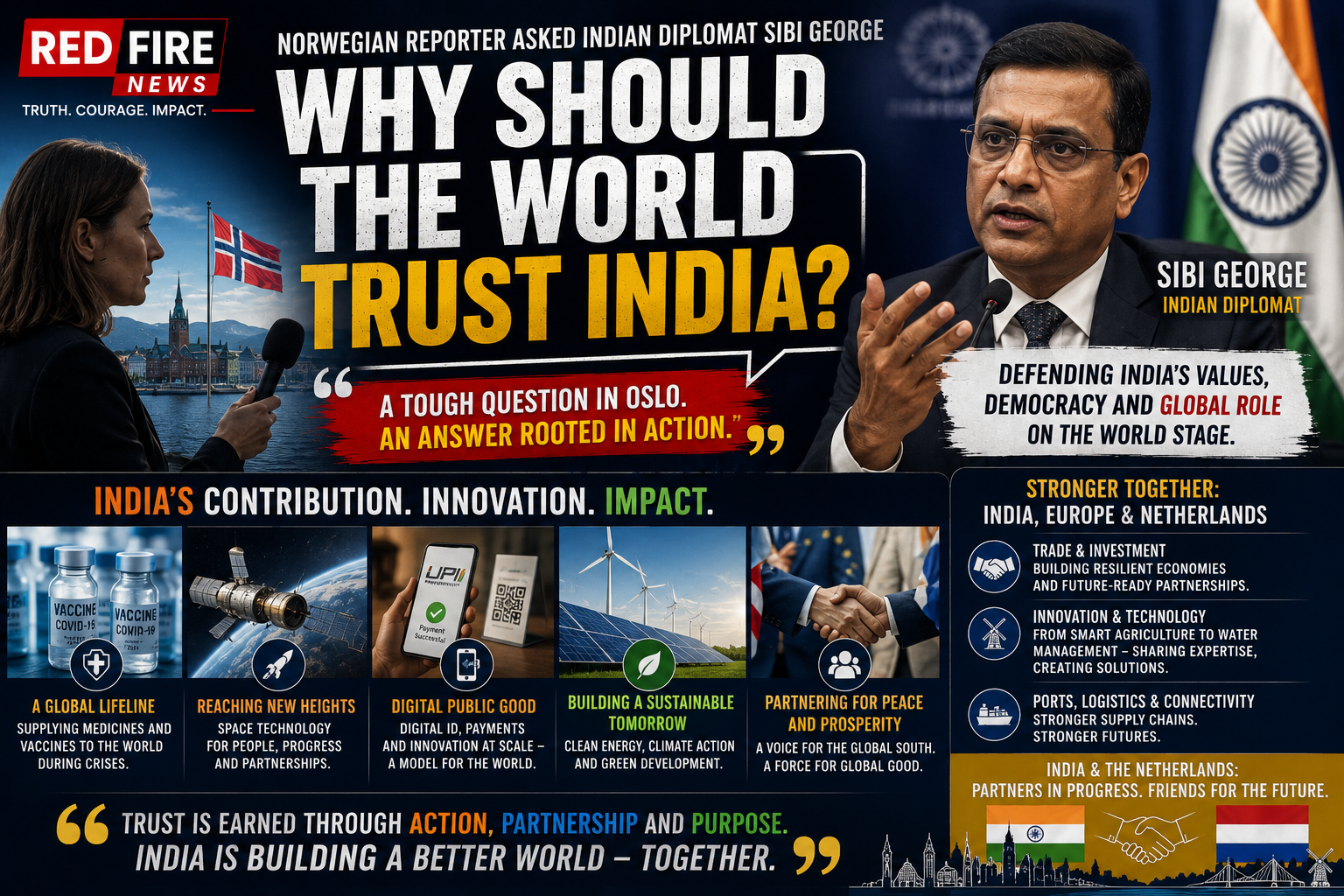
After a Norwegian reporter questioned why the world should trust India, the moment sparked a larger conversation: India’s democratic journey, innovation economy, humanitarian outreach, and growing contribution to Europe and the Netherlands.
Trust is one of the most difficult things to explain.
Countries do not earn it with speeches alone. They earn it through decades of action, reliability, partnerships, innovation, and the ability to show up when the world needs them.
That is why a sharp question asked in Oslo recently triggered a much larger conversation.
During a media interaction linked to Indian Prime Minister Narendra Modi’s visit to Norway, a Norwegian journalist asked Indian diplomat Sibi George why the world should trust India and raised broader concerns connected to democracy, human rights and public accountability. The exchange quickly spread internationally and became a talking point across media and social platforms.
But beyond the moment itself lies a larger and more interesting question:
How does a nation earn trust?
And if trust is measured not by words but by contribution-what does India’s global record actually look like?
The answer is more layered than celebration or criticism.
Trust Is Not Built by Claims. It Is Built by Performance.
In his response, Sibi George defended India by referring to constitutional guarantees, democratic institutions, India’s scale and its role during global crises including COVID-era support.
Whether one agrees fully with his framing or not, the exchange opened something useful.
It shifted attention from abstract perception to measurable contribution.
Trust between nations is rarely emotional.
It usually grows from four things:
Economic reliability
Innovation capacity
Crisis partnership
Long-term cooperation
India’s story increasingly intersects with all four.
Europe’s Relationship With India Has Quietly Changed
For decades, Europe viewed India largely through the lens of demographics and market potential.
Today, that conversation has changed.
India is increasingly discussed as:
A technology partner
A resilient supply-chain destination
A digital governance case study
A strategic manufacturing base
A clean-energy collaborator
European governments and businesses are investing more heavily in long-term engagement with India not simply because of population size-but because India’s capabilities have expanded.
That relationship is visible across trade, semiconductors, pharmaceuticals, sustainability and research.
Trust in international relations rarely appears in slogans.
It appears in contracts.
The Netherlands and India: One of Europe’s Most Underestimated Partnerships
Among European relationships, India’s connection with Netherlands often receives less attention than it deserves.
Yet economically and technologically, the relationship has become increasingly important.
The Netherlands has emerged as one of India’s major investment partners and a significant gateway into European markets.
But the relationship extends beyond capital.
Agriculture and Food Innovation
The Netherlands is globally known for advanced agriculture despite limited land.
India brings scale, climate diversity and agricultural demand.
Together, collaboration increasingly touches:
Precision farming
Water management
Food logistics
Greenhouse technologies
Sustainable agriculture
Ports and Logistics
India’s expanding maritime ambitions and Dutch expertise in logistics and port systems create opportunities for long-term cooperation.
Water Engineering
Dutch expertise in water resilience aligns naturally with India’s urban growth and climate adaptation goals.
Technology and Startups
Indian digital talent and Dutch innovation ecosystems increasingly intersect through startups, research and industrial collaboration.
This relationship is less visible than political headlines-but often more durable.
India’s Innovation Story Is Larger Than Outsourcing
For years, global conversations reduced India to low-cost services.
That description increasingly feels outdated.
India’s contribution today extends into:
Digital public infrastructure
Space technology
Financial inclusion systems
Pharmaceutical production
Deep-tech entrepreneurship
AI and software ecosystems
One of India’s strongest modern exports is not a physical product.
It is scalable public technology.
Digital identity systems, payment infrastructure and digital service delivery have increasingly drawn global attention as governance models.
That does not mean perfection.
It means experimentation at unprecedented scale.
The COVID Years Changed Global Perception
Global trust often becomes visible during emergencies.
During the pandemic years, India emerged as a major supplier of medicines and vaccines across multiple regions while maintaining domestic pressures of its own. Sibi George referenced this dimension during his response in Oslo.
Critics and supporters continue debating aspects of pandemic policy.
But one thing became difficult to ignore:
India demonstrated manufacturing capacity at extraordinary scale.
For many countries, reliability during crisis became part of how India’s global image evolved.
India and Europe Are Increasingly Building Together
There is another reason Europe’s trust equation is changing.
India is no longer viewed only as a market.
Increasingly, India is becoming a co-builder.
Areas of emerging collaboration include:
Green hydrogen
Semiconductor ecosystems
AI governance
Mobility transitions
Cyber resilience
Climate adaptation
Academic research
This reflects a shift from transactional relationships to strategic partnerships.
And strategic partnerships require trust.
Trust Also Means Accepting Questions
The Oslo exchange created debate for another reason.
Some praised the diplomat’s confidence.
Others argued difficult questions should always be answered directly and openly. Public commentary around the interaction reflected both reactions.
That duality matters.
Strong democracies are not measured only by achievements.
They are also measured by how comfortably they engage scrutiny.
Questions about governance, media, institutions and rights are not unique to India.
European democracies face them too.
The existence of questioning itself is often part of democratic culture.
Trust grows when institutions respond with confidence and openness.
India’s Global Contribution Is Also Human
Numbers matter.
Trade matters.
Technology matters.
But countries are also remembered for softer influence.
India’s influence has travelled through:
Philosophy
Mathematics
Education
Yoga
Cinema
Literature
Diaspora communities
Entrepreneurship
Sibi George also referenced India’s civilisational legacy and democratic traditions during the exchange.
Yet modern influence increasingly comes not from history alone.
It comes from relevance.
India’s challenge now is converting historical confidence into future leadership.
The Real Question May Not Be “Why Trust India?”
Perhaps the better question is:
What makes any nation trustworthy?
Is it flawless governance?
No country qualifies.
Is it economic power?
Power changes.
Is it values?
Values evolve.
Trust between nations often emerges from something more practical:
Does the country contribute?
Does it cooperate?
Does it remain reliable?
Does it create solutions?
Does it engage criticism without fear?
India’s global image today sits at that intersection.
Too large to ignore.
Too complex to summarize.
Too important to judge through stereotypes alone.
From Oslo to the World
The exchange in Norway may eventually fade.
Another headline will replace it.
Another debate will begin.
But the question will remain valuable.
Because nations, like people, are shaped not by how loudly they defend themselves—
but by what they build.
India’s next chapter in Europe, including with the Netherlands and Nordic nations, may ultimately be written not through speeches or rebuttals.
AI Conversationalist, Global Marketer, TEDx Speaker, Member-Board Of Studies-CDSW, AI Governance, Mentor Onboarded CCMB-Atal Incubation Center, Entrepreneurship Coach