The ₹Trillion Question: Should Tata Sons Stay Private or Step Into the Market Spotlight?
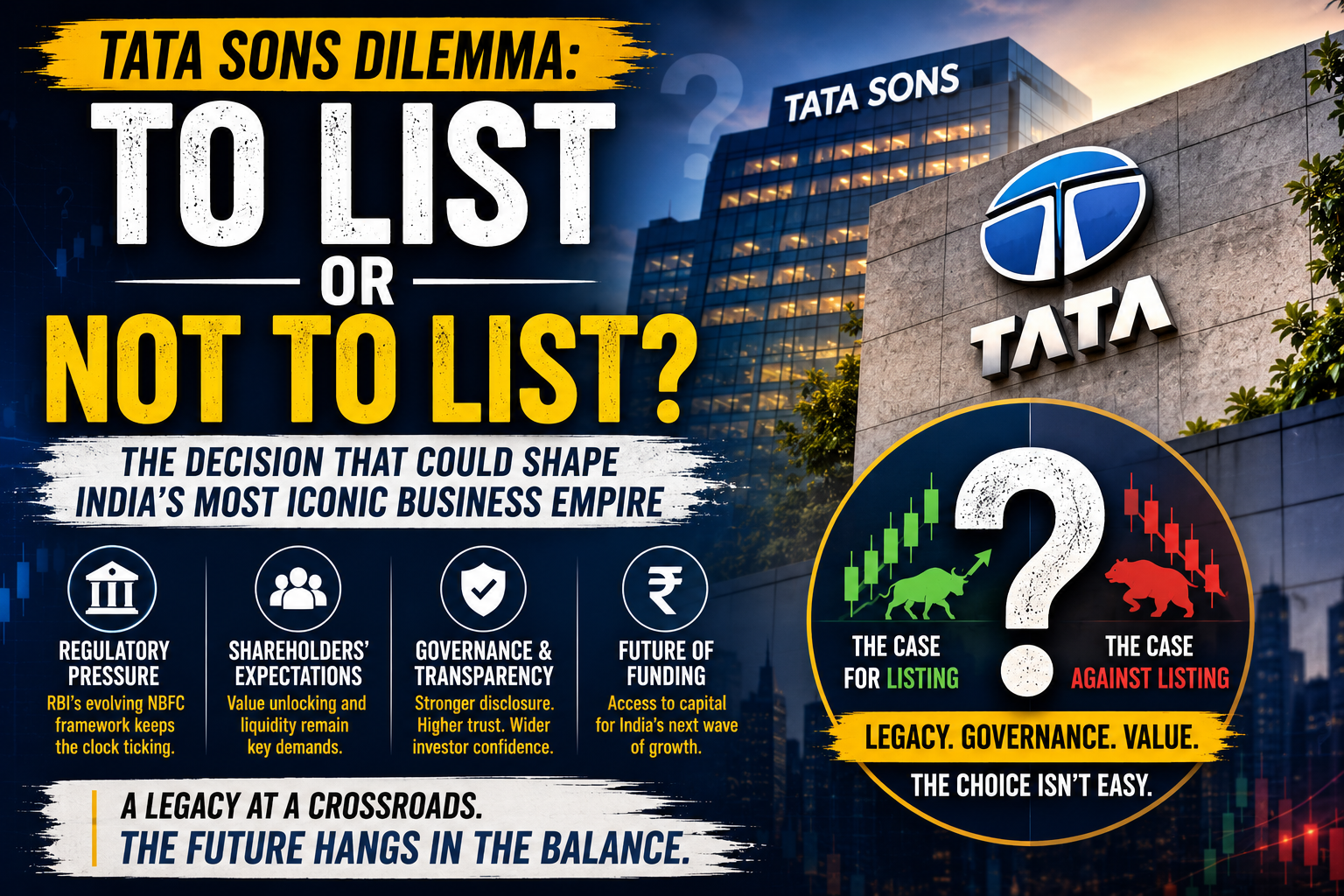
Tata Sons faces one of its biggest strategic crossroads as regulatory pressure, shareholder expectations and governance questions reignite the debate over whether India’s iconic holding company should finally list.
Mumbai – Few names in Indian business command the emotional trust, institutional respect and economic influence that Tata carries.
For generations, the group has represented something larger than commerce — reliability, nation-building, long-term thinking and a reputation built over more than a century.
But today, the company sitting at the very top of that empire faces one of the most consequential decisions in its history.
Should Tata Sons remain private -preserving its unique ownership model and long-term philosophy?
Or should it finally enter public markets and become one of India’s most anticipated listings?
What was once considered a theoretical discussion has now become a serious strategic question driven by regulation, shareholder pressure, governance expectations and changing financial realities.
And the answer could reshape Indian corporate history.
Why Tata Sons Is Suddenly at the Centre of India’s Biggest Listing Debate
Unlike many famous Tata companies traded publicly, Tata Sons itself remains privately held.
It functions as the principal holding company of the Tata Group, controlling stakes across a vast business network that spans software, steel, automobiles, aviation, retail, electronics and infrastructure.
For decades, remaining private was never viewed as a problem.
But regulatory developments changed the equation.
In 2022, the Reserve Bank of India classified Tata Sons as an Upper Layer Non-Banking Financial Company (NBFC), placing it within a stricter regulatory framework. Under those norms, upper-layer entities were expected to pursue public listing within a defined period.
That timeline passed.
Tata Sons did not list.
And now the question is becoming harder to postpone.
The Regulatory Clock Has Not Fully Stopped
Tata Sons has explored alternatives to avoid mandatory listing.
One major strategy involved reducing debt and seeking deregistration as a Core Investment Company (CIC), which could potentially remove the listing obligation.
But the RBI has continued to classify Tata Sons within the upper-layer framework while broader NBFC reforms remain under discussion.
Recent draft changes proposed by the RBI may make the debate even more difficult.
The regulator is considering moving toward an asset-size-based classification system, which could tighten oversight for very large financial entities. Given Tata Sons’ scale, analysts believe this could reinforce scrutiny rather than reduce it.
The uncertainty has created a rare situation where one of India’s most influential business groups appears caught between structure and strategy.
Why Many Believe Listing Makes Sense
Supporters of a Tata Sons listing argue that public markets could unlock substantial value.
Their reasoning is straightforward.
1. Greater Transparency
Public companies operate under higher disclosure standards.
Quarterly reporting, governance requirements and greater investor visibility could strengthen confidence in decision-making and capital allocation.
Proxy advisory firm InGovern has publicly argued that an institution of Tata Sons’ size should operate under stronger disclosure expectations comparable to systemically important entities.
2. Better Access to Capital
Tata Group is investing aggressively across future industries including electronics, manufacturing and technology.
A listed Tata Sons could potentially access larger capital pools while giving investors direct exposure to the broader Tata ecosystem.
Some observers believe this may become increasingly relevant as India enters an infrastructure and industrial expansion cycle.
3. Liquidity for Existing Shareholders
One of the most discussed dimensions involves shareholder flexibility.
The Shapoorji Pallonji Group, which owns a significant stake in Tata Sons, has renewed support for listing and described it as a natural evolution that may improve governance and unlock value.
Supporters argue that listing creates a cleaner mechanism for valuation and shareholder participation.
Why Others Think Listing Could Change Tata’s DNA
But there is another side to this debate.
And it may be equally powerful.
Critics of listing argue that Tata Sons is not simply another corporate holding company.
They believe its ownership structure has enabled something rare in modern business: long-term decisions insulated from quarterly market pressure.
Former Tata executive N.A. Soonawala recently warned that public listing could fundamentally alter the institution’s character. According to his view, public ownership may push the group toward short-term performance expectations at the expense of broader social and developmental objectives.
That concern resonates because a large portion of Tata Sons ownership ultimately links to philanthropic trusts.
Many supporters of the current structure argue that this model has historically enabled patient capital allocation and institution-building.
Their concern is not whether Tata can succeed as a listed entity.
Their concern is whether Tata would remain the same Tata afterward.
The Governance Question Nobody Can Ignore
Beyond regulation and philosophy lies a deeper issue: governance.
India’s corporate landscape has changed dramatically.
That expectation increasingly applies even to iconic private institutions.
Some governance advocates argue that companies with such large economic footprints should embrace public-market discipline regardless of historical structure.
Others counter that governance quality should be measured by outcomes rather than listing status.
The Tata debate therefore reflects a broader national conversation:
Does transparency require listing?
Or can private stewardship still deliver public trust?
What Happens if Tata Sons Lists?
If Tata Sons eventually enters public markets, it would likely become one of India’s most anticipated corporate events.
Potential consequences could include:
A landmark valuation event for Indian capital markets
Increased institutional participation
Global investor attention
New governance frameworks
Greater visibility into group-level strategy
The listing could also trigger intense investor interest because many market participants have historically wanted direct exposure to the broader Tata ecosystem rather than individual subsidiaries.
For markets, it could become more than an IPO.
It could become a symbol of Indian corporate evolution.
What Happens if It Stays Private?
Remaining private would send a different message.
It would signal that long-term stewardship and mission-driven ownership still have a place even in an era dominated by public markets.
Tata Sons has historically operated differently from many conglomerates.
That model helped the group navigate economic cycles while maintaining continuity across generations.
If regulators eventually permit an alternative structure, supporters may argue that preserving institutional identity matters as much as regulatory conformity.
Yet staying private would likely keep governance questions alive.
And every future regulatory revision may reopen the debate.
The Leadership Factor
The timing of this debate also coincides with broader conversations inside the Tata ecosystem.
Leadership continuity, strategic investments and future capital allocation have all become increasingly interconnected with the listing discussion.
Any eventual decision will not simply affect ownership.
It will influence:
Growth strategy
Investor relations
Board expectations
Capital structure
Global expansion priorities
That makes this far more complex than a standard IPO discussion.
More Than a Listing Decision
At first glance, the Tata Sons debate appears financial.
But underneath, it is philosophical.
This is a conversation about how India’s most respected institutions adapt without losing identity.
Should scale automatically lead to public ownership?
Should legacy structures evolve with regulation?
Can a company preserve long-term values while opening itself to market discipline?
Those questions do not have easy answers.
What makes the Tata Sons dilemma so compelling is that both sides make persuasive arguments.
One side sees transparency, access and modernization.
The other sees continuity, independence and purpose.
The Decision That Could Define the Next Tata Era
For now, Tata Sons remains private.
The RBI’s future framework, shareholder expectations and strategic choices inside the group will determine what comes next.
But one thing is increasingly clear.
This is no longer just about whether Tata Sons lists.
It is about defining what India expects from its largest institutions in the next decade.
If Tata Sons lists, it could transform Indian capital markets.
If it stays private, it may redefine how legacy institutions survive in a more regulated world.
Either way, the decision will not just create headlines.
AI Conversationalist, Global Marketer, TEDx Speaker, Member-Board Of Studies-CDSW, AI Governance, Mentor Onboarded CCMB-Atal Incubation Center, Entrepreneurship Coach