Asia’s Twin Titans: The Race Between India and China That Could Decide the 21st Century
India and China are emerging as the defining powers of the 21st century through technology, manufacturing, trade, innovation and geopolitical influence. Explore how Asia’s two giants are competing and reshaping the global economy.
New Delhi / Beijing – Every century produces defining rivalries.
The 20th century witnessed the industrial rise of the United States and the strategic contest of the Cold War. The early decades of the 21st century, however, appear increasingly shaped by a different story – one unfolding across Asia.
Two ancient civilizations with modern ambitions are rewriting assumptions about growth, technology and influence.
China and India.
Together, they account for more than one-third of humanity. Their economies touch nearly every global supply chain, their markets influence multinational strategies and their policy choices increasingly affect trade, energy, finance and diplomacy across continents.
Yet despite being grouped together as Asian giants, their paths to influence could not be more different.
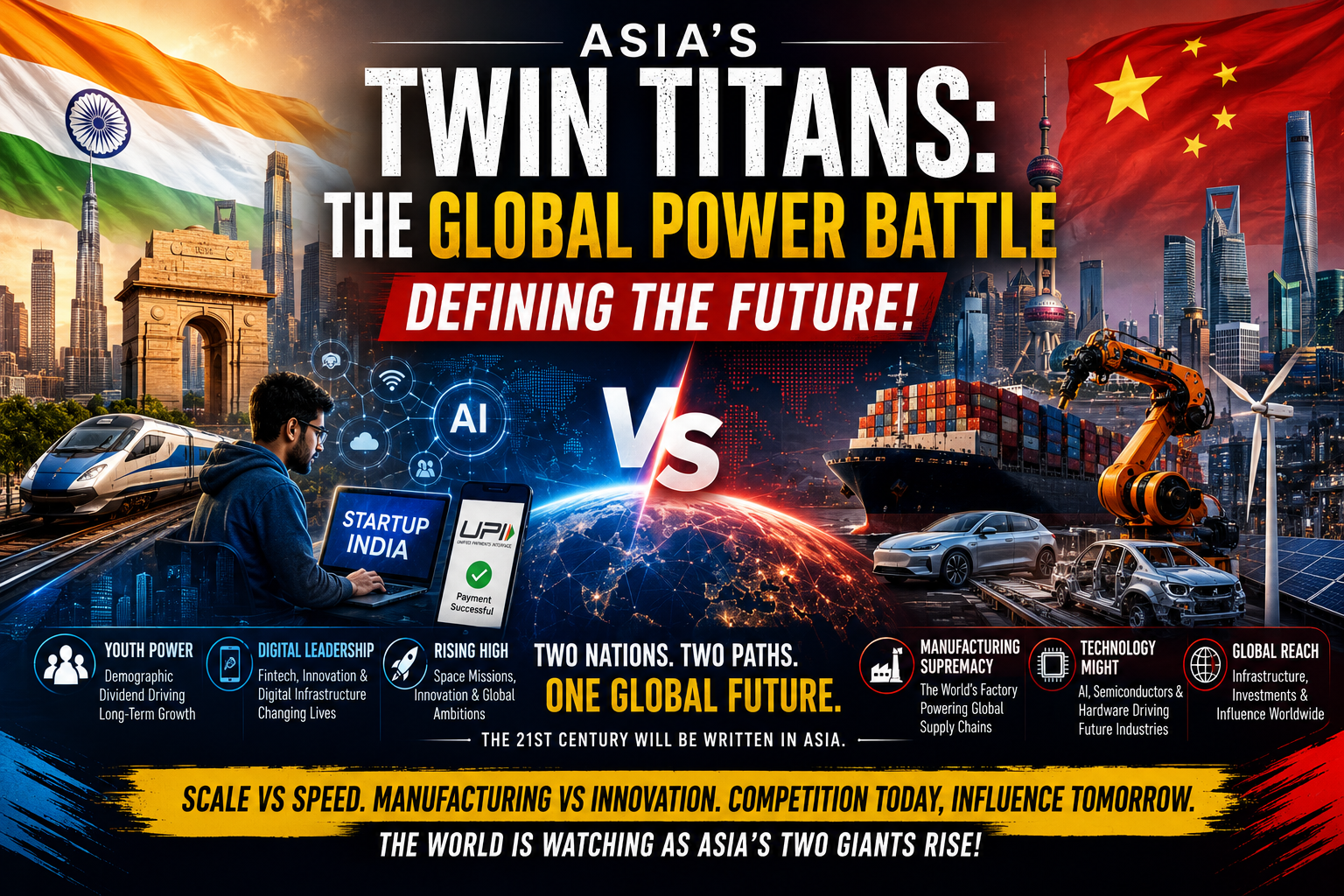
China built scale.
India is building velocity.
China industrialized first.
India digitized faster.
China mastered manufacturing.
India became a software and services powerhouse.
Now, the world is watching a new question emerge:
Which model will define the future?
Two Giants, Two Different Playbooks
China and India are often compared because of size, population and growth potential.
But underneath those similarities lie fundamentally different economic engines.
China’s rise was powered by manufacturing dominance, export capacity, infrastructure expansion and centralized industrial execution.
India’s growth story has leaned more heavily on services, entrepreneurship, technology adoption and demographic momentum.
The contrast matters.
China became known as the world’s factory.
India increasingly wants to become the world’s innovation and digital growth laboratory.
Neither model is complete on its own.
And that is exactly what makes this competition so fascinating.
China’s Manufacturing Machine Changed the World
China’s transformation over the last four decades remains one of modern history’s most significant economic stories.
Massive industrial zones, deep logistics networks, export-oriented policies and infrastructure investment turned the country into the backbone of global production.
Today, China dominates multiple sectors:
Electronics manufacturing
Electric vehicles
Solar panel production
Industrial machinery
Consumer exports
Supply-chain integration
Its industrial ecosystem operates at a scale few countries can match.
Factories, ports, rail systems and supplier networks often function as interconnected growth engines.
This infrastructure advantage helped Chinese companies move beyond low-cost production into advanced technologies.
The result is an economy that increasingly competes not only on price but also on capability.
China’s influence now extends into infrastructure financing, trade agreements and technology ecosystems across Asia, Africa and Latin America.
Its rise changed globalization itself.
India’s Digital Acceleration Is Creating a Different Story
If China’s strength is physical infrastructure, India’s recent rise has been powered by digital infrastructure.
Over the past decade, India built large-scale public digital systems that transformed access to payments, services and entrepreneurship.
The growth of digital identity platforms, real-time payments and technology-led inclusion created conditions for rapid expansion.
At the same time:
Startup creation accelerated
Fintech adoption surged
Software exports expanded
Digital consumption exploded
Entrepreneurship moved beyond metro cities
India’s advantage increasingly comes from participation rather than scale alone.
Its economy benefits from millions of first-time consumers entering formal systems.
That creates a growth cycle with different characteristics from traditional manufacturing-led expansion.
India’s model remains more decentralized, more consumer-driven and increasingly technology-enabled.
India entered a phase many economists describe as a demographic advantage period — with a relatively young population compared with aging economies in parts of East Asia and Europe.
That matters because future growth depends not only on capital but also on workers, consumers and creators.
India’s youthful workforce is increasingly becoming part of global conversations around:
Software engineering
Technology services
Product development
AI talent
Entrepreneurship
China, meanwhile, faces a different demographic reality.
After decades of extraordinary growth, slowing population momentum and aging trends are becoming policy considerations.
That does not reduce China’s current industrial power.
But it changes how future competitiveness may evolve.
India’s challenge is turning population potential into productivity.
China’s challenge is sustaining productivity amid demographic transition.
The New Battlefield: AI, Chips and Strategic Technology
Manufacturing and services alone no longer define global leadership.
Technology does.
And that is where competition is becoming more intense.
Artificial intelligence, semiconductor capability, advanced computing and digital ecosystems are emerging as the next major arenas.
China has invested heavily in:
Semiconductor independence
AI research
Hardware ecosystems
Smart manufacturing
Industrial automation
India is pursuing a different route:
Software-led AI deployment
Startup ecosystems
Semiconductor investment incentives
Digital public infrastructure
Global technology partnerships
One nation is building vertically integrated systems.
The other is trying to become the preferred innovation and execution partner.
The outcome could influence industries for decades.
Space Is Becoming a Symbol of National Ambition
Once dominated by a handful of global powers, space exploration is now becoming another arena where India and China are projecting capability.
China’s advances in lunar missions, space stations and deep-space programs reflect long-term investment and strategic ambition.
India has gained global recognition for cost-efficient missions and rapidly growing space capabilities.
Space matters because it represents more than prestige.
It connects to:
Telecommunications
Navigation
National security
Commercial opportunity
Scientific leadership
The competition above Earth increasingly mirrors competition on Earth.
Energy, Climate and the Next Economic Revolution
The future economy will not run on yesterday’s energy systems.
That makes renewable energy another major dimension of the India–China story.
China currently dominates large parts of the clean-energy manufacturing chain.
It has built enormous capacity in solar modules, battery production and electric mobility.
India is expanding rapidly with ambitions around:
Renewable deployment
Green manufacturing
Energy independence
Sustainable infrastructure
Energy leadership may become one of the biggest strategic advantages of the next generation.
Countries controlling production and deployment could shape future industrial growth.
Supply Chains Are Being Redrawn
Global businesses increasingly want resilience alongside efficiency.
That shift accelerated after disruptions in recent years exposed vulnerabilities in concentrated production networks.
As a result:
China remains deeply embedded in global manufacturing.
India is positioning itself as an alternative growth destination.
Companies now talk less about replacing China and more about diversification.
This shift creates opportunities for India while preserving China’s central role.
Many global firms increasingly adopt dual strategies rather than choosing one market over the other.
That means the future may not belong exclusively to either country.
It may belong to whoever integrates better with the changing global system.
Geopolitics Is No Longer Separate From Economics
Economic influence increasingly translates into geopolitical influence.
Trade agreements, infrastructure financing, diplomatic partnerships and strategic investments now shape global relationships.
China expanded international influence through infrastructure connectivity and trade outreach.
India expanded influence through strategic partnerships, technology cooperation and economic engagement.
Their approaches differ.
But both are competing for relevance in a multipolar world.
This competition is influencing decisions across:
Trade policy
Security partnerships
Technology standards
Investment flows
Regional diplomacy
Countries worldwide are increasingly balancing relationships with both.
Can Both Win?
The conversation around India and China often becomes framed as a zero-sum rivalry.
But reality may be more complex.
China’s manufacturing ecosystem and India’s digital growth engine could coexist and even complement global development.
The world economy is large enough for multiple centers of influence.
The more important question may not be who wins.
It may be:
Who adapts faster?
China already proved scale can transform history.
India is trying to prove that inclusion, technology and demographics can create a new growth model.
Both strategies carry strengths.
Both face challenges.
And neither journey is complete.
The Decades Ahead Could Belong to Asia
For much of modern history, economic gravity remained concentrated elsewhere.
Today, the center of global attention increasingly points east.
Asia is no longer simply participating in global growth.
It is shaping it.
And at the heart of that transformation stand two nations following different roads toward influence.
China offers industrial strength, execution and scale.
India offers demographic energy, entrepreneurship and digital momentum.
The contest between them is not just economic.
It is technological.
Strategic.
Cultural.
Institutional.
And ultimately, global.
The next great story of the 21st century may not be about whether Asia rises.
That story has already begun.
The bigger question is this:
When history looks back decades from now, will the future have been built in factories, coded in startups — or created through a combination of both?
That answer may emerge from the choices made in New Delhi and Beijing.
AI Conversationalist, Global Marketer, TEDx Speaker, Member-Board Of Studies-CDSW, AI Governance, Mentor Onboarded CCMB-Atal Incubation Center, Entrepreneurship Coach