Not every billionaire story begins in luxury.
Some begin in pain.
Struggle.
And survival.
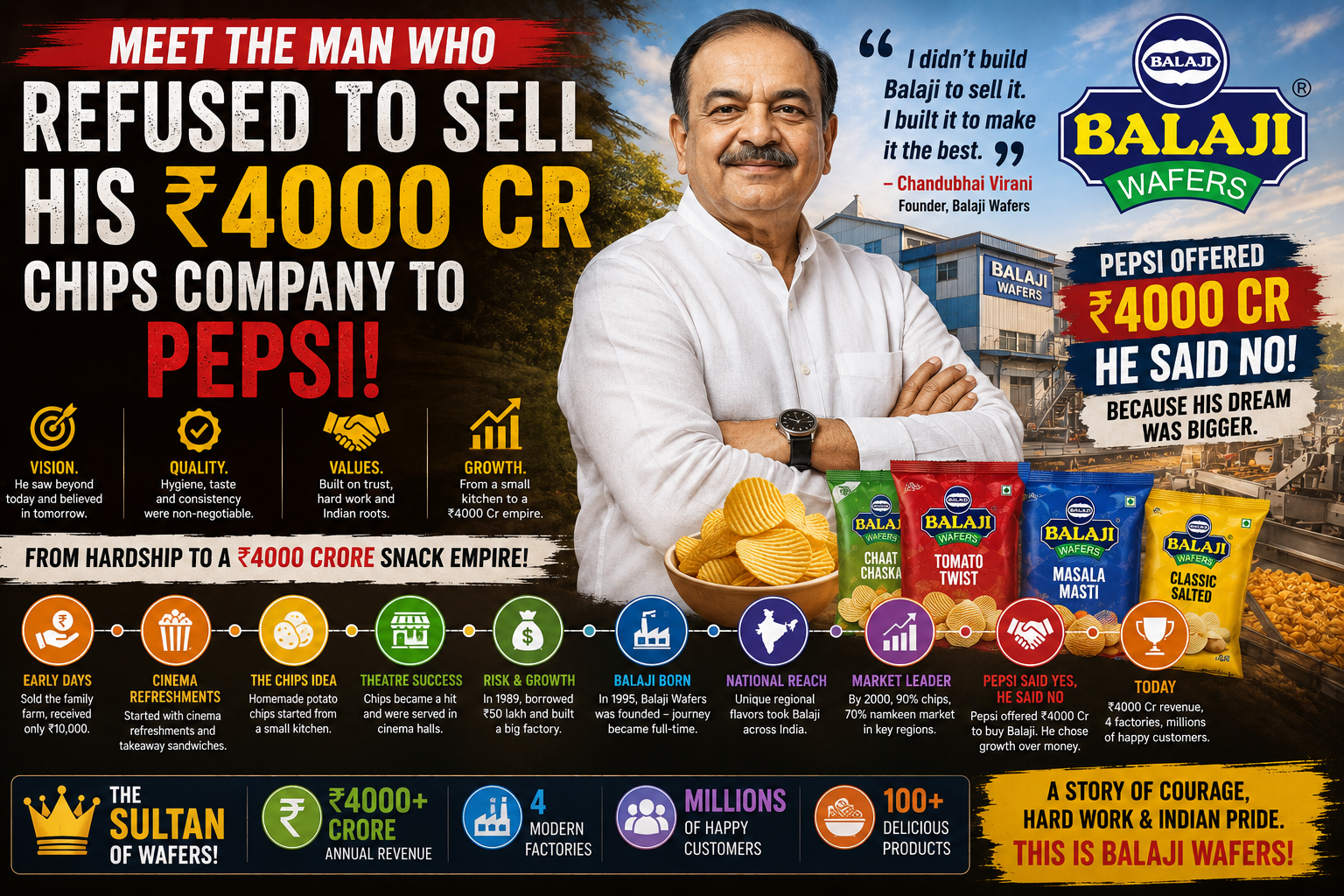
Imagine selling your family farm, receiving barely ₹10,000 , and wondering how life will move forward.
For most people, it would feel like the end.
But for Chandubhai Virani , it became the beginning of one of India’s most inspiring business stories.
Today, Balaji Wafers is one of India’s most loved snack brands, competing against global giants like Lay’s and dominating regional markets with unbelievable strength.
The company generates nearly ₹4,000 crore in annual revenue .
And perhaps the most shocking part?
Chandubhai reportedly refused Pepsi’s ₹4,000 crore acquisition offer .
Why?
Because he believed Balaji could become even bigger.
This is not just a chips company story.
It’s a story of resilience.
Hard work.
Smart business decisions.
And the power of staying true to your roots.
This is the inspiring Balaji Wafers Success Story .
The Early Struggles: When Life Changed Overnight Before success arrived-
Life tested Chandubhai Virani.
Born into a humble farming family in Gujarat, life was simple but difficult.
Then came a major setback.
The family farm had to be sold.
After everything was settled, Chandubhai reportedly received only around:
₹10,000 Think about that for a moment.
No big inheritance.
No investor.
No startup ecosystem.
No fancy MBA degree.
Just uncertainty.
And a strong desire to survive.
Many successful founders start with ambition.
Chandubhai started with necessity.
He simply wanted a better future.
The First Step: Selling Refreshments at Cinema Halls Sometimes success comes from noticing small opportunities.
Chandubhai initially entered a modest business.
He began selling refreshments at local cinema halls.
Tea.
Snacks.
Small food items.
Simple business.
But something interesting happened.
Customers loved takeaway snacks.
Particularly sandwiches.
People wanted convenient food they could carry home.
This observation taught Chandubhai an important lesson:
People don’t just buy products-they buy convenience. That mindset later helped shape Balaji Wafers.
The Potato Chips Idea That Changed Everything One day, Chandubhai noticed something.
People visiting cinemas enjoyed potato wafers.
But quality was inconsistent.
Supply was limited.
And packaged chips were not easily available.
Instead of ignoring the opportunity-
He acted.
Chandubhai started making potato chips .
Initially on a very small scale.
No massive factory.
No expensive machinery.
Just effort.
Experimentation.
And determination.
Production began from home.
A tiny setup slowly emerged.
What started as a small idea soon became something bigger.
Step-by-Step Journey of Chandubhai Virani Starting Small Cinema refreshments became his first business school.
Spotting Demand People loved chips.
Demand kept growing.
Home-Based Production Chips production began from home.
Expansion into Theatres Soon, theaters started serving his wafers.
Thinking Bigger Instead of staying small-
Chandubhai scaled aggressively.
The Turning Point: Demand Exploded As theater audiences tasted Chandubhai’s wafers-
Word spread.
People loved the freshness.
The taste stood out.
Demand increased rapidly.
Soon, his chips became popular in multiple theaters.
This was the moment Chandubhai realized:
This wasn’t just a side business anymore. It had serious potential.
What began as part-time work slowly became full-time ambition.
And once he committed fully-
Everything changed.
1989: The Biggest Risk of His Life Great entrepreneurs often make scary decisions.
In 1989 , Chandubhai took a massive leap.
He borrowed around:
₹50 lakh At the time, this was a huge risk.
Failure could destroy everything.
But Chandubhai believed in one thing:
Quality wins customers. With this capital, he built one of Gujarat’s largest chips factories .
And unlike many businesses focused only on profit-
He obsessed over:
Hygiene Technology Consistent taste Better production systems Quality ingredients This focus became Balaji’s biggest strength.
Production capacity increased to around:
250 kg per hour At a time when competitors were still operating traditionally-
Chandubhai was thinking industrial scale.
The Birth of Balaji Wafers in 1995 In 1995 , the company officially became:
Balaji Wafers This was the real beginning.
The timing proved perfect.
India’s snack market was growing.
Urban lifestyles were changing.
People wanted affordable packaged snacks.
But there was one problem:
Big brands mostly sold generic flavors.
Chandubhai spotted an opportunity.
Instead of copying competitors-
Balaji focused on:
Regional Indian flavors This changed the game.
Balaji understood local taste better than multinational companies.
Flavors matched regional preferences.
Consumers connected emotionally.
The result?
Massive loyalty.
Why Balaji Outsmarted Big Brands Most people assume multinational companies always win.
But Balaji proved otherwise.
Chandubhai understood something global companies often miss:
India is not one market. It’s many markets.
Different states.
Different tastes.
Different food habits.
Balaji localized aggressively.
Affordable pricing.
Better flavors.
Strong distributor relationships.
Fresh inventory.
This strategy helped the brand expand beyond Gujarat into neighboring states.
Soon-
Balaji became impossible to ignore.
The Unbelievable Market Dominance By the year 2000 , Balaji had achieved something extraordinary.
In several regions, the company reportedly controlled:
90% of the chips market And around:
70% of the namkeen market That level of dominance is almost unheard of.
Especially when competing against global corporations.
While giants spent heavily on advertising-
Balaji focused on:
Distribution + Taste + Pricing Sometimes the simplest strategies win.
The Battle Against Lay’s Every inspiring business story has competition.
For Balaji-
That competition was Lay’s , owned by PepsiCo.
Lay’s had:
Massive marketing budgets Celebrity endorsements Global expertise Huge infrastructure On paper-
Balaji had no chance.
But Chandubhai had something more powerful:
Deep understanding of Indian consumers Balaji snacks felt local.
Affordable.
Fresh.
And relatable.
Slowly-
Balaji started eating into market share.
In several regions, consumers preferred Balaji over Lay’s.
That’s extraordinary.
An Indian regional brand competing against a global giant-
And winning.
The ₹1,000 Crore Milestone Growth continued.
Relentlessly.
Balaji eventually crossed:
₹1,000 crore in company valuation and revenue milestones The company expanded aggressively.
Distribution widened.
Factories multiplied.
Brand trust deepened.
This was no longer a Gujarat company.
It had become a serious national player.
And then came a moment that shocked everyone.
The Day Pepsi Wanted to Buy Balaji Imagine building something from scratch.
And suddenly-
A global giant wants to buy it.
Reports suggest PepsiCo offered around ₹4,000 crore to acquire Balaji Wafers.
For most founders-
This would be life-changing.
An easy exit.
Generational wealth.
Instant success.
But Chandubhai said:
No. Why?
Because he believed Balaji’s story was just beginning.
He didn’t want to sell.
He wanted to grow.
That decision revealed extraordinary confidence.
He saw something others didn’t.
The future.
Balaji Wafers Today: A Snack Empire Today, Balaji Wafers is one of India’s biggest snack companies.
The business generates nearly:
₹4,000 crore in annual revenue With:
4 massive factories Producing enormous quantities daily.
Its products include:
Potato chips Namkeen Extruded snacks Traditional Indian snacks Wafers in regional flavors Millions of Indians consume Balaji products regularly.
Especially across western India—
The brand enjoys cult-like loyalty.
That’s hard to build.
And even harder to sustain.
Why Chandubhai Virani Succeeded The Balaji Wafers Success Story teaches powerful business lessons.
1. Start Small, Dream Big He started with cinema refreshments.
Not factories.
2. Understand Customers Deeply Regional flavors made Balaji unique.
3. Focus on Quality Hygiene and consistency built trust.
4. Take Calculated Risks Borrowing ₹50 lakh changed everything.
5. Stay Independent Rejecting Pepsi showed long-term vision.
6. Build Distribution Availability matters as much as quality.
What Entrepreneurs Can Learn from Chandubhai Chandubhai’s story proves something powerful:
You don’t need privilege to build greatness. You need:
Patience Observation Courage Discipline Relentless consistency He didn’t have Silicon Valley funding.
No startup hype.
No flashy branding.
Just sharp business instincts.
And execution.
Final Thoughts: The Sultan of Wafers Today, Chandubhai Virani is often called:
“The Sultan of Wafers” And honestly-
The title feels deserved.
From receiving only ₹10,000 after selling the family farm …
To building a ₹4,000 crore snack empire …
To rejecting Pepsi’s acquisition offer-
His story feels unbelievable.
Yet it’s real.
And maybe that’s what makes it inspiring.
Because success doesn’t always come from privilege.
Sometimes-
It comes from someone who simply refuses to quit.
And Chandubhai Virani never did.
About The Author AI Conversationalist, Global Marketer, TEDx Speaker, Member-Board Of Studies-CDSW, AI Governance, Mentor Onboarded CCMB-Atal Incubation Center, Entrepreneurship Coach
Post navigation