Beyond Inheritance: How Analjit Singh Turned Adversity into a ₹30,000 Crore Legacy of Enterprise and Impact
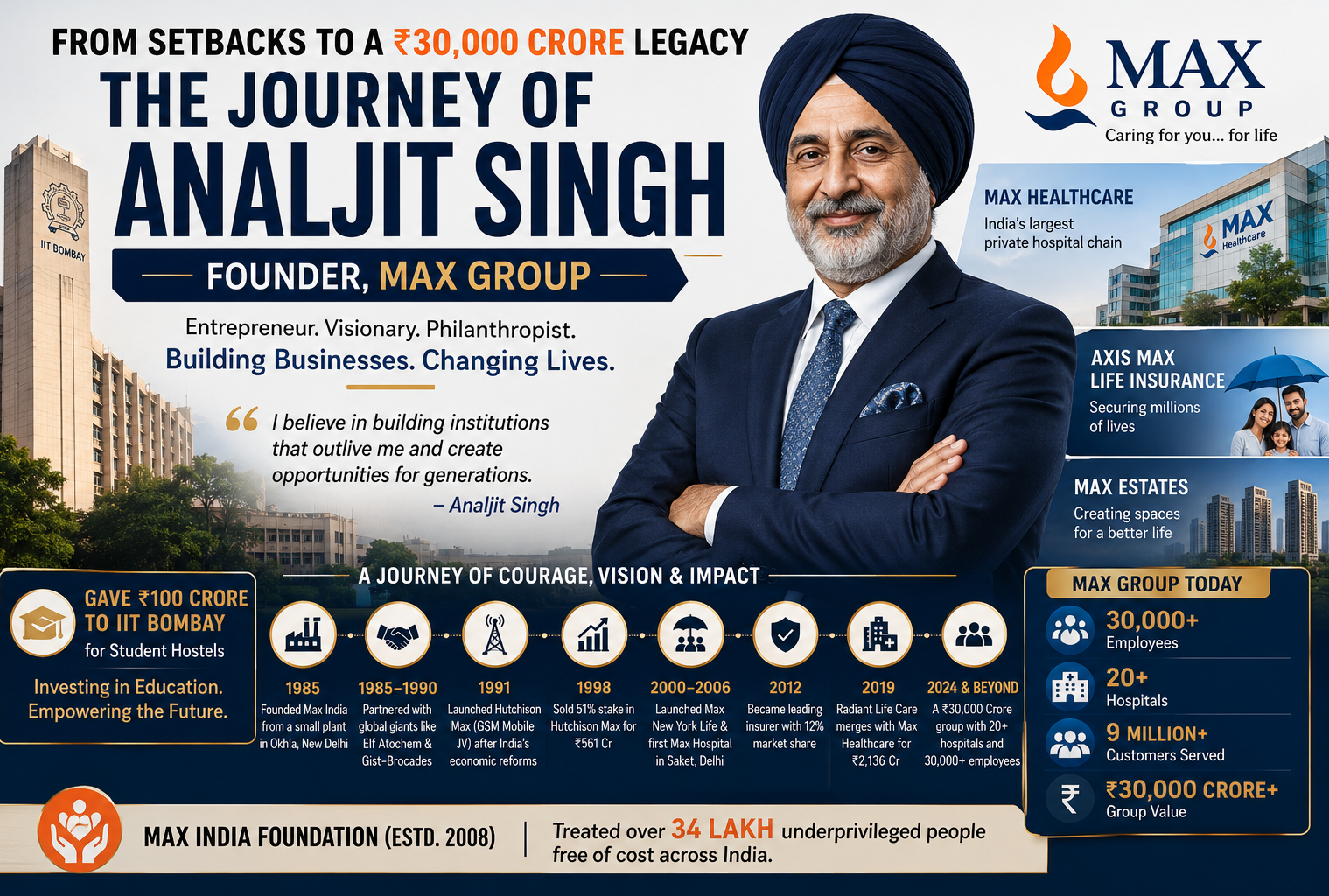
Discover the inspiring journey of Analjit Singh, the founder of Max Group, who transformed personal setbacks into a ₹30,000 crore business empire spanning healthcare, insurance, real estate, and philanthropy while donating ₹100 crore to IIT Bombay for student hostels.
In the world of Indian business, there are entrepreneurs who inherit opportunities and there are those who create them. Then there are rare individuals who lose everything, rebuild from scratch, and ultimately create institutions that outlast generations.
Analjit Singh belongs firmly in the third category.
Today, he is recognized as one of India’s most respected business leaders, heading the sprawling Max Group, a conglomerate valued at nearly ₹30,000 crore with interests spanning healthcare, insurance, senior living, and real estate. His organizations employ approximately 30,000 people, serve millions of customers, and operate some of the country’s most trusted healthcare and financial service brands.
Yet the journey to this remarkable achievement was anything but smooth.
Long before he became synonymous with healthcare excellence and insurance innovation, Analjit Singh faced personal and professional setbacks that could have ended many entrepreneurial careers before they truly began.
Instead, those challenges became the foundation of a story defined by resilience, patience, strategic vision, and an unwavering commitment to building institutions that improve lives.
Adding another chapter to his legacy, Analjit Singh recently made headlines for contributing ₹100 crore to IIT Bombay for student hostels, reinforcing his belief that education remains one of the most powerful catalysts for national development.
Born into a Business Legacy, Forced to Create His Own
Analjit Singh’s story begins within one of India’s most prominent business families.
He is the youngest son of the late Bhai Mohan Singh, the legendary entrepreneur behind Ranbaxy Laboratories, which grew into one of India’s most successful pharmaceutical companies.
Being born into such a family naturally brought expectations.
Many assumed that the next generation would seamlessly inherit thriving businesses and continue expanding them.
However, life had different plans.
Analjit initially took responsibility for an older manufacturing facility located in Okhla, New Delhi. The plant represented an opportunity to contribute meaningfully to the family enterprise while carving out his own identity.
But just four years later, a family split dramatically altered his future.
The security and resources that many assumed would define his career suddenly disappeared.
For many people, such a setback could have become a permanent obstacle.
For Analjit Singh, it became motivation.
Instead of dwelling on what was lost, he focused on what could be built.
Reinventing an Old Factory into a Global Opportunity
After the family division, Analjit recognized that India was entering a period of industrial transformation.
The pharmaceutical sector offered significant opportunities, particularly for entrepreneurs willing to invest in quality manufacturing and international standards.
He envisioned producing penicillin drug intermediates and transforming the aging Okhla facility into something extraordinary.
The result was groundbreaking.
The factory became India’s first manufacturing plant approved by the United States Food and Drug Administration (US FDA), a distinction that immediately elevated its credibility in international markets.
Achieving FDA approval was no small feat.
It required world-class processes, stringent quality controls, and significant investments in technology and infrastructure.
For a young entrepreneur rebuilding his career, it was a bold gamble.
Fortunately, it paid off.
Recognizing the importance of partnerships, Analjit actively sought collaborations with leading global chemical and pharmaceutical companies.
These efforts culminated in the creation of Max India in 1985.
What began as an industrial venture would eventually evolve into one of India’s most diversified and respected business groups.
Building Global Partnerships Before Globalization Became Fashionable
During the 1980s, India was still operating under a heavily regulated economic framework.
International collaborations were far less common than they are today.
Nevertheless, Analjit understood that long-term competitiveness required access to global expertise, advanced technologies, and international capital.
Max India began forming partnerships with global giants such as Elf Atochem and Gist-Brocades.
These alliances helped the company acquire advanced manufacturing capabilities while building credibility in international markets.
The strategy reflected a recurring theme throughout Analjit’s career.
Rather than trying to do everything alone, he consistently sought partnerships that accelerated learning and growth.
However, success was not immediate.
Surviving the Gulf War Shock
Just as Max India was gaining momentum, an unexpected global event disrupted the pharmaceutical industry.
The Gulf War of 1990 created widespread uncertainty across international markets.
Several firms reduced investments or suspended expansion plans.
Even established players reconsidered their growth strategies.
Analjit Singh faced a critical decision.
Should he retreat like many others or continue preparing for future opportunities?
He chose patience.
While uncertainty dominated the market, he continued investing in capabilities and waiting for the right moment.
That moment arrived sooner than expected.
Liberalization Changes Everything
On July 24, 1991, India embarked on one of the most transformative economic reforms in its history.
The Liberalization, Privatization, and Globalization (LPG) reforms opened the Indian economy to competition, foreign investment, and unprecedented growth opportunities.
Few sectors benefited more dramatically than telecommunications.
Analjit Singh quickly recognized the potential.
Rather than remaining confined to pharmaceuticals, he expanded into emerging industries poised for explosive growth.
Partnering with Hutchison Asia, he launched Hutchison Max, a GSM mobile telecommunications venture in Mumbai.
At a time when mobile phones were considered luxury products, the venture represented a bold bet on India’s future.
The decision would prove visionary.
As mobile adoption accelerated across the country, Hutchison Max emerged as an important player in India’s telecom revolution.
A Defining Exit Creates New Possibilities
Seven years after entering telecommunications, another major turning point arrived.
In 1998, Analjit Singh sold his 51 percent stake in Hutchison Max.
The transaction generated approximately ₹561 crore—a significant amount during that era.
For many entrepreneurs, such a windfall might have marked the end of active business building.
Analjit viewed it differently.
The capital provided him with resources to pursue even larger ambitions.
Rather than consolidating wealth, he reinvested aggressively into sectors that would define India’s future.
Healthcare and financial services became his next frontiers.
Entering Insurance and Healthcare
The turn of the millennium marked a new phase in Analjit Singh’s entrepreneurial journey.
In 2000, he launched Max New York Life Insurance, entering a sector that was still evolving after regulatory reforms.
Insurance penetration in India remained low, creating immense opportunities for organizations capable of earning customer trust.
The venture focused on transparency, service quality, and long-term customer relationships.
Around the same period, Analjit identified another critical need.
India required world-class healthcare infrastructure capable of serving a growing population with rising healthcare expectations.
This realization led to the establishment of Max Healthcare.
In 2006, the first Max Super Speciality Hospital opened in Saket, Delhi.
The facility represented a new standard in private healthcare delivery, combining advanced medical technology with patient-centric care.
What began as a single hospital would eventually become one of India’s largest healthcare networks.
Weathering Failure During the Global Financial Crisis
Every successful entrepreneur encounters setbacks.
For Analjit Singh, one of the most challenging periods arrived during the global financial crisis of 2008.
Several ventures struggled to achieve expected outcomes.
According to various accounts of his entrepreneurial journey, nearly ten business initiatives either failed or were discontinued over time.
For many business leaders, repeated failures can create hesitation and risk aversion.
Analjit responded differently.
He viewed setbacks as learning opportunities rather than permanent defeats.
Instead of abandoning his vision, he refined it.
He concentrated resources on businesses demonstrating long-term potential and gradually strengthened the group’s core operations.
This disciplined approach would ultimately create one of the strongest business portfolios in the country.
Building Leaders in Insurance
By 2012, Max New York Life had emerged as one of India’s leading life insurance providers.
The company captured approximately 12 percent market share and built a reputation for reliability, customer service, and financial strength.
Recognizing opportunities for strategic restructuring, Analjit executed another landmark transaction.
The 26 percent stake held by New York Life Insurance was sold to Mitsui Sumitomo for approximately ₹2,731 crore.
The move strengthened the company’s financial position and laid the groundwork for its future evolution.
Today, the business operates as Axis Max Life Insurance and remains one of India’s most prominent insurance brands.
The success validated Analjit’s belief that insurance could become a powerful instrument for financial security and wealth protection.
Scaling a Business Group to National Prominence
Between 2010 and 2019, the growth trajectory of Max Group accelerated dramatically.
Revenue expanded from approximately ₹7,836 crore to ₹24,134 crore.
The group served more than nine million customers across healthcare, insurance, and other businesses.
Managing an organization of such scale required careful structuring and strategic clarity.
Analjit increasingly focused on creating independent businesses with strong leadership teams, governance frameworks, and clear growth strategies.
This institutional approach ensured that growth did not depend solely on a single individual.
Instead, it became embedded within the organization itself.
Creating India’s Largest Private Hospital Network
One of the most significant milestones in the group’s history arrived in 2019.
On June 22 of that year, KKR-backed Radiant Life Care acquired a controlling 49.7 percent stake and merged with Max Healthcare in a transaction valued at approximately ₹2,136 crore.
The merger transformed the healthcare landscape.
The combined entity operated approximately 3,500 beds across India and emerged as the country’s largest private hospital chain.
The development reflected decades of investment, strategic planning, and operational excellence.
More importantly, it reinforced Max Healthcare’s position as a trusted healthcare provider serving millions of patients.
Today, the network spans more than 20 hospitals and continues expanding access to high-quality medical care.
The Modern Max Group
Today, Max Group stands as a diversified business powerhouse valued at approximately ₹30,000 crore.
Its portfolio includes three publicly listed businesses and multiple growth platforms.
Max India focuses on senior living and wellness initiatives through Antara.
Axis Max Life Insurance continues serving millions of policyholders.
Max Estates is building premium residential and commercial real estate projects.
Meanwhile, Max Healthcare remains one of India’s most respected healthcare providers.
Collectively, these businesses employ around 30,000 professionals and impact millions of lives annually.
The scale of the achievement becomes even more remarkable when viewed against the backdrop of the challenges Analjit faced early in his career.
A Legacy Beyond Business
Perhaps the most inspiring aspect of Analjit Singh’s journey lies beyond financial success.
Despite navigating multiple business failures and economic crises, he remained deeply committed to social impact.
In 2008, he established the Max India Foundation.
The initiative focused on improving healthcare access for underserved communities.
Since its inception, the foundation has provided free treatment and healthcare support to more than 34 lakh underprivileged individuals.
For many beneficiaries, these interventions represented access to medical care that would otherwise have remained out of reach.
The foundation embodies Analjit’s belief that businesses must contribute meaningfully to society.
Investing in the Next Generation
Another powerful example of this philosophy emerged through his contribution of ₹100 crore to IIT Bombay for student hostel development.
The donation reflects a broader commitment to strengthening educational infrastructure and supporting future generations of innovators, entrepreneurs, and leaders.
Hostels play a critical role in shaping the student experience, particularly for young people arriving from diverse socioeconomic backgrounds.
By supporting such initiatives, Analjit is investing in talent that will drive India’s future growth.
It is a gesture that aligns perfectly with the values that have defined his entrepreneurial journey—creating opportunities, empowering individuals, and building institutions that endure.
The Enduring Lesson of Analjit Singh
The story of Analjit Singh is not merely about wealth creation.
It is about resilience.
It is about reinvention.
It is about choosing persistence over comfort and long-term institution-building over short-term gains.
From losing control of inherited opportunities to creating a ₹30,000 crore business empire, his journey demonstrates that true entrepreneurship is not defined by where one starts but by the determination to keep moving forward.
Today, as Max Group continues to expand its influence across healthcare, insurance, real estate, and social impact initiatives, Analjit Singh’s legacy serves as a powerful reminder that setbacks can become stepping stones, failures can become lessons, and vision combined with perseverance can transform adversity into enduring success.
In an era obsessed with overnight success, his story stands as proof that some of the greatest achievements are built patiently-one challenge, one decision, and one institution at a time.
AI Conversationalist, Global Marketer, TEDx Speaker, Member-Board Of Studies-CDSW, AI Governance, Mentor Onboarded CCMB-Atal Incubation Center, Entrepreneurship Coach