PVR’s Architect: The Visionary Behind Building a ₹17,000 Crore Cinema Empire
Discover the inspiring journey of Ajay Bijli, the visionary entrepreneur who transformed a single cinema hall into PVR, India's largest multiplex chain worth over ₹17,000 crore. Learn how innovation, resilience, and customer experience reshaped the Indian entertainment industry.
How Ajay Bijli Transformed a Single Cinema Hall into India’s Largest Multiplex Revolution
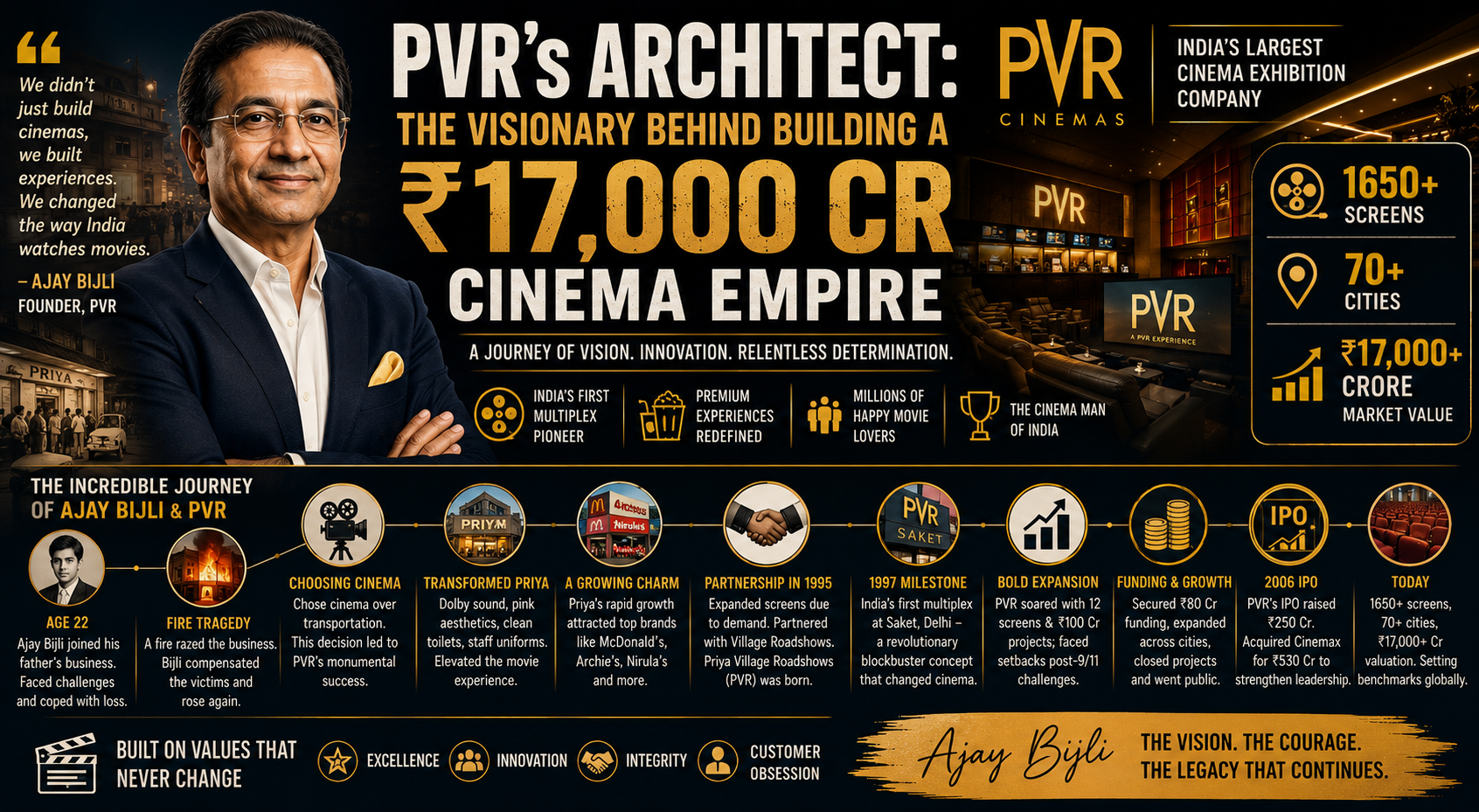
In the world of Indian entrepreneurship, some leaders build businesses, while others create entirely new industries. Ajay Bijli belongs to the latter category. Long before multiplexes became a part of urban India’s lifestyle, before luxury recliners, Dolby sound systems, gourmet popcorn, and premium movie experiences became the norm, Bijli envisioned a future where cinema would be more than just watching a film-it would become an experience.
Today, PVR stands as India’s largest cinema exhibition company, operating thousands of screens across dozens of cities and commanding a valuation exceeding ₹17,000 crore. But behind this success lies a remarkable story of resilience, calculated risk-taking, innovation, and an unwavering belief in the future of entertainment.
Ajay Bijli’s journey from inheriting a struggling family business to becoming known as “The Cinema Man of India” is a masterclass in entrepreneurial vision. His story demonstrates how customer obsession, adaptability, and courage can transform an entire industry.
A Young Entrepreneur Thrust into Responsibility
Ajay Bijli’s entrepreneurial journey began earlier than he had expected.
At the age of 22, he joined his father’s business, stepping into a world filled with responsibilities and uncertainties. While many young graduates were exploring career options, Bijli was learning firsthand about business operations, financial management, and the realities of entrepreneurship.
The family’s business interests included transportation and cinema operations, sectors that were facing their own challenges during a rapidly changing economic environment.
The transition wasn’t easy.
Like many second-generation entrepreneurs, Bijli had to prove himself while simultaneously navigating market challenges and business setbacks. Yet these early experiences provided valuable lessons that would later shape his leadership style.
Rather than being discouraged by difficulties, he developed the resilience that every successful entrepreneur eventually requires.
When Disaster Struck
One of the defining moments in Bijli’s early career came when a devastating fire severely impacted business operations.
For many business owners, such an event could have marked the end of the journey. Financial losses mounted, uncertainty loomed large, and rebuilding appeared daunting.
However, what distinguished Ajay Bijli was his response.
Instead of walking away from responsibility, he reportedly ensured that affected parties were compensated and obligations were honored. This commitment to integrity reinforced an important principle that would later become central to PVR’s culture: trust matters.
The experience taught him that businesses are not merely financial entities; they are relationships built on credibility.
While the fire created significant challenges, it also strengthened his determination to rebuild and innovate.
Choosing Cinema Over Transportation
At a critical crossroads in his career, Bijli faced a decision that would shape his future.
The family business had interests in transportation, a relatively stable and established sector. Cinema, on the other hand, was unpredictable, highly dependent on consumer preferences, and vulnerable to economic fluctuations.
Many would have chosen the safer path.
Ajay Bijli chose cinema.
What he saw wasn’t merely a movie hall business. He saw an opportunity to transform how Indians experienced entertainment.
At a time when cinema halls were often poorly maintained, lacked customer focus, and offered limited comfort, Bijli envisioned something entirely different.
His decision to concentrate on cinema laid the foundation for what would eventually become one of India’s most successful entertainment companies.
Reinventing Priya Cinema
The first major chapter of PVR’s story began with Priya Cinema in Delhi.
Rather than operating the cinema conventionally, Bijli focused on customer experience.
He introduced innovations that were uncommon in Indian cinema halls at the time.
Dolby sound systems enhanced audio quality.
Modern aesthetics improved visual appeal.
Clean and hygienic restrooms elevated customer comfort.
Uniformed staff created a professional environment.
Attention to detail transformed the overall movie-going experience.
While these improvements may seem standard today, they were revolutionary during that era.
Customers noticed the difference immediately.
Priya Cinema soon developed a reputation for offering a premium experience that stood apart from traditional single-screen theatres.
Creating a Lifestyle Destination
Ajay Bijli understood something many cinema operators overlooked.
People were not simply purchasing movie tickets.
They were purchasing an outing.
This insight led him to create an environment that extended beyond film screenings.
As Priya Cinema gained popularity, major brands began establishing their presence nearby.
Restaurants, food outlets, and retail stores recognized the value of the growing foot traffic.
Well-known names such as McDonald’s, Archie’s, and Nirula’s became part of the ecosystem surrounding the cinema.
The result was transformational.
Movie-going evolved from a simple activity into a complete social experience.
This concept would later become a defining characteristic of multiplex culture across India.
The Birth of PVR
By the mid-1990s, Ajay Bijli recognized that the future of cinema exhibition required scale, innovation, and global expertise.
In 1995, he entered into a partnership with Village Roadshow, an international entertainment company.
The collaboration resulted in the creation of Priya Village Roadshow, better known today as PVR.
The partnership brought valuable insights into global cinema operations, technology adoption, and customer engagement.
More importantly, it provided the foundation for introducing a completely new concept to India—the multiplex.
While single-screen theatres dominated the market, Bijli believed audiences would embrace a more flexible and premium format.
His conviction would soon change Indian cinema forever.
India’s First Multiplex Revolution
In 1997, PVR launched India’s first multiplex at Saket in Delhi.
It was a watershed moment for the country’s entertainment industry.
Instead of relying on a single large screen, the multiplex model offered multiple screens within one location.
This innovation delivered several advantages.
Different films could be shown simultaneously.
Screen utilization improved dramatically.
Customers enjoyed greater choice and convenience.
The model also allowed operators to cater to diverse audience preferences.
Initially, the concept appeared risky.
Many questioned whether Indian consumers would embrace higher ticket prices in exchange for a better experience.
The answer came quickly.
Audiences loved it.
The Saket multiplex became a blockbuster success, proving that consumers were willing to pay for quality and comfort.
A new era had begun.
Scaling Amid Challenges
Success brought expansion opportunities.
PVR rapidly began adding screens and investing in new projects.
Large-scale developments worth hundreds of crores were planned to capitalize on growing demand.
However, expansion was not without challenges.
The aftermath of global economic uncertainties, including disruptions following the September 11 attacks, affected investor sentiment and business growth.
Financing became more difficult.
Projects faced delays.
Market conditions grew uncertain.
Yet Ajay Bijli remained focused on the long-term vision.
Instead of retreating, he continued building infrastructure that would support future growth.
His confidence in India’s emerging middle class and increasing appetite for premium entertainment remained unwavering.
Securing Capital and Accelerating Growth
A major turning point arrived when PVR secured substantial funding that enabled further expansion.
The fresh capital allowed the company to strengthen its presence across multiple cities, improve operational efficiency, and pursue new opportunities.
Not every project succeeded.
Some ventures were closed or restructured.
However, Bijli viewed setbacks as part of the growth process rather than signs of failure.
This disciplined approach helped PVR avoid many of the pitfalls that often accompany rapid expansion.
As the company matured, it became increasingly attractive to investors.
The stage was set for one of the most important milestones in its history.
Going Public
In 2006, PVR launched its Initial Public Offering (IPO).
The public issue raised approximately ₹250 crore and marked a significant moment in the company’s evolution.
The IPO accomplished more than fundraising.
It validated PVR’s business model, enhanced credibility, and provided resources for future growth.
Public listing also increased accountability and transparency, helping strengthen corporate governance.
Investors recognized the potential of the multiplex industry and the leadership capabilities of Ajay Bijli.
The market’s confidence would soon be rewarded.
Strategic Acquisitions and Market Leadership
As competition intensified, PVR pursued strategic acquisitions to consolidate its position.
One of the most significant moves came with the acquisition of Cinemax.
The deal substantially expanded PVR’s footprint and accelerated its growth trajectory.
Rather than relying solely on organic expansion, Bijli used acquisitions strategically to strengthen market leadership.
This approach enabled PVR to reach new geographies, increase screen count, and improve operational efficiencies.
Over time, the company emerged as the dominant force in India’s cinema exhibition sector.
Building a Premium Entertainment Brand
PVR’s success cannot be explained solely through screen count.
The company continuously focused on enhancing customer experience.
Luxury seating, premium lounges, advanced projection technologies, gourmet food offerings, and immersive sound systems became standard features.
PVR transformed cinema-going into an aspirational experience.
Customers increasingly viewed multiplex visits as premium leisure activities rather than simple entertainment purchases.
This positioning enabled the company to command higher ticket prices while maintaining strong customer loyalty.
The strategy proved remarkably effective.
Navigating the Digital Era
The rise of streaming platforms posed one of the biggest challenges to traditional cinemas.
Many analysts predicted that online content would reduce theatre attendance significantly.
Ajay Bijli took a different view.
He believed that while technology changes consumption habits, the communal experience of watching a film on the big screen remains irreplaceable.
Instead of resisting change, PVR embraced technology.
Online ticketing, mobile applications, loyalty programs, digital payments, and personalized customer engagement became integral parts of the business.
This adaptability helped the company remain relevant in a rapidly evolving landscape.
Becoming India’s Largest Multiplex Chain
Over the years, PVR expanded aggressively across metropolitan cities, tier-two markets, and emerging urban centers.
The company eventually operated more than 1,650 screens across over 70 cities, becoming the undisputed leader in India’s multiplex industry.
Its scale provided significant advantages.
Better bargaining power with film distributors.
Stronger brand recognition.
Improved operational efficiency.
Enhanced customer reach.
What began as a single cinema hall had evolved into a nationwide entertainment network.
The transformation reflected decades of strategic execution and visionary leadership.
The Cinema Man of India
Few entrepreneurs become synonymous with an industry.
Ajay Bijli achieved precisely that.
His contributions fundamentally changed how Indians watch movies.
Before PVR, cinema halls were often treated as basic venues.
After PVR, movie-going became an experience centered on comfort, quality, technology, and service.
His influence extended beyond his own company.
Competitors adopted multiplex models.
Industry standards improved.
Consumer expectations evolved.
The entire ecosystem benefited from innovations pioneered by PVR.
This impact earned him the title “The Cinema Man of India.”
A ₹17,000 Crore Legacy
Today, PVR’s valuation exceeds ₹17,000 crore, representing one of India’s most successful entertainment enterprises.
The company’s journey reflects far more than financial growth.
It represents the transformation of an entire industry.
From a young entrepreneur facing setbacks to the architect of India’s multiplex revolution, Ajay Bijli’s story embodies the power of vision, resilience, and execution.
His success demonstrates that industries are not transformed by technology alone.
They are transformed by leaders willing to challenge conventions and imagine a better future.
As India’s entertainment landscape continues to evolve, Ajay Bijli’s legacy remains firmly embedded in every multiplex, every premium movie experience, and every family outing that begins with a simple phrase:
“Let’s go to the movies.”
For millions of Indians, that experience has been shaped by one man’s extraordinary vision-and that man is Ajay Bijli.
AI Conversationalist, Global Marketer, TEDx Speaker, Member-Board Of Studies-CDSW, AI Governance, Mentor Onboarded CCMB-Atal Incubation Center, Entrepreneurship Coach