From Haldiram’s to Empowering Bikaji: Shiv Ratan Agarwal’s ₹13,000 Crore Entrepreneurial Triumph
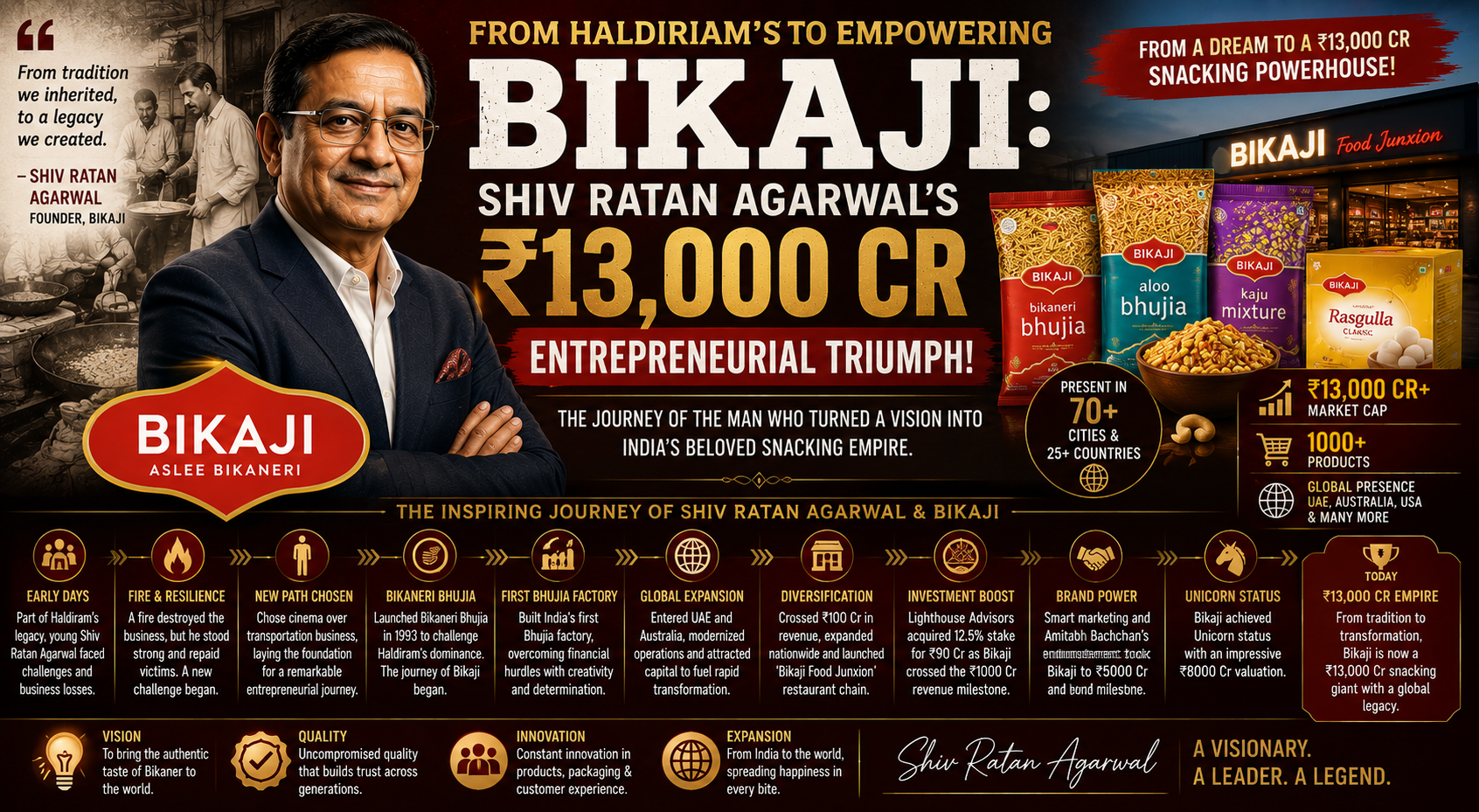
Discover the inspiring journey of Shiv Ratan Agarwal, the visionary entrepreneur who left Haldiram's and built Bikaji into a ₹13,000 crore FMCG powerhouse. Learn how innovation, resilience, and strategic expansion transformed a regional bhujia brand into a global snack giant.
The Extraordinary Story of a Visionary Who Turned Family Adversity into One of India’s Most Successful Snack Brands
In the fiercely competitive world of Indian food and FMCG businesses, very few entrepreneurs manage to step out of a powerful legacy and build a successful empire of their own. Even fewer succeed in competing against the very brand that shaped their early business journey.
Shiv Ratan Agarwal belongs to that rare category of entrepreneurs.
Known today as the driving force behind Bikaji Foods International, Agarwal transformed what began as an ambitious regional snack venture into a ₹13,000 crore enterprise with a global presence. His journey is not merely a story of business growth; it is a powerful narrative of resilience, vision, family legacy, innovation, and entrepreneurial courage.
Starting from the shadows of the iconic Haldiram’s brand, Shiv Ratan Agarwal charted his own path, building Bikaji into one of India’s most recognized packaged food companies. His story demonstrates that success is not always inherited—it is often earned through perseverance, strategic thinking, and an unwavering belief in one’s vision.
Today, Bikaji products are available across India and in multiple international markets, serving millions of consumers who associate the brand with authentic taste, quality, and innovation.
But the road to success was anything but easy.
A Legacy Rooted in Bikaner’s Bhujia Tradition
The roots of Bikaji’s story lie in Bikaner, Rajasthan, a city famous for its culinary heritage and world-renowned bhujia.
Shiv Ratan Agarwal was born into a family deeply connected with the snack industry through Haldiram’s, one of India’s most respected food brands.
Growing up, he witnessed firsthand how traditional recipes, quality ingredients, and customer trust could build a successful business. These early experiences provided valuable insights into manufacturing, distribution, branding, and consumer behavior.
However, family businesses are not always free from challenges.
Internal disagreements and changing family dynamics eventually led to a turning point in Agarwal’s entrepreneurial journey.
Rather than remaining within the comfort zone of an established business, he chose a path that demanded courage, conviction, and self-belief.
He decided to create a legacy of his own.
That decision would ultimately give birth to one of India’s largest snack food companies.
The Birth of a Challenger Brand
In the early 1990s, India’s packaged snack market was still evolving.
Consumers largely relied on local namkeen shops and regional brands. Organized players were relatively few, and Haldiram’s enjoyed significant dominance in several categories.
For most entrepreneurs, challenging such an established player would have seemed impossible.
Shiv Ratan Agarwal saw an opportunity.
In 1993, he launched Bikaji with a clear mission-to create a brand rooted in authentic Bikaneri flavors while expanding into new markets with modern business practices.
The company’s early focus was Bikaneri Bhujia, the iconic snack synonymous with Rajasthan.
Competing against a market leader required more than confidence.
It required differentiation.
Agarwal focused on maintaining authenticity while introducing modern packaging, improved quality control, and broader distribution channels.
Consumers responded positively.
The foundation for Bikaji’s future success had been laid.
Building India’s First Dedicated Bhujia Manufacturing Scale
One of the most significant milestones in Bikaji’s journey was the establishment of large-scale manufacturing operations dedicated to bhujia production.
At a time when many traditional snack businesses relied on limited-scale production methods, Shiv Ratan Agarwal recognized the importance of industrializing manufacturing without compromising taste.
The challenge was enormous.
Building manufacturing infrastructure required significant investment.
Financial resources were limited.
Market uncertainty remained high.
Yet Agarwal believed that long-term success depended on scalability.
By investing in production capabilities, quality systems, and operational efficiency, Bikaji positioned itself for sustained growth.
This strategic decision would eventually become one of the company’s greatest competitive advantages.
The ability to produce consistently high-quality products at scale enabled Bikaji to expand rapidly across multiple regions.
Transforming a Regional Brand into a National Player
As Bikaji gained traction in Rajasthan and neighboring states, Agarwal began pursuing a larger vision.
His goal was not merely to become a successful regional brand.
He wanted Bikaji to become a household name across India.
The company’s revenue growth accelerated steadily.
As sales crossed significant milestones, including the ₹100 crore mark, confidence within the organization grew stronger.
Expansion strategies focused on strengthening distribution networks, entering new markets, and building brand awareness.
Unlike many businesses that grow too quickly and lose control of quality, Bikaji maintained a disciplined approach.
Every new market entry was supported by operational readiness and customer understanding.
This balance between ambition and execution became a hallmark of Agarwal’s leadership.
Introducing Innovation Beyond Bhujia
While bhujia remained Bikaji’s flagship product, Shiv Ratan Agarwal understood a critical business principle:
No brand can depend indefinitely on a single product category.
To sustain long-term growth, diversification was essential.
Bikaji expanded into multiple segments, including namkeens, papads, sweets, packaged snacks, rasgullas, and ready-to-eat products.
Each new category strengthened the company’s relationship with consumers.
Instead of being known solely for bhujia, Bikaji evolved into a comprehensive food brand.
Innovation became a key growth driver.
Consumer preferences were changing rapidly.
Urban lifestyles demanded convenience.
Retail formats were evolving.
Agarwal ensured that Bikaji remained relevant by continuously introducing new products while preserving the authentic taste that customers loved.
This combination of tradition and innovation became a powerful competitive advantage.
International Expansion: Taking Indian Flavors Global
As domestic success accelerated, Shiv Ratan Agarwal turned his attention toward international markets.
Millions of Indians living abroad represented a growing opportunity.
Consumers worldwide were increasingly exploring Indian cuisine and snacks.
Bikaji began expanding into countries including the UAE and Australia, among other international markets.
The move required significant adaptation.
Global quality standards had to be met.
Supply chains needed strengthening.
Brand positioning required localization while maintaining authenticity.
The international expansion journey demonstrated Agarwal’s ability to think beyond domestic boundaries.
It also reinforced Bikaji’s ambition to become a globally recognized Indian food brand.
Today, the company’s products reach consumers across numerous countries, strengthening its reputation as an ambassador of Indian flavors.
Modernization and Strategic Capital Infusion
As the business expanded, modernization became increasingly important.
Traditional family-run processes needed to evolve into professional corporate systems capable of supporting national and international growth.
Bikaji invested heavily in technology, automation, manufacturing upgrades, and organizational development.
Attracting external investors became part of this transformation.
Strategic capital infusion enabled the company to accelerate expansion plans, strengthen infrastructure, and enhance operational efficiency.
One notable milestone came when Lighthouse Advisors acquired a stake in the company.
The investment not only brought capital but also validated Bikaji’s growth potential in the eyes of the broader investment community.
Institutional confidence further accelerated the company’s journey toward becoming a major FMCG player.
Creating Experiences Through Bikaji Food Junxon
Shiv Ratan Agarwal understood that modern consumers seek experiences, not just products.
This insight led to the development of Bikaji Food Junxon, a restaurant and food service concept designed to showcase the brand’s offerings in an immersive environment.
The initiative allowed customers to engage directly with Bikaji’s culinary heritage.
It also strengthened brand visibility and customer loyalty.
Food Junxon became more than a restaurant concept.
It became an extension of the Bikaji brand experience.
By integrating retail products with hospitality, Agarwal demonstrated his ability to think beyond conventional FMCG strategies.
The move diversified revenue streams while deepening consumer engagement.
The Marketing Masterstroke
One of the defining elements of Bikaji’s rise has been its strategic marketing approach.
As competition intensified, building a strong emotional connection with consumers became essential.
Bikaji invested significantly in brand-building initiatives.
Advertising campaigns highlighted authenticity, family traditions, and product quality.
The company’s visibility increased substantially through celebrity endorsements and mass-media campaigns.
A major turning point came when legendary Bollywood icon Amitabh Bachchan became associated with the brand.
The endorsement amplified consumer trust and national recognition.
Brand awareness surged.
Consumer engagement strengthened.
Sales growth accelerated significantly.
The campaign demonstrated how effective storytelling and trusted brand ambassadors can transform market perception.
Crossing the ₹1,000 Crore Milestone
For any FMCG company, crossing ₹1,000 crore in revenue represents a major achievement.
For Bikaji, it signaled the transition from a successful regional enterprise to a national powerhouse.
The milestone reflected years of disciplined execution.
Manufacturing excellence.
Distribution expansion.
Brand-building efforts.
Product innovation.
Consumer trust.
Everything was coming together.
Investors, analysts, and industry observers increasingly viewed Bikaji as one of India’s most promising food companies.
The company’s growth trajectory showed no signs of slowing.
From ₹1,000 Crore to ₹5,000 Crore Brand Strength
As revenues expanded, so did the company’s valuation and market influence.
Strategic marketing campaigns, improved distribution reach, and growing consumer demand fueled exponential growth.
Bikaji’s presence expanded across modern retail chains, traditional kirana stores, e-commerce platforms, and international markets.
The brand became synonymous with premium Indian snacks.
Consumers across generations embraced its offerings.
Industry experts increasingly cited Bikaji as one of the strongest challenger brands in India’s food sector.
What started as a bold entrepreneurial experiment was rapidly evolving into a major FMCG success story.
Achieving Unicorn-Like Status
Bikaji’s remarkable growth eventually propelled the company to valuations exceeding ₹8,000 crore, placing it among India’s most valuable food brands.
The achievement reflected far more than financial success.
It represented validation of Shiv Ratan Agarwal’s long-term vision.
Years earlier, he had left an established family business to pursue an uncertain path.
Many questioned whether he could compete against larger players.
The results speak for themselves.
Through perseverance, innovation, and strategic execution, Bikaji emerged as one of India’s most respected consumer brands.
Building a ₹13,000 Crore Empire
Today, Bikaji stands as a ₹13,000 crore enterprise with a growing international footprint.
The company serves millions of consumers through an extensive product portfolio and a vast distribution network.
Its success illustrates the power of entrepreneurship in transforming challenges into opportunities.
More importantly, it demonstrates that family legacy can be a starting point—not a limitation.
Shiv Ratan Agarwal built Bikaji by honoring tradition while embracing innovation.
He respected the heritage of Bikaneri snacks while modernizing production, marketing, and distribution.
This balance enabled the company to achieve extraordinary growth without losing its identity.
Lessons from Shiv Ratan Agarwal’s Journey
Several powerful lessons emerge from Bikaji’s success story.
First, adversity often creates opportunities for reinvention.
Second, competing against established players requires differentiation, not imitation.
Third, long-term success depends on balancing tradition with innovation.
Fourth, scalability and operational excellence matter as much as product quality.
Finally, great entrepreneurs build brands that connect emotionally with consumers.
These principles have guided Bikaji’s journey from a regional snack manufacturer to a global food company.
The Legacy Continues
As India’s FMCG industry becomes increasingly competitive, Bikaji remains well-positioned for future growth.
Consumer preferences continue evolving.
Digital commerce is expanding.
Global demand for Indian food products is rising.
The company is strategically positioned to capitalize on these trends.
For Shiv Ratan Agarwal, the journey represents far more than financial achievement.
It represents the fulfillment of a vision born from courage, resilience, and determination.
From stepping away from Haldiram’s legacy to building a ₹13,000 crore empire of his own, his story stands as one of India’s most inspiring entrepreneurial journeys.
It is proof that true success is not about where you start.
It is about the vision you pursue, the challenges you overcome, and the legacy you leave behind.
And in the story of Indian entrepreneurship, Shiv Ratan Agarwal’s Bikaji journey has already secured its place among the most remarkable success stories of modern India.
AI Conversationalist, Global Marketer, TEDx Speaker, Member-Board Of Studies-CDSW, AI Governance, Mentor Onboarded CCMB-Atal Incubation Center, Entrepreneurship Coach