From Barmer to Harvard: How Ruma Devi Turned Adversity into a Global Movement of Women’s Empowerment
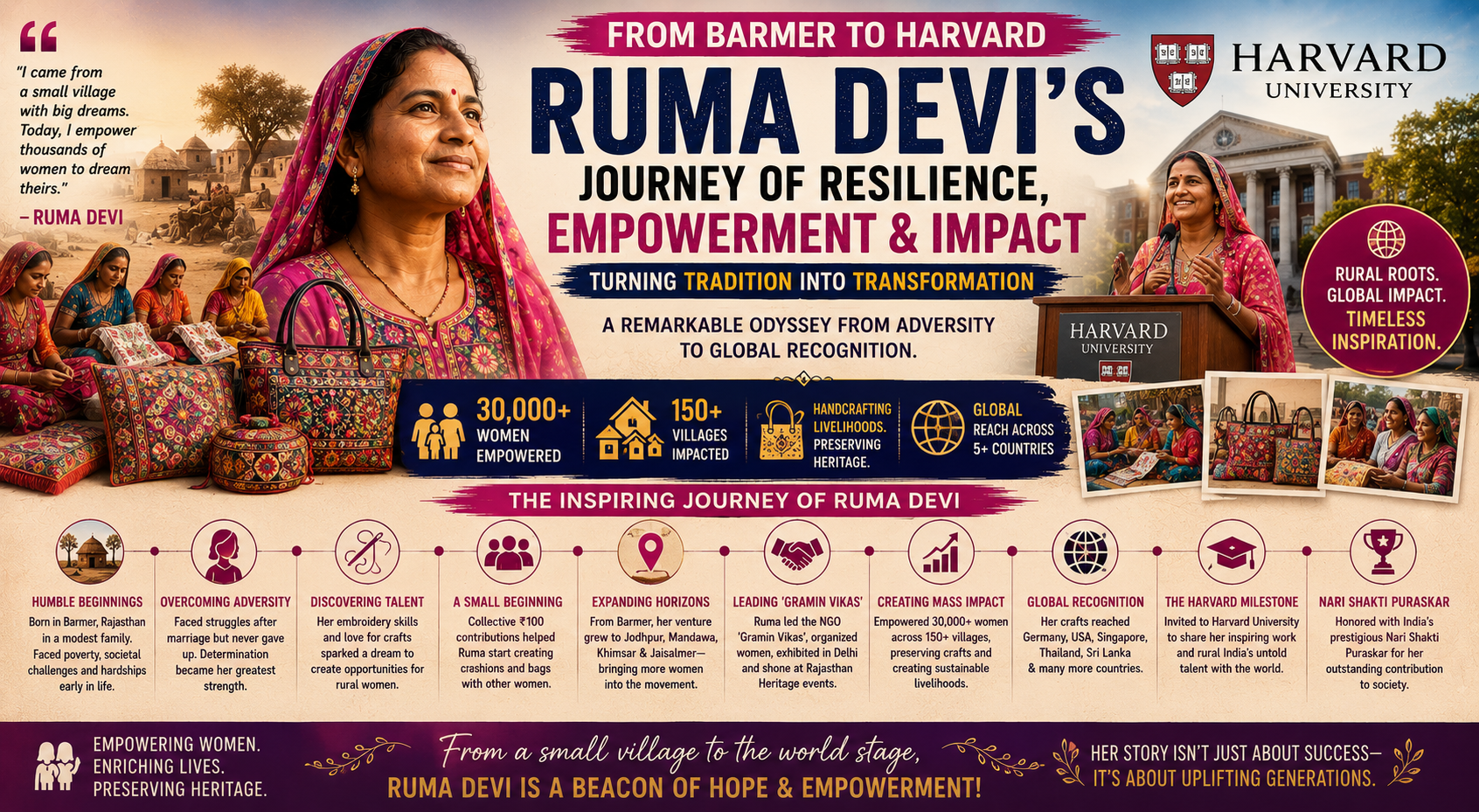
Discover the inspiring story of Ruma Devi, the self-made social entrepreneur from Rajasthan who transformed traditional handicrafts into a global movement. From Barmer village to Harvard, her journey of resilience, women’s empowerment, and cultural preservation continues to inspire millions.
Success stories often begin in boardrooms, elite universities, or privileged environments. But sometimes, the most extraordinary journeys emerge from the most unexpected places. The story of Ruma Devi is one such example-a story born in the deserts of Barmer and celebrated on global platforms, including Harvard University.
Her remarkable rise from a struggling village woman facing personal hardships to becoming a globally recognized social entrepreneur is not just a tale of individual success. It is a story of empowerment, resilience, cultural preservation, and community transformation. Through traditional embroidery and handicrafts, Ruma Devi created opportunities for thousands of rural women, proving that entrepreneurship can flourish even in the most challenging circumstances.
Today, her work has touched more than 30,000 women across over 150 villages, while her handcrafted products have reached international markets in countries such as Germany, Singapore, Thailand, Sri Lanka, and the United States.
A Childhood Marked by Challenges
Ruma Devi’s early years were far from easy. Born into a modest family in rural Rajasthan, she grew up amid economic hardship and social limitations that often restricted opportunities for women.
Life in rural India can be demanding, especially for young girls who frequently face barriers to education, financial independence, and personal growth. Ruma Devi experienced many of these challenges firsthand. Yet even during difficult times, she possessed an inner determination that would later define her journey.
Her life took another difficult turn after marriage. Like many women in conservative rural communities, she had to navigate social expectations, family responsibilities, and financial struggles simultaneously. The future seemed uncertain.
However, adversity became the foundation of her strength.
Rather than allowing circumstances to define her destiny, Ruma Devi began searching for ways to create opportunities—not only for herself but also for other women facing similar hardships.
Discovering the Power of Traditional Crafts
Rajasthan has long been known for its vibrant textiles, intricate embroidery, and rich handicraft traditions. These skills have been passed from generation to generation, preserving centuries of cultural heritage.
Ruma Devi realized that these traditional crafts represented more than artistic expression. They could become a source of income, dignity, and independence for rural women.
What began as a personal skill soon evolved into a larger vision.
She started working on embroidery and handicraft products, using techniques deeply rooted in Rajasthan’s cultural identity. Her craftsmanship attracted attention for its authenticity, detail, and uniqueness.
More importantly, she recognized that countless women around her possessed similar skills but lacked access to markets, customers, and economic opportunities.
This realization sparked a mission that would eventually transform thousands of lives.
The Beginning of a Grassroots Enterprise
Every successful enterprise starts with a first step. For Ruma Devi, that step was remarkably humble.
According to accounts of her journey, a group of women pooled small contributions of approximately ₹100 each to support the creation of handcrafted products such as cushions, bags, and decorative items.
The amount may have been small, but the vision was enormous.
With limited resources and virtually no access to formal funding, the women began producing handcrafted goods while Ruma Devi coordinated efforts and explored potential markets.
At the time, many observers might have viewed the initiative as a small local activity.
Yet beneath the surface, something powerful was taking shape-a women-led entrepreneurial movement driven by creativity, determination, and community collaboration.
Building a Brand from Rural Rajasthan
One of the biggest challenges facing artisans is market access.
Many talented craftspeople create exceptional products but struggle to connect with buyers willing to pay fair prices. Middlemen often capture much of the value, leaving artisans with minimal earnings.
Ruma Devi understood this challenge and focused on creating direct opportunities for artisans.
Her efforts gradually expanded beyond Barmer into other regions of Rajasthan, including cities and tourist destinations where handcrafted products attracted significant interest.
The response was encouraging.
Customers appreciated the authenticity of the products and the stories behind them. Each item reflected not only artistic skill but also the aspirations of the women who created it.
As demand increased, more women joined the initiative.
What started as a small group soon evolved into a growing network of artisans committed to preserving traditional crafts while improving their economic conditions.
Turning Craftsmanship into Empowerment
The true significance of Ruma Devi’s work extends beyond business metrics.
At its core, her mission has always been about empowerment.
For many rural women, financial independence can transform every aspect of life. It can improve access to education, healthcare, nutrition, and decision-making power within households.
By creating sustainable income opportunities through handicrafts, Ruma Devi helped thousands of women gain confidence and economic security.
Women who once had limited opportunities found themselves becoming contributors to household income. Many developed leadership skills, trained other artisans, and became role models within their communities.
This ripple effect multiplied the impact of her efforts far beyond individual earnings.
Entire families benefited.
Entire villages benefited.
And most importantly, a new generation of girls began seeing different possibilities for their futures.
The Rise of Gramin Vikas and Community Leadership
As her influence expanded, Ruma Devi became associated with community development initiatives that focused on rural empowerment and artisan support.
Through grassroots leadership and collective action, she helped organize women into productive networks capable of generating meaningful economic activity.
These efforts demonstrated an important lesson: sustainable development often works best when communities themselves become active participants rather than passive recipients of assistance.
Ruma Devi encouraged women to believe in their abilities and leverage skills they already possessed.
Rather than introducing entirely new industries, she elevated traditional knowledge into modern economic opportunities.
This approach preserved cultural heritage while simultaneously creating livelihoods.
It was a powerful combination of tradition and innovation.
Taking Rajasthan’s Craft Heritage to National Platforms
As the movement gained momentum, Ruma Devi’s work began attracting attention across India.
Handicraft exhibitions, cultural events, and artisan showcases provided opportunities to present products to wider audiences.
Her creations stood out because they represented authentic craftsmanship rather than mass-produced alternatives.
Exhibitions in cities such as New Delhi and across Rajasthan introduced customers, policymakers, and industry observers to the extraordinary talent emerging from rural communities.
The exposure opened new doors.
Orders increased.
Recognition grew.
And more women became involved in the initiative.
The success demonstrated that traditional crafts, when supported effectively, could compete in modern markets while preserving cultural identity.
Creating Opportunities for More Than 30,000 Women
Perhaps the most remarkable aspect of Ruma Devi’s journey is the scale of her impact.
Over time, her initiatives expanded to include more than 30,000 women across approximately 150 villages.
These numbers represent far more than participation statistics.
Each woman involved represents a family touched by opportunity.
Each village represents a community experiencing positive change.
Each handcrafted product represents a story of resilience and determination.
The scale of this achievement is particularly impressive given the limited resources available at the beginning of the journey.
It highlights what can happen when vision, leadership, and community collaboration come together around a meaningful purpose.
Global Recognition for Local Talent
As awareness of her work spread, international interest followed.
Products created by women artisans associated with Ruma Devi found markets beyond India.
Craft collections reached customers in Germany, Singapore, Thailand, Sri Lanka, and the United States, among other countries.
This international exposure delivered several benefits.
It generated income opportunities.
It elevated the visibility of Indian handicrafts.
And it showcased the extraordinary capabilities of rural women entrepreneurs on a global stage.
For many artisans, seeing their creations appreciated by customers thousands of miles away was a source of immense pride.
It reinforced the idea that talent knows no geographical boundaries.
The Harvard Milestone
One of the defining moments in Ruma Devi’s journey came when she was invited to share her experiences at programs associated with Harvard University.
For a woman who began her journey in a small village in Rajasthan, this achievement carried profound symbolic significance.
Harvard represents one of the world’s most respected academic institutions.
Standing on such a platform allowed Ruma Devi to share lessons from rural India with a global audience.
Her presence there was not merely a personal accomplishment.
It was recognition of the power of grassroots entrepreneurship, women’s empowerment, and cultural preservation.
It demonstrated that transformative ideas can emerge from anywhere.
The journey from Barmer to Harvard became a symbol of possibility for millions of people who aspire to overcome barriers and create meaningful change.
Recognition Through the Nari Shakti Puraskar
Ruma Devi’s contributions have also been recognized through prestigious national honors.
Among the most notable is the Nari Shakti Puraskar, one of India’s highest recognitions for women making exceptional contributions to society.
The award acknowledged not only her entrepreneurial achievements but also her broader impact on social development and women’s empowerment.
Recognition of this nature matters because it highlights stories that deserve national attention.
It encourages others to pursue similar paths.
And it reinforces the importance of inclusive growth and community leadership.
Lessons from Ruma Devi’s Journey
There are several powerful lessons embedded in Ruma Devi’s story.
1. Adversity Can Become Opportunity
Challenges often appear as obstacles, but they can also become catalysts for innovation and growth.
Ruma Devi transformed personal hardships into motivation for creating change.
2. Traditional Skills Have Modern Value
In an age dominated by technology, traditional crafts continue to hold significant economic and cultural value.
By modernizing market access while preserving authenticity, artisans can thrive.
3. Empowerment Creates Multiplying Impact
When women gain economic independence, the benefits extend to families, communities, and future generations.
4. Leadership Is About Service
Ruma Devi’s success stems not only from personal ambition but also from her commitment to helping others succeed.
5. Global Success Can Begin Locally
International recognition often starts with solving local problems effectively.
Her journey illustrates how grassroots initiatives can achieve worldwide impact.
A Symbol of Modern India
Ruma Devi represents a powerful vision of modern India-one that celebrates entrepreneurship, inclusivity, cultural heritage, and social innovation simultaneously.
Her story challenges conventional assumptions about success.
She did not build a technology startup.
She did not come from wealth.
She did not possess elite credentials when she began.
Instead, she built her success through determination, craftsmanship, and community leadership.
That is precisely what makes her journey so inspiring.
The Road Ahead
As India continues to emphasize entrepreneurship, skill development, and women-led growth, stories like Ruma Devi’s become increasingly relevant.
Her work demonstrates that sustainable development can emerge from local communities when talent is recognized and nurtured.
The future holds immense potential for expanding artisan networks, increasing global market access, and preserving traditional crafts for future generations.
If the achievements of the past decade are any indication, Ruma Devi’s impact is likely to continue growing.
Conclusion
From the deserts of Barmer to the halls of Harvard, Ruma Devi’s journey stands as one of India’s most inspiring modern success stories. What began as a struggle against adversity evolved into a movement that empowered more than 30,000 women, preserved cultural heritage, and brought global recognition to traditional Indian craftsmanship.
Her story is not merely about business success or international acclaim. It is about courage in the face of hardship, belief in one’s abilities, and the transformative power of collective action.
At a time when the world is searching for models of inclusive and sustainable growth, Ruma Devi offers a compelling example of how entrepreneurship can create both economic value and social impact.
Her journey proves that greatness is not determined by where one starts, but by the determination to keep moving forward. From a small village in Rajasthan to one of the world’s most prestigious institutions, Ruma Devi has shown that dreams rooted in purpose can truly reach the world.
AI Conversationalist, Global Marketer, TEDx Speaker, Member-Board Of Studies-CDSW, AI Governance, Mentor Onboarded CCMB-Atal Incubation Center, Entrepreneurship Coach