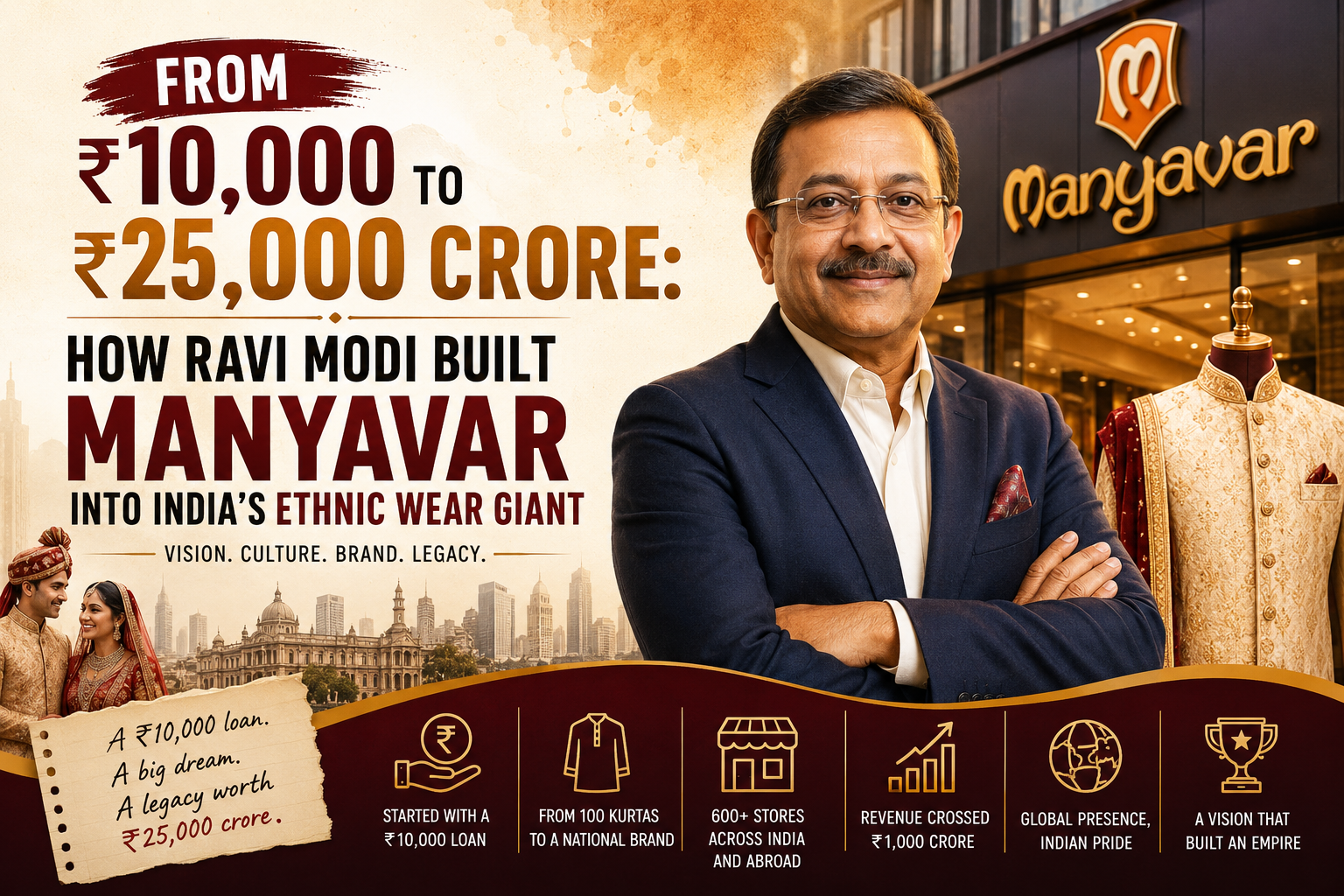
From ₹10,000 to ₹25,000 Crore: How Ravi Modi Built Manyavar into India’s Ethnic Wear Giant
Discover how Ravi Modi transformed a ₹10,000 loan into Manyavar, India's leading ethnic wear brand valued at over ₹25,000 crore. Explore his entrepreneurial journey, business strategy, marketing innovations, and lessons for aspiring entrepreneurs
In a world where startup success stories are often associated with technology companies, venture capital funding, and billion-dollar valuations, the journey of Ravi Modi stands out for a different reason. His story proves that even traditional industries can create extraordinary wealth when innovation meets vision.
Today, Manyavar is one of India’s most recognizable ethnic wear brands, serving millions of customers across India and around the world. Valued at over ₹25,000 crore, the company has become synonymous with weddings, celebrations, and Indian tradition.
But what makes this achievement remarkable is where it began.
Not in a corporate boardroom.
Not with massive funding.
Not with influential investors.
It started with a modest ₹10,000 loan and a young entrepreneur who believed that Indian ethnic wear deserved a stronger identity in a rapidly modernizing country.
The rise of Ravi Modi and Manyavar is not merely a business success story. It is a lesson in patience, conviction, branding, and understanding the cultural heartbeat of India.
A Young Entrepreneur in Kolkata
Ravi Modi was born into a business family in Kolkata. Like many traditional business households, entrepreneurship was not a distant concept but part of everyday life.
His father operated a clothing store in Kolkata’s famous AC Market.
At a time when Western fashion was increasingly dominating urban India, Ravi noticed something interesting.
Indian ethnic wear continued to have immense emotional value.
People wore traditional attire during weddings, festivals, religious ceremonies, and important family occasions.
Yet the market lacked organized branding.
The industry was fragmented.
Most products were sold through local stores.
Few brands had national recognition.
For Ravi Modi, this represented an opportunity.
Rather than following fashion trends imported from abroad, he believed Indian culture itself could become the foundation of a powerful business.
That belief would eventually transform the entire ethnic wear industry.
The First Step: A ₹10,000 Loan
Every entrepreneurial journey begins with a first investment.
For Ravi Modi, that investment came in the form of a ₹10,000 loan from his mother.
The amount may seem insignificant compared to the scale of his eventual success, but it represented something far greater than money.
It represented trust.
It represented belief.
And it represented the beginning of a dream.
With this modest capital, Ravi began manufacturing kurta-pyjama sets.
Initially, production was limited.
The goal was simple: create quality products and find customers who appreciated traditional Indian clothing.
His first batch reportedly consisted of around 100 kurta-pyjama sets.
There were no grand offices.
No celebrity endorsements.
No sophisticated marketing campaigns.
Only determination and a willingness to learn.
Like most entrepreneurs, Ravi encountered numerous obstacles in the early years.
Yet he remained focused on one idea: building a brand around Indian tradition.
Understanding the Untapped Market
One of Ravi Modi’s greatest strengths was his ability to see opportunities that others overlooked.
During the late 1990s and early 2000s, India’s retail industry was undergoing rapid transformation.
International brands were entering the market.
Consumers were becoming more fashion-conscious.
Western clothing dominated advertising campaigns.
Many business observers assumed ethnic wear would remain limited to festive occasions.
Ravi disagreed.
He believed Indian clothing had the potential to become aspirational.
Rather than treating ethnic wear as a necessity, he wanted to transform it into a lifestyle choice.
This shift in thinking became the foundation of Manyavar’s future success.
He recognized that weddings alone represented a massive market.
Every year, millions of Indians celebrated weddings with elaborate ceremonies that placed traditional attire at the center of the experience.
If a brand could own that emotional connection, it could build tremendous value.
The Birth of Manyavar
In 2002, Ravi Modi formally launched Manyavar.
The name itself reflected elegance, respect, and Indian tradition.
From the beginning, the brand positioned itself differently from local clothing retailers.
Manyavar was not merely selling garments.
It was selling identity.
It was selling celebration.
It was selling tradition in a modern format.
The strategy resonated strongly with customers.
Families looking for wedding attire appreciated the convenience of a dedicated ethnic wear brand.
Young consumers found modern styling combined with traditional craftsmanship appealing.
The company began gaining traction.
What started as a small operation slowly evolved into a recognized name.
Challenging Western Fashion Dominance
Perhaps one of Ravi Modi’s boldest decisions was choosing to double down on Indian wear when many businesses were chasing Western fashion trends.
At the time, critics questioned whether ethnic wear could become a large-scale branded business.
Many assumed young Indians would increasingly abandon traditional clothing.
Ravi saw the situation differently.
He believed culture would always remain relevant.
He understood that weddings, festivals, and family celebrations were deeply embedded in Indian society.
As long as those traditions existed, demand for ethnic wear would continue.
Rather than fighting cultural identity, Manyavar embraced it.
The company celebrated Indian traditions through its products, advertising, and customer experience.
That strategic clarity helped distinguish the brand from competitors.
Expanding Retail Presence
As customer demand increased, Ravi Modi focused on retail expansion.
In 2008, Manyavar opened its first exclusive brand outlet.
The move proved transformational.
Exclusive stores allowed the company to control customer experience, showcase complete collections, and strengthen brand identity.
Unlike multi-brand retailers, dedicated outlets created a premium environment tailored specifically for ethnic wear shoppers.
Customers responded enthusiastically.
Store performance exceeded expectations.
The success encouraged rapid expansion.
Over the following years, Manyavar continued opening outlets across major Indian cities.
Each new location strengthened the company’s national presence.
The brand was no longer regional.
It was becoming a national phenomenon.
The Marketing Masterstroke
While product quality and retail expansion were important, Ravi Modi understood that branding would ultimately determine long-term success.
One of Manyavar’s most innovative moves came through advertising.
In 2014, the company aggressively leveraged cinema advertising and emotionally driven campaigns.
At a time when many fashion brands focused exclusively on glamour, Manyavar emphasized relationships, family values, and celebration.
Its advertisements connected emotionally with audiences.
The campaigns told stories rather than simply promoting products.
Viewers remembered the emotions.
As a result, they remembered the brand.
This approach dramatically increased visibility and customer loyalty.
Manyavar had successfully transformed from a clothing company into a cultural brand.
Crossing ₹500 Crore Revenue
By 2016, Manyavar had achieved a major milestone.
Annual revenues crossed ₹500 crore.
Even more impressive was the company’s financial discipline.
The business remained largely debt-free.
This achievement attracted attention from investors, competitors, and global fashion companies.
Many industry experts began studying the company’s growth model.
How had a traditional clothing brand achieved such rapid expansion?
The answer lay in Ravi Modi’s combination of operational discipline, strong branding, and deep cultural understanding.
Unlike businesses dependent on heavy borrowing, Manyavar focused on sustainable growth.
The strategy provided stability while enabling expansion.
The Virat Kohli Effect
A major turning point in Manyavar’s journey came through celebrity endorsements.
The company partnered with renowned Indian cricketer Virat Kohli.
The partnership helped strengthen Manyavar’s appeal among younger consumers.
Virat Kohli represented confidence, modernity, and success.
His association helped bridge the gap between traditional attire and contemporary aspirations.
The campaign proved highly successful.
Brand awareness increased significantly.
Customer engagement grew.
Sales accelerated.
Manyavar demonstrated that ethnic wear could be fashionable, aspirational, and relevant for modern India.
Launching Mohey
Recognizing the enormous opportunity in women’s ethnic fashion, Ravi Modi introduced Mohey in 2016.
The brand focused on bridal lehengas and women’s celebration wear.
This expansion allowed Manyavar to participate more comprehensively in India’s wedding economy.
To strengthen the launch, the company partnered with Anushka Sharma as brand ambassador.
The move generated widespread attention.
Mohey quickly established itself as a respected player in the bridal wear segment.
The expansion showcased Ravi Modi’s ability to identify adjacent opportunities while leveraging existing brand strength.
The Road to ₹1,000 Crore
Strong marketing, retail expansion, and category diversification pushed Manyavar past another major milestone.
Revenues crossed ₹1,000 crore.
The achievement attracted interest from institutional investors.
Among them was Kedaara Capital, which invested in the company.
The partnership provided additional resources for expansion while validating Manyavar’s business model.
Importantly, Ravi Modi maintained strategic control and continued focusing on long-term growth rather than short-term gains.
The company remained committed to its core philosophy: celebrating Indian traditions through high-quality ethnic wear.
Building a Nationwide Presence
Over time, Manyavar expanded aggressively across India.
The company established hundreds of stores spanning metropolitan cities, tier-two markets, and emerging urban centers.
Its retail network eventually surpassed 600 stores.
The scale was unprecedented within the ethnic wear category.
Manyavar succeeded because it understood local preferences while maintaining national consistency.
Customers could expect similar quality, service, and product experience regardless of location.
This reliability strengthened brand trust.
It also created significant barriers for competitors.
Going Global
Ravi Modi’s ambitions extended beyond India.
With millions of Indians living abroad, demand for premium ethnic wear existed in international markets as well.
Manyavar began opening stores in countries with significant Indian diaspora populations.
International outlets expanded the brand’s reach while strengthening its global identity.
Customers in North America, the Middle East, Europe, and other regions gained access to the brand.
This global expansion reinforced an important insight.
Indian culture is not limited by geography.
The emotional connection to traditional attire transcends borders.
Manyavar successfully leveraged this connection to build an international business.
The IPO Success Story
One of the most significant milestones in Manyavar’s journey came through its public market debut.
The company’s IPO generated strong investor interest and reflected confidence in its long-term growth potential.
For Ravi Modi, the IPO represented more than financial success.
It symbolized the validation of a vision that began decades earlier with a ₹10,000 loan.
Public market investors recognized the strength of the brand, the scalability of the business model, and the company’s leadership position within the ethnic wear segment.
The listing further enhanced Manyavar’s reputation and growth prospects.
A ₹25,000 Crore Empire
Today, Manyavar stands among India’s most successful fashion brands.
The company commands a valuation exceeding ₹25,000 crore and continues serving customers across hundreds of cities.
Its influence extends far beyond clothing.
Manyavar has helped redefine perceptions of Indian ethnic wear.
It transformed traditional attire from a fragmented retail category into a branded lifestyle segment.
The company has also created employment opportunities, supported textile ecosystems, and contributed significantly to India’s retail landscape.
Few businesses have achieved such impact while remaining deeply rooted in cultural identity.
The Patience Behind the Success
One of the lesser-known aspects of Ravi Modi’s journey is his patience.
Despite building a rapidly growing business, he reportedly waited nearly 15 years before purchasing a luxury Mercedes-Benz.
The decision reflected a mindset common among disciplined entrepreneurs.
Rather than prioritizing personal luxury, Ravi focused on reinvesting profits into business growth.
This approach allowed Manyavar to expand without excessive financial strain.
The lesson is powerful.
True entrepreneurship often requires delayed gratification.
Success is built not through immediate rewards but through long-term commitment.
Lessons from Ravi Modi’s Journey
Several important lessons emerge from Ravi Modi’s remarkable story.
First, opportunities often exist in traditional industries. Innovation is not limited to technology.
Second, branding matters. Customers connect with stories, values, and emotions, not just products.
Third, cultural understanding can become a competitive advantage.
Fourth, sustainable growth often outperforms aggressive expansion fueled by debt.
Fifth, patience and discipline remain essential ingredients of long-term success.
Conclusion
Ravi Modi’s transformation of a ₹10,000 loan into a ₹25,000 crore empire stands among India’s most inspiring entrepreneurial journeys. At a time when many believed traditional clothing had limited growth potential, he saw an opportunity to build a brand around culture, identity, and celebration.
From selling small batches of kurta-pyjama sets to leading one of India’s largest ethnic wear companies, his journey reflects vision, resilience, and strategic execution. Manyavar’s success demonstrates that innovation does not always mean creating something entirely new. Sometimes, it means reimagining something timeless.
Today, as Manyavar continues expanding across India and international markets, Ravi Modi’s story serves as a powerful reminder that entrepreneurship is not about the size of the starting capital. It is about the strength of the vision.
From a modest loan provided by family support to building a business worth over ₹25,000 crore, Ravi Modi has shown that determination, patience, and belief in one’s culture can create an empire that stands the test of time.
AI Conversationalist, Global Marketer, TEDx Speaker, Member-Board Of Studies-CDSW, AI Governance, Mentor Onboarded CCMB-Atal Incubation Center, Entrepreneurship Coach