From ₹10,000 to ₹50,000+ Crore: Kiran Mazumdar’s Epic Odyssey Building Biocon into a Global Biotech Powerhouse
Discover the inspiring journey of Kiran Mazumdar-Shaw, who transformed a ₹10,000 startup into Biocon, a ₹50,000+ crore biotechnology powerhouse, overcoming bias, funding challenges, and industry barriers to revolutionize global healthcare.
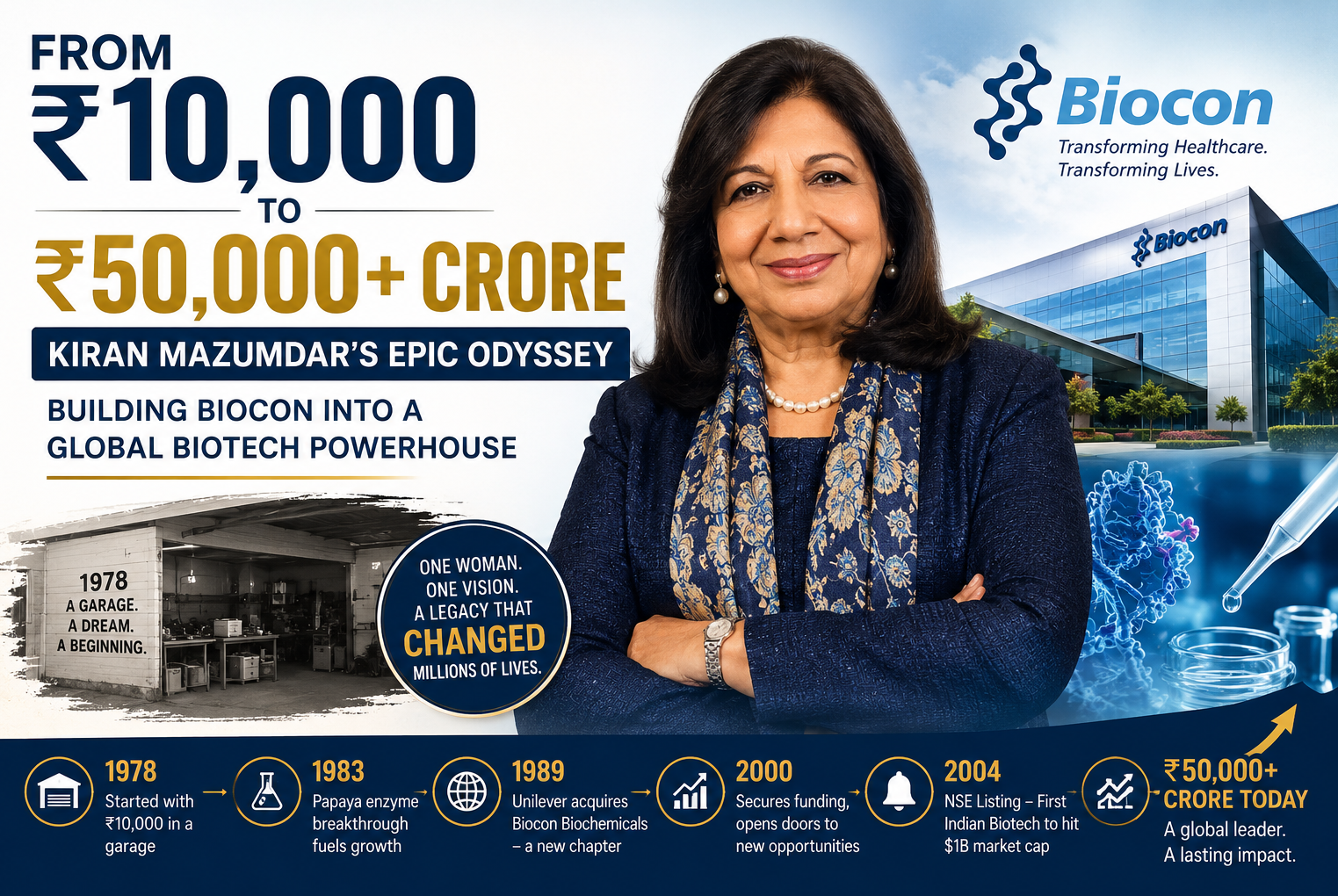
In the annals of Indian entrepreneurship, few stories are as inspiring, resilient, and transformative as that of Kiran Mazumdar-Shaw. What began in 1978 with a modest investment of just ₹10,000 in a rented garage has evolved into Biocon, one of India’s most respected biotechnology companies with a valuation exceeding ₹50,000 crore and a global footprint spanning over 120 countries.
Her story is not merely about building a successful company. It is about challenging conventions, breaking gender barriers, embracing science-driven innovation, and proving that determination can turn impossible dreams into reality.
Today, Kiran Mazumdar-Shaw is celebrated as one of India’s most influential entrepreneurs and a pioneer who placed Indian biotechnology on the global map. Yet, her remarkable journey was anything but easy.
A Dream Takes Shape in 1978
When Kiran Mazumdar graduated as a brewmaster from Australia, she envisioned a career in brewing. However, reality delivered a harsh lesson.
Despite her qualifications, brewing companies in India were reluctant to hire a woman for leadership positions. Repeated rejections forced her to reconsider her career path.
Instead of allowing disappointment to define her future, she turned adversity into opportunity.
In 1978, at just 25 years old, Kiran partnered with an Irish entrepreneur to establish Biocon India. The company initially focused on producing industrial enzymes derived from microorganisms.
With an initial capital of only ₹10,000 and operations running out of her garage in Bengaluru, the odds appeared stacked against her.
There were no venture capital firms eager to fund biotech ventures. Biotechnology itself was a relatively unknown field in India. Infrastructure was poor, resources were scarce, and credibility was difficult to establish.
Yet Kiran believed in one thing above all else: science could create value.
Battling Gender and Age Bias
The early years of Biocon were filled with obstacles.
Potential employees hesitated to join a startup led by a young woman. Banks refused loans because they questioned both the viability of biotechnology and Kiran’s ability to run a company.
Investors were skeptical.
Customers were uncertain.
Industry experts doubted her vision.
Many people considered biotechnology too risky and too futuristic for India.
Kiran often recalls how difficult it was to convince people that biotechnology could become a significant industry. The combination of being young, female, and operating in a niche scientific field created enormous challenges.
Yet every rejection strengthened her resolve.
Instead of focusing on barriers, she concentrated on building credibility through quality, innovation, and persistence.
The Struggles of 1982
By 1982, Biocon had survived its initial years but faced another critical challenge.
India’s infrastructure limitations created significant operational difficulties. Reliable power supply was inconsistent. Scientific equipment was expensive and difficult to obtain. Research facilities were limited.
Raising capital remained a nightmare.
Investors struggled to understand the biotech business model. Traditional lenders preferred established industries over scientific ventures.
The company often had to operate under resource constraints while competing against international players with vastly superior infrastructure and funding.
Many startups would have collapsed under such pressure.
Biocon endured.
Kiran’s leadership focused on maximizing available resources while continuously improving operational capabilities.
Her ability to navigate these difficult years laid the foundation for future growth.
The Papaya Enzyme Breakthrough of 1983
A turning point arrived in 1983.
Biocon developed innovative enzyme products, including papaya-based enzymes that found commercial applications in brewing and industrial processes.
The breakthrough demonstrated that Indian biotechnology companies could create globally competitive products.
The success of these enzyme innovations opened international markets and established Biocon as a serious player in the global enzyme industry.
Exports began increasing.
Revenue improved.
Most importantly, confidence grew.
For the first time, Biocon was no longer viewed as an experiment. It was becoming a business with real commercial potential.
The breakthrough validated Kiran’s belief that scientific innovation could create sustainable competitive advantages.
Building an International Reputation
As the 1980s progressed, Biocon steadily expanded its enzyme business.
Unlike many Indian companies of the era that focused exclusively on domestic markets, Biocon adopted a global outlook from the beginning.
The company built relationships with international customers and established export channels.
This international orientation proved crucial.
It exposed Biocon to global standards, encouraged innovation, and created opportunities beyond the limitations of the domestic market.
Kiran understood that biotechnology was inherently global. Scientific discoveries and healthcare solutions transcended national borders.
This perspective would later become one of Biocon’s greatest strengths.
The Unilever Chapter in 1989
A major milestone arrived in 1989 when global consumer giant Unilever acquired Biocon Biochemicals through its subsidiary.
For many entrepreneurs, such an acquisition would represent the ultimate destination.
For Kiran, it was merely another chapter.
While the association with Unilever provided credibility, resources, and global exposure, she remained committed to a larger vision.
She believed Biocon could become much more than an enzyme manufacturer.
She envisioned a company capable of pioneering advanced biotechnology research, pharmaceuticals, and affordable healthcare solutions.
That ambition continued to guide her strategic decisions.
The partnership with Unilever helped strengthen operational capabilities while preparing Biocon for its next phase of evolution.
Entering the World of Healthcare
The 1990s marked a strategic transformation.
Rather than limiting itself to industrial enzymes, Biocon began expanding into biopharmaceuticals and healthcare.
This decision required substantial investment in research, development, infrastructure, and talent.
It also involved greater risk.
Drug development is among the most challenging and expensive endeavors in business.
Success is never guaranteed.
Yet Kiran recognized an opportunity.
India needed affordable healthcare solutions.
Millions of patients lacked access to life-saving medicines due to high costs.
Biotechnology offered a pathway to address this challenge.
Biocon’s focus shifted toward creating innovative healthcare products capable of improving lives while building long-term value.
The Turning Point of 2000
The year 2000 represented a major breakthrough.
Biocon secured significant funding support, including approximately $4 million from ICICI.
This investment changed the company’s trajectory.
For years, financial institutions had been reluctant to support biotechnology ventures.
Now, investors were beginning to recognize Biocon’s potential.
Banks became more willing to extend credit.
Financial markets started paying attention.
The biotech pioneer that once struggled for basic funding had become an attractive investment opportunity.
The influx of capital enabled Biocon to accelerate research, expand facilities, and pursue larger ambitions.
For Kiran, it was validation of decades of perseverance.
Learning Through Failure
Success rarely follows a straight line.
Even as Biocon expanded, several research projects faced setbacks.
One notable challenge emerged during efforts to develop oral insulin technology.
The project represented a bold attempt to revolutionize diabetes treatment.
While some aspects of glucose-related research produced promising results, other scientific objectives proved difficult to achieve.
Failures and disappointments are common in biotechnology.
Years of research can end without commercial success.
Kiran understood this reality better than most.
Instead of viewing setbacks as defeats, she treated them as learning opportunities.
This mindset became part of Biocon’s culture.
Innovation requires experimentation, and experimentation inevitably involves risk.
The willingness to continue despite failures distinguished Biocon from many competitors.
Achieving Historic Scientific Milestones
Biocon’s commitment to innovation eventually produced remarkable achievements.
The company became known for developing affordable biopharmaceutical solutions and advanced research capabilities.
Among its notable accomplishments was its work in statins, insulin, biosimilars, and other biotechnology products.
Biocon achieved important regulatory approvals, including recognition from international regulators such as the United States Food and Drug Administration (USFDA).
These approvals represented more than commercial victories.
They signaled that Indian biotechnology could meet the highest global standards.
For decades, advanced biotechnology had been dominated by companies from developed economies.
Biocon demonstrated that Indian scientific talent could compete at the highest level.
The achievement elevated not only the company but also India’s reputation within the global biotechnology ecosystem.
The Historic IPO of 2004
One of the most defining moments in Biocon’s history came in 2004.
The company launched its Initial Public Offering (IPO) and listed on the National Stock Exchange.
The response was extraordinary.
On listing day, Biocon became the first Indian biotechnology company to cross the $1 billion market capitalization mark.
Investors embraced the company’s vision.
The IPO transformed Biocon into a symbol of India’s emerging knowledge economy.
For Kiran, it represented the culmination of 26 years of persistence.
The woman who once struggled to secure bank loans had built a billion-dollar enterprise.
The achievement inspired countless entrepreneurs, especially women aspiring to build businesses in science and technology.
Expanding Across the World
Following its successful public listing, Biocon accelerated its global expansion.
The company entered new markets, formed international partnerships, and increased investment in research and development.
Its products reached patients across multiple continents.
Biocon’s biosimilars and insulin products became particularly significant in addressing global healthcare needs.
The company focused on making advanced therapies more affordable and accessible.
This mission resonated strongly in developing countries where healthcare affordability remains a major challenge.
By combining innovation with cost efficiency, Biocon created a unique position in the global pharmaceutical landscape.
Building More Than a Business
What sets Kiran Mazumdar-Shaw apart is that her vision extends beyond profits.
Throughout her career, she has emphasized the importance of social impact.
Her philanthropic initiatives focus on healthcare access, cancer care, education, scientific research, and public health.
The Kiran Mazumdar-Shaw Cancer Center and various healthcare initiatives reflect her commitment to improving lives beyond corporate success.
She has consistently advocated for stronger healthcare infrastructure, medical innovation, and scientific advancement in India.
For her, entrepreneurship is not merely about wealth creation.
It is about creating solutions that benefit society.
A Global Leader Emerges
Today, Biocon stands as one of Asia’s leading biotechnology companies.
With annual revenues exceeding $1.37 billion, a strong international presence, and a reputation for innovation, the company continues to influence the future of healthcare.
Its portfolio spans biosimilars, generic formulations, research services, and novel biological therapies.
The company serves millions of patients worldwide and remains committed to making healthcare more accessible.
From a small garage operation to a globally recognized biotech enterprise, the transformation is extraordinary.
Yet perhaps Biocon’s greatest achievement lies in the doors it opened for future innovators.
Lessons from Kiran Mazumdar-Shaw’s Journey
Kiran’s story offers powerful lessons for entrepreneurs across industries.
First, expertise can become opportunity. What began as knowledge in brewing eventually evolved into a biotechnology revolution.
Second, resilience matters. Every major stage of Biocon’s journey involved obstacles that could have ended the company.
Third, innovation requires patience. Scientific breakthroughs often take years, sometimes decades, to achieve.
Fourth, purpose creates endurance. Kiran’s commitment to improving healthcare helped sustain her vision through difficult periods.
Finally, leadership means believing in possibilities before others can see them.
These lessons remain relevant for entrepreneurs, researchers, students, and business leaders alike.
The Legacy of a Pioneer
Few business leaders have transformed an industry the way Kiran Mazumdar-Shaw transformed biotechnology in India.
She challenged stereotypes, built a world-class company, created thousands of jobs, advanced healthcare innovation, and inspired generations of entrepreneurs.
Her journey from a ₹10,000 startup to a ₹50,000-plus crore biotech powerhouse demonstrates what vision, courage, and perseverance can accomplish.
In an era where innovation drives economic progress, Kiran Mazumdar-Shaw remains a shining example of how determination can overcome limitations and create global impact.
The garage where Biocon began may have been small, but the dream that emerged from it was immense.
Nearly five decades later, that dream continues to shape healthcare, biotechnology, and entrepreneurship across the world.
As Biocon marches forward into the future, Kiran Mazumdar-Shaw’s story stands as a reminder that extraordinary success often begins with ordinary resources, unwavering belief, and the courage to pursue an idea when nobody else sees its potential.
From ₹10,000 to a biotech empire worth more than ₹50,000 crore, hers is not just a success story—it is one of India’s greatest entrepreneurial odysseys.
AI Conversationalist, Global Marketer, TEDx Speaker, Member-Board Of Studies-CDSW, AI Governance, Mentor Onboarded CCMB-Atal Incubation Center, Entrepreneurship Coach