The Billion-Dollar Cart: How Radhakishan Damani Turned Personal Loss into India’s Most Admired Retail Success Story
Discover how Radhakishan Damani overcame personal tragedy, left college, mastered value investing, and built DMart into one of India’s most valuable retail chains worth over ₹3 lakh crore through discipline, simplicity, and long-term vision.
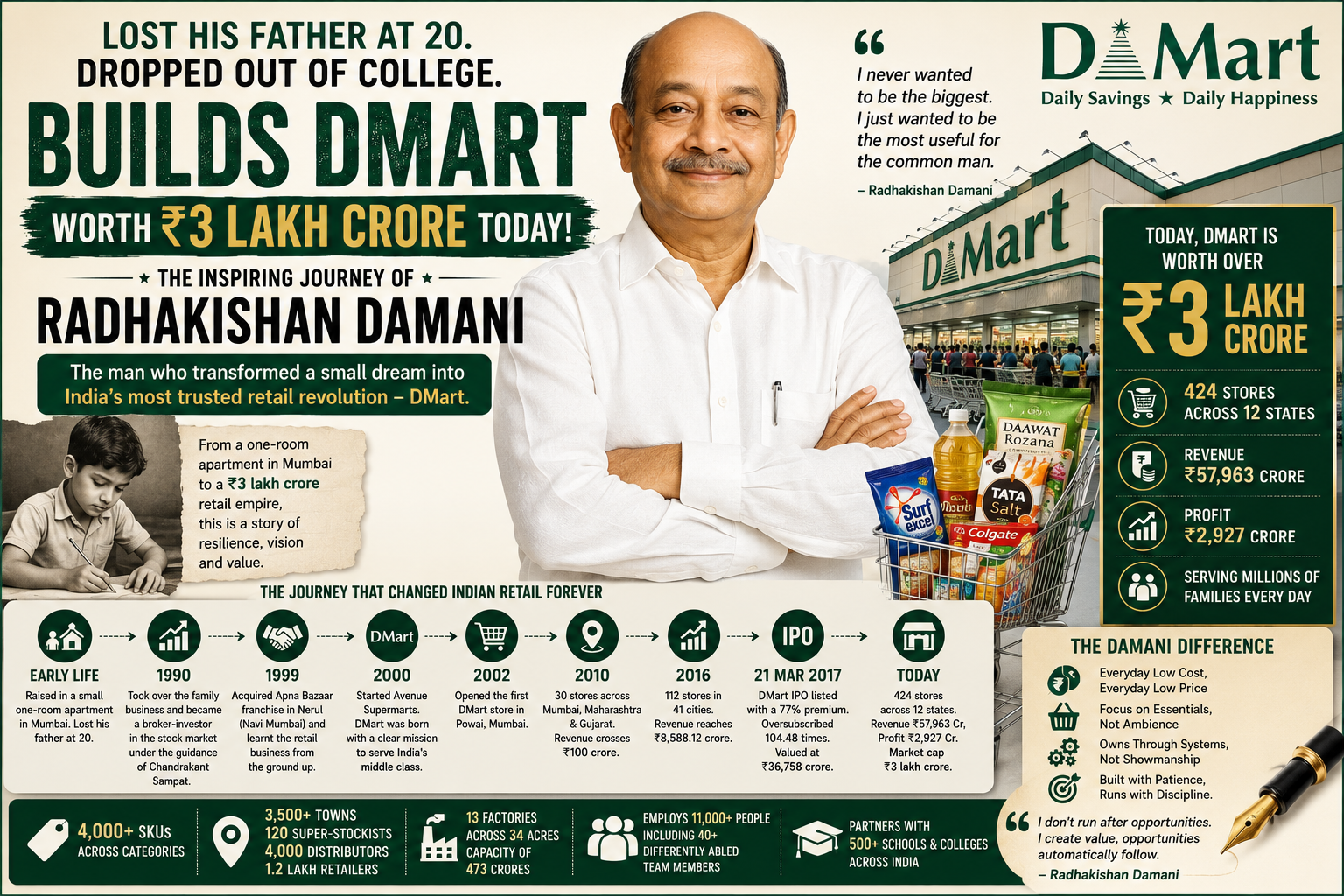
A college dropout, stock market strategist, and retail visionary who quietly built a ₹3 lakh crore empire by understanding how ordinary Indians shop
In a business world often dominated by flashy founders, celebrity CEOs, and aggressive publicity campaigns, Radhakishan Damani stands apart.
He rarely gives interviews.
He avoids the spotlight.
He is known for simplicity rather than spectacle.
Yet, despite maintaining one of the lowest public profiles among Indian business leaders, Damani has built one of the country’s most successful and valuable enterprises-DMart.
Today, Avenue Supermarts, the company behind DMart, commands a market value of nearly ₹3 lakh crore, operates hundreds of stores across India, and serves millions of customers every month. It is widely regarded as one of the greatest retail success stories in modern Indian business history.
What makes the achievement even more remarkable is where it began.
Not in a wealthy business dynasty.
Not in a sprawling corporate office.
Not with venture capital funding.
It began in a modest one-room apartment in Mumbai, where a young man faced an uncertain future after losing his father at just 20 years of age.
The story of Radhakishan Damani is not merely about wealth creation. It is about resilience, patience, disciplined thinking, and understanding the needs of ordinary Indian families better than anyone else.
Humble Beginnings in Mumbai
Radhakishan Shivkishanji Damani was born into a Maharashtrian-Marwari family in Mumbai.
His father ran a small ball-bearing trading business. The family lived modestly in a one-room apartment, where resources were limited but values such as hard work and discipline were abundant.
Like many young Indians, Damani initially followed a traditional educational path.
However, life had different plans.
In his twenties, tragedy struck when his father passed away unexpectedly.
The loss changed everything.
Suddenly, the young Damani found himself facing responsibilities that most people encounter much later in life.
His family’s business required attention.
Financial stability became a priority.
Education had to take a back seat.
As a result, he left college and stepped into the business world far earlier than anticipated.
Few could have imagined that this difficult chapter would eventually lead to one of India’s most remarkable entrepreneurial journeys.
Entering the World of Business and Markets
After taking over his father’s business operations, Damani began exploring opportunities beyond traditional trading.
He was drawn toward the stock market.
The Indian equity market during the 1980s and early 1990s offered opportunities for those willing to learn, observe, and think independently.
Damani immersed himself in studying businesses, financial statements, and investment strategies.
A significant influence during this period was renowned investor Chandrakant Sampat, who introduced him to the philosophy of value investing.
This approach emphasized buying quality businesses at reasonable valuations and holding them for the long term.
The lessons resonated deeply with Damani.
Unlike speculative traders seeking quick profits, he focused on understanding business fundamentals.
Over time, he developed a reputation as a disciplined and thoughtful investor.
The stock market became his classroom.
Every success and setback contributed to his understanding of how businesses create value.
Lessons from the Harshad Mehta Era
The early 1990s were among the most dramatic periods in Indian financial history.
The Harshad Mehta scam exposed vulnerabilities within the financial system and shook investor confidence across the country.
Many investors suffered significant losses.
Markets became highly volatile.
For Damani, the episode reinforced important lessons about risk, discipline, and sustainability.
He recognized that wealth creation required more than market speculation.
It required ownership of businesses capable of generating long-term value.
The experience also sparked a broader question.
What industries offered durable opportunities for growth?
Where could he build something lasting?
The answer would emerge from a completely different sector.
Retail.
Observing a Gap in Indian Retail
During the 1990s, Indian retail remained largely fragmented.
Consumers often encountered inconsistent pricing, limited product choices, and uneven shopping experiences.
There was little standardization.
Shopping for everyday essentials could vary significantly from one store to another.
Damani observed these inefficiencies closely.
At the same time, he studied international retail giants such as Walmart and Costco.
These companies had transformed retail by offering consistent pricing, large-scale operations, efficient supply chains, and strong value propositions.
Their success stemmed from a simple principle.
Offer customers quality products at the lowest possible prices.
Damani wondered whether a similar model could work in India.
Most experts believed the Indian market was too different.
He disagreed.
He believed Indian consumers valued savings as much as customers anywhere else in the world.
That belief would eventually give birth to DMart.
Learning the Retail Business from Scratch
Rather than rushing into entrepreneurship, Damani chose to learn.
In 1999, he acquired a franchise of Apna Bazaar, a cooperative department-store chain located in Nerul, Navi Mumbai.
This step allowed him to understand retail operations at the ground level.
He studied inventory management.
Customer behavior.
Store layouts.
Vendor relationships.
Pricing strategies.
Supply chains.
Profit margins.
Retailing appeared simple from the outside.
In reality, it required extraordinary attention to detail.
The experience convinced Damani that a disciplined, value-driven retail model could succeed in India.
Armed with practical knowledge, he was ready for the next step.
The Birth of Avenue Supermarts
In 2000, Damani established Avenue Supermarts Limited.
The vision was clear.
Create a retail chain designed specifically for India’s mass middle class.
The concept prioritized affordability over luxury.
Essentials over extravagance.
Efficiency over aesthetics.
Unlike many modern retailers that invested heavily in elaborate store designs, Damani focused on delivering tangible savings to customers.
Every operational decision revolved around that goal.
In 2002, the first DMart store opened in Powai, Mumbai.
Few people realized they were witnessing the beginning of a retail revolution.
A Different Retail Philosophy
At the time, India’s organized retail sector was becoming increasingly competitive.
Major players such as Big Bazaar, Reliance Fresh, and Subhiksha were expanding aggressively.
Many companies pursued rapid growth through expensive marketing campaigns and ambitious expansion plans.
Damani adopted a different philosophy.
Instead of chasing visibility, he focused on economics.
His model became known as Everyday Low Cost, Everyday Low Price.
The concept was straightforward.
Keep operating costs low.
Pass the savings to customers.
Build trust through consistently affordable prices.
This approach created strong customer loyalty.
Shoppers knew they could visit DMart and find dependable value without waiting for promotional offers.
The simplicity became a powerful competitive advantage.
Mastering Real Estate Strategy
One of the most important decisions in DMart’s early years involved real estate.
Retail businesses often struggle because of high rental costs.
Many competitors either leased expensive locations or purchased properties without sufficient financial discipline.
Damani approached the issue strategically.
Initially, he secured long-term leases to control costs and reduce risk.
As the business matured, DMart increasingly acquired key properties, creating long-term asset value.
This strategy offered multiple benefits.
Stable occupancy costs.
Protection from rental inflation.
Stronger balance-sheet strength.
Improved profitability.
Over time, the real-estate portfolio became one of DMart’s most valuable competitive advantages.
Building Through Clusters
By 2010, DMart had expanded to approximately 30 stores across Maharashtra and Gujarat.
Revenue had crossed the ₹100 crore mark.
While competitors expanded across diverse geographies, Damani preferred a cluster-based approach.
Stores were concentrated within regions where logistics could be managed efficiently.
Warehousing and distribution centers supported multiple locations.
Transportation costs remained lower.
Inventory movement became faster.
Operational efficiency improved.
The strategy reflected Damani’s broader philosophy.
Grow steadily.
Optimize continuously.
Avoid unnecessary complexity.
This disciplined expansion model would later help DMart outperform larger rivals.
Creating an Ownership Culture
Another often-overlooked aspect of DMart’s success is its workforce culture.
Damani believed frontline employees should think like business owners rather than merely staff members.
Managers were encouraged to focus on efficiency, accountability, and customer satisfaction.
Store teams developed a strong sense of responsibility.
Operational discipline became embedded throughout the organization.
This culture translated into better execution.
Cleaner stores.
Efficient inventory management.
Faster replenishment.
Improved customer experiences.
The cumulative effect strengthened the brand’s reputation across markets.
Scaling Across India
The years between 2010 and 2016 witnessed extraordinary growth.
DMart expanded rapidly while maintaining profitability.
By 2016, the company operated approximately 112 stores across 41 cities.
Revenue surged to over ₹8,588 crore.
The growth attracted widespread attention.
Industry observers began recognizing DMart as a serious challenger to established retail giants.
Yet Damani remained focused on fundamentals.
Rather than celebrating scale, he continued emphasizing cost control, inventory efficiency, and customer value.
His disciplined approach created a stark contrast with competitors that prioritized expansion over economics.
The results would soon become evident.
Outlasting the Competition
The Indian retail landscape experienced significant turbulence.
Several highly visible retailers struggled with debt, operational inefficiencies, and unsustainable business models.
Subhiksha collapsed.
Big Bazaar eventually shut down after financial distress.
Other chains faced ongoing challenges.
Meanwhile, DMart continued growing.
Its focus on profitability, disciplined expansion, and customer trust insulated the business from many of the pressures affecting competitors.
The company demonstrated that sustainable growth often outperforms aggressive expansion.
Damani’s patience was proving more valuable than speed.
The Historic IPO
On March 21, 2017, Avenue Supermarts entered the public markets.
The Initial Public Offering became one of the most anticipated listings in Indian corporate history.
Investor enthusiasm was overwhelming.
The IPO was oversubscribed approximately 104 times.
Such demand reflected extraordinary confidence in the company’s business model and leadership.
When the stock debuted, it delivered impressive gains.
The market capitalization quickly reached approximately ₹36,758 crore.
For investors, it was a validation of DMart’s unique retail strategy.
For Damani, it represented another milestone in a journey that had begun with personal adversity decades earlier.
The Road to ₹3 Lakh Crore
Since its public listing, DMart has continued expanding steadily.
The company now operates approximately 424 stores across 12 Indian states.
Its presence spans metropolitan cities, emerging urban centers, and high-growth suburban markets.
The financial performance has been equally impressive.
Annual revenue has reached approximately ₹57,963 crore.
Net profits stand around ₹2,927 crore.
These figures place DMart among India’s most successful retail businesses.
Most remarkably, the company’s market value has climbed to nearly ₹3 lakh crore.
This extraordinary achievement reflects years of disciplined execution rather than short-term opportunism.
Why Customers Love DMart
The success of DMart ultimately stems from understanding consumer psychology.
Indian shoppers are highly value conscious.
They appreciate quality.
But they also seek affordability.
DMart consistently delivers both.
Its stores focus on essential categories including groceries, FMCG products, household items, apparel, and daily necessities.
The emphasis remains on practical value rather than luxury experiences.
Customers know they are likely to save money on everyday purchases.
That trust drives repeat visits.
And repeat visits drive growth.
The Investor Who Became a Retail Legend
Even while building DMart, Damani maintained his reputation as one of India’s most respected investors.
His investment philosophy mirrors his retail strategy.
Patience.
Discipline.
Long-term thinking.
Focus on fundamentals.
Avoid unnecessary risks.
These principles have guided both his investing career and entrepreneurial journey.
They also explain why he remains one of India’s wealthiest and most admired business figures.
Leadership Through Simplicity
One of the most fascinating aspects of Damani’s success is his simplicity.
He avoids excessive publicity.
He rarely seeks attention.
He lets results speak for themselves.
In an era dominated by social media visibility and personal branding, his approach feels refreshingly different.
It demonstrates that enduring success often comes from execution rather than promotion.
The strongest brands are built through consistency.
The most valuable businesses are built through discipline.
DMart embodies both principles.
A Legacy His Father Would Be Proud Of
When Radhakishan Damani lost his father in his twenties, few could have predicted what lay ahead.
The young man who stepped into family responsibilities after dropping out of college eventually became one of India’s most successful entrepreneurs.
He transformed lessons from trading, investing, and retailing into a business model that reshaped organized retail in India.
From a one-room Mumbai apartment to a ₹3 lakh crore enterprise, his journey stands as one of modern India’s most inspiring business stories.
Today, millions of Indian families shop at DMart stores without necessarily knowing the remarkable story behind them.
Yet every discounted grocery item, every efficiently managed shelf, and every satisfied customer reflects the vision of a man who believed that understanding ordinary consumers could create extraordinary success.
Radhakishan Shivkishanji Damani may have begun life in modest circumstances, but through patience, discipline, and relentless focus on value, he built a retail empire that has made not only investors proud-but undoubtedly his late father as well.
AI Conversationalist, Global Marketer, TEDx Speaker, Member-Board Of Studies-CDSW, AI Governance, Mentor Onboarded CCMB-Atal Incubation Center, Entrepreneurship Coach