The CEO Who Turned Crisis into a Billion-Dollar Milestone-and Thanked 21,000 Employees with an iPad
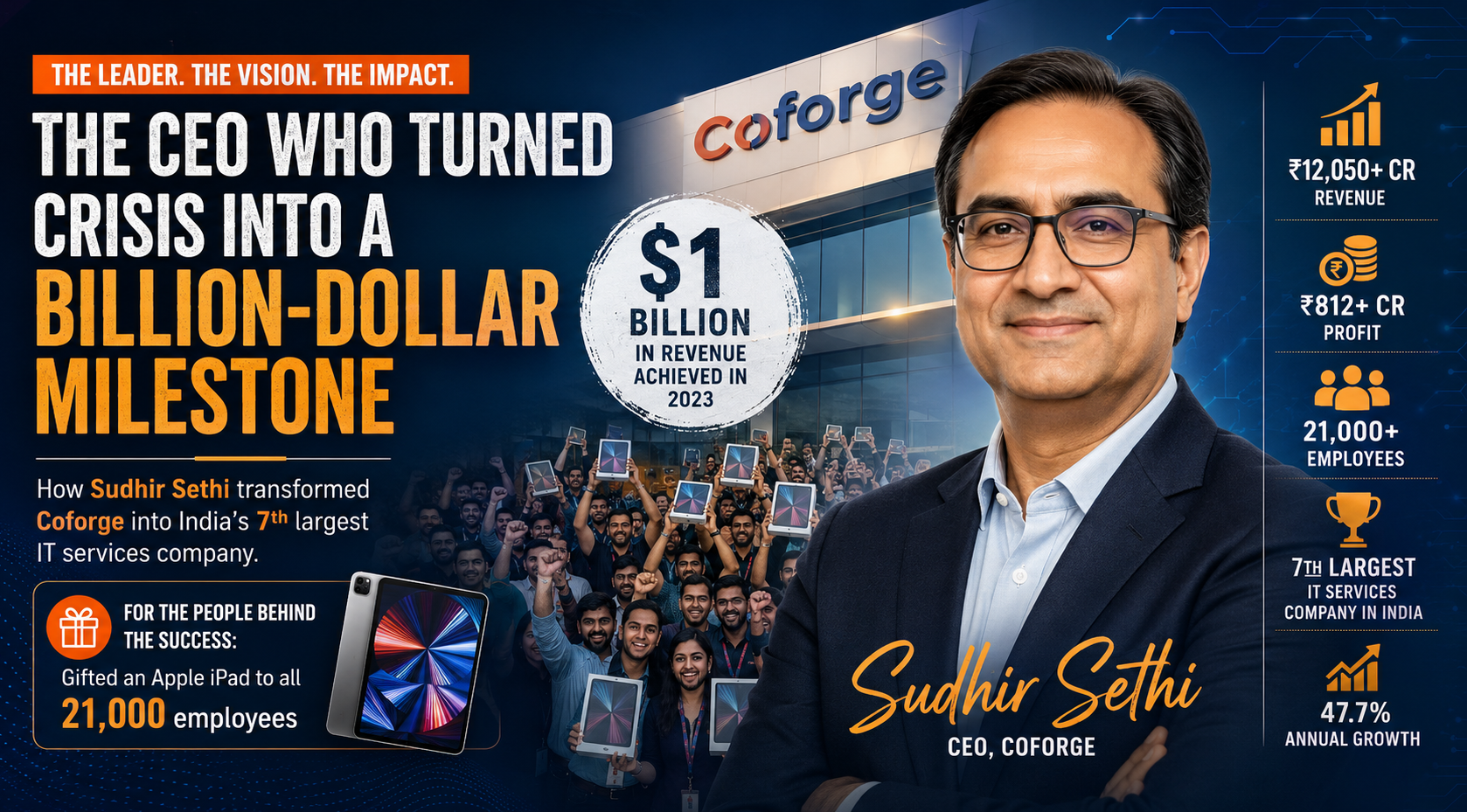
Discover the inspiring journey of Sudhir Sethi, the IIT-BHU and IIM Calcutta graduate who transformed Coforge into India's seventh-largest IT services company and rewarded 21,000 employees with Apple iPads after crossing $1 billion in revenue.
In the world of corporate leadership, stories of remarkable turnarounds are often accompanied by tales of relentless determination, strategic foresight, and the ability to inspire people through difficult times. Yet, only a handful of leaders manage to combine financial success with genuine appreciation for employees. One such leader is Sudhir Sethi, the man who transformed a struggling mid-sized IT services company into one of India’s fastest-growing technology enterprises and celebrated the achievement by gifting Apple iPads to all 21,000 employees.
The gesture made headlines across the business world. While many organizations reward top executives or select performers when major milestones are achieved, Sudhir Sethi chose to share the success with every employee. The decision reflected a leadership philosophy that had helped shape the extraordinary rise of Coforge, a company that today stands among India’s most respected IT services firms.
Behind this achievement lies a fascinating journey spanning decades, industries, countries, and corporate transformations.
A Childhood of Constant Change
Sudhir Sethi’s story begins in an Indian Army family, where stability was often replaced by mobility. Growing up in military cantonments across India meant frequent relocations every few years. For many children, changing schools repeatedly can be disruptive and challenging.
However, these experiences helped build resilience and adaptability in young Sudhir. Moving from one city to another exposed him to different cultures, languages, and environments, teaching him valuable life skills that would later become crucial in his professional career.
Despite the challenges of a constantly changing lifestyle, he remained focused on academics. His dedication eventually earned him admission to the prestigious Indian Institute of Technology, Banaras Hindu University (IIT-BHU), where he pursued engineering. Determined to strengthen his management capabilities, he later secured admission to the Indian Institute of Management Calcutta (IIM Calcutta), one of India’s most respected business schools.
The combination of technical expertise and business education would later prove instrumental in helping him navigate the complexities of the global technology industry.
Humble Beginnings at Hindustan Unilever
Like many successful corporate leaders, Sudhir Sethi’s career did not begin in corner offices or boardrooms.
After completing his MBA, he joined Hindustan Unilever Limited (HUL) as a management trainee. The role demanded ground-level exposure rather than executive privileges. He spent considerable time selling products in rural markets, understanding consumer behavior, and learning the realities of India’s vast and diverse economy.
At the time, he reportedly earned just ₹70 per day.
The experience was far from glamorous, but it offered valuable lessons in sales, customer engagement, distribution management, and market dynamics. Working in rural India taught him how businesses create value at the grassroots level and how understanding customers remains central to sustainable growth.
For six and a half years, he built his professional foundation at HUL. Yet, the rapidly evolving global economy was presenting new opportunities.
Riding the IT Wave
The late 1990s and early 2000s marked the rise of India’s IT revolution. Companies were expanding globally, outsourcing was becoming mainstream, and technology services were emerging as one of the country’s strongest growth engines.
Recognizing the potential of the sector, Sudhir Sethi made a bold career shift.
He moved to the United States and joined Infosys as a Business Development Manager. The decision represented a major transition—from consumer goods to technology services and from domestic operations to global markets.
At Infosys, he gained deep exposure to international clients, large-scale technology projects, and the rapidly changing landscape of digital transformation. Over nine years, he developed expertise in managing client relationships, expanding business operations, and understanding the demands of global enterprises.
The experience significantly broadened his perspective and prepared him for leadership roles of much greater responsibility.
A Leadership Role at Genpact
After nearly a decade at Infosys, Sudhir returned to India to join Genpact as the Chief Operating Officer of its Capital Markets business.
The role placed him at the center of strategic decision-making. He oversaw operations, growth initiatives, and acquisitions while interacting with clients across financial services and capital markets.
During this period, he observed how businesses could unlock value through focused transformation strategies. He also recognized that many organizations possessed strong capabilities but lacked strategic direction.
This observation would eventually shape one of the most important decisions of his career.
Taking Charge of a Struggling IT Firm
Founded in 1992, NIIT Technologies had established itself as a respected player in the IT services industry. However, compared to larger competitors, it remained a relatively small mid-tier company.
The company faced multiple challenges. Growth hovered around 5 percent annually, and profit margins were limited to approximately 12 percent. Although it possessed strong technical capabilities, it struggled to differentiate itself in an increasingly competitive market.
After spending nearly seven years at Genpact, Sudhir Sethi decided to take on what many considered a difficult challenge.
He joined NIIT Technologies as Chief Executive Officer.
The timing was far from ideal.
The technology industry was becoming more competitive, clients were demanding greater specialization, and larger firms dominated the market. Yet Sethi believed the company had untapped potential.
Navigating a Perfect Storm
If turning around a mid-sized IT company was difficult, the events that followed made the challenge even greater.
In 2019, global investment firm Baring Private Equity Asia acquired a controlling 56 percent stake in NIIT Technologies.
Major organizational changes followed. Several senior leaders exited the company, creating uncertainty across the organization.
Then came the COVID-19 pandemic.
The crisis severely impacted industries worldwide, but NIIT Technologies faced a particularly difficult situation because nearly 30 percent of its business was linked to airports and airlines—sectors that experienced unprecedented disruption.
Revenue pressures intensified, clients delayed projects, and the future appeared uncertain.
For many companies, such a combination of events could have resulted in stagnation or decline.
Instead, it became the catalyst for transformation.
The Birth of Coforge
Sudhir Sethi understood that surviving in a crowded technology marketplace required more than incremental improvements.
He introduced a strategy known as “Transform at the Intersect.”
The concept focused on combining deep industry expertise with advanced technology capabilities. Rather than attempting to compete broadly across every sector, the company concentrated on areas where it already possessed significant strengths, particularly financial services and insurance.
At the same time, it invested heavily in emerging technologies such as artificial intelligence, cloud computing, automation, analytics, and digital transformation solutions.
The strategy helped position the company as a specialist rather than a generalist.
In August 2020, NIIT Technologies was rebranded as Coforge.
The new identity represented more than a name change. It signaled a renewed vision focused on innovation, agility, and industry specialization.
Building a Specialist Organization
One of Sethi’s most distinctive decisions involved talent strategy.
Instead of relying solely on broad-based delivery models, Coforge emphasized hiring specialists with deep expertise across multiple operational layers.
These professionals understood client challenges in detail and could recommend solutions without requiring extensive external guidance.
The approach increased customer confidence and strengthened long-term client relationships.
At the same time, the company rapidly adapted to remote operations during the pandemic. While many organizations struggled with distributed workforces, Coforge maintained service quality and operational continuity.
The results began to show quickly.
Within just three years, revenue surged to approximately ₹4,000 crore, supported by annual growth rates that significantly outpaced many industry peers.
Winning Global Clients
As Coforge’s reputation grew, it attracted some of the world’s most respected organizations.
The company expanded relationships with major enterprises including British Airways, ING Group, and Sabre.
Large contract wins became increasingly common. Deals valued between ₹200 crore and ₹400 crore demonstrated the market’s growing confidence in the company’s capabilities.
The organization also diversified beyond its traditional sectors.
New opportunities emerged in healthcare, retail, public sector services, travel, insurance, and digital transformation programs. This diversification reduced dependence on individual industries while creating multiple growth engines.
The combination of specialization and diversification proved highly effective.
Crossing the Billion-Dollar Mark
One of the defining moments in Coforge’s history arrived in 2023.
The company crossed the $1 billion revenue milestone, equivalent to approximately ₹8,014 crore.
For any technology company, reaching this threshold represents a significant achievement. For Coforge, it symbolized the successful completion of a transformation journey that had begun during one of the most challenging periods in modern business history.
The milestone validated years of strategic decisions, organizational restructuring, technological investments, and cultural evolution.
However, what happened next attracted even greater attention.
A Gift for Every Employee
To celebrate the achievement, Sudhir Sethi announced that every Coforge employee would receive an Apple iPad.
The initiative covered approximately 21,000 employees across the organization.
Corporate rewards often focus on executives or top-performing teams. Sethi chose a different path.
His decision reflected a belief that the company’s success belonged to everyone—from engineers and consultants to support staff and operational teams.
The gesture resonated strongly across the workforce and became an example of employee-centric leadership.
In an era where retention, engagement, and workplace culture have become critical competitive advantages, the move reinforced Coforge’s reputation as an organization that values its people.
The Numbers Behind the Success
Today, Coforge stands as one of India’s most successful IT services companies.
The company reports revenue exceeding ₹12,050 crore and profits of approximately ₹812 crore. Its rapid expansion has resulted in a market valuation of around ₹55,476 crore.
Growth rates approaching 47.7 percent have positioned the company among the fastest-growing firms in the sector.
These achievements have helped Coforge become the seventh-largest Indian IT services company, competing alongside much larger and more established industry players.
The transformation demonstrates how focused strategy, technological innovation, and disciplined execution can reshape an organization’s trajectory.
Leadership Lessons from Sudhir Sethi
Sudhir Sethi’s journey offers several important lessons for aspiring leaders and entrepreneurs.
First, adaptability matters. Growing up in an Army family and navigating multiple career transitions taught him to embrace change rather than fear it.
Second, strong foundations create long-term advantages. His experiences in rural sales, global business development, and operational leadership contributed to a well-rounded understanding of business.
Third, specialization can outperform scale. By focusing on areas where Coforge possessed deep expertise, the company differentiated itself in a crowded marketplace.
Fourth, crises can create opportunities. Rather than retreating during the pandemic, Coforge accelerated transformation and emerged stronger.
Finally, people remain central to success. The decision to reward every employee after reaching a major milestone reflects a leadership philosophy that values collective achievement over individual recognition.
A Story Still Being Written
The transformation of Coforge from a struggling mid-tier IT services company into a billion-dollar enterprise is one of India’s most compelling corporate turnaround stories.
At the center of that journey stands Sudhir Sethi-a leader who combined strategic vision with operational discipline and employee-centric values.
From earning ₹70 a day in rural sales to leading one of India’s fastest-growing technology firms, his career illustrates how perseverance, adaptability, and thoughtful leadership can create extraordinary outcomes.
The Apple iPads may have captured headlines, but they represent something larger: a culture where success is shared.
As India’s technology sector continues to evolve, the story of Sudhir Sethi and Coforge serves as a reminder that sustainable growth is not merely about revenue, profits, or valuations. It is about building organizations where people, purpose, and performance move forward together.
And in a business world often defined by numbers, that may be the most valuable achievement of all.
AI Conversationalist, Global Marketer, TEDx Speaker, Member-Board Of Studies-CDSW, AI Governance, Mentor Onboarded CCMB-Atal Incubation Center, Entrepreneurship Coach