

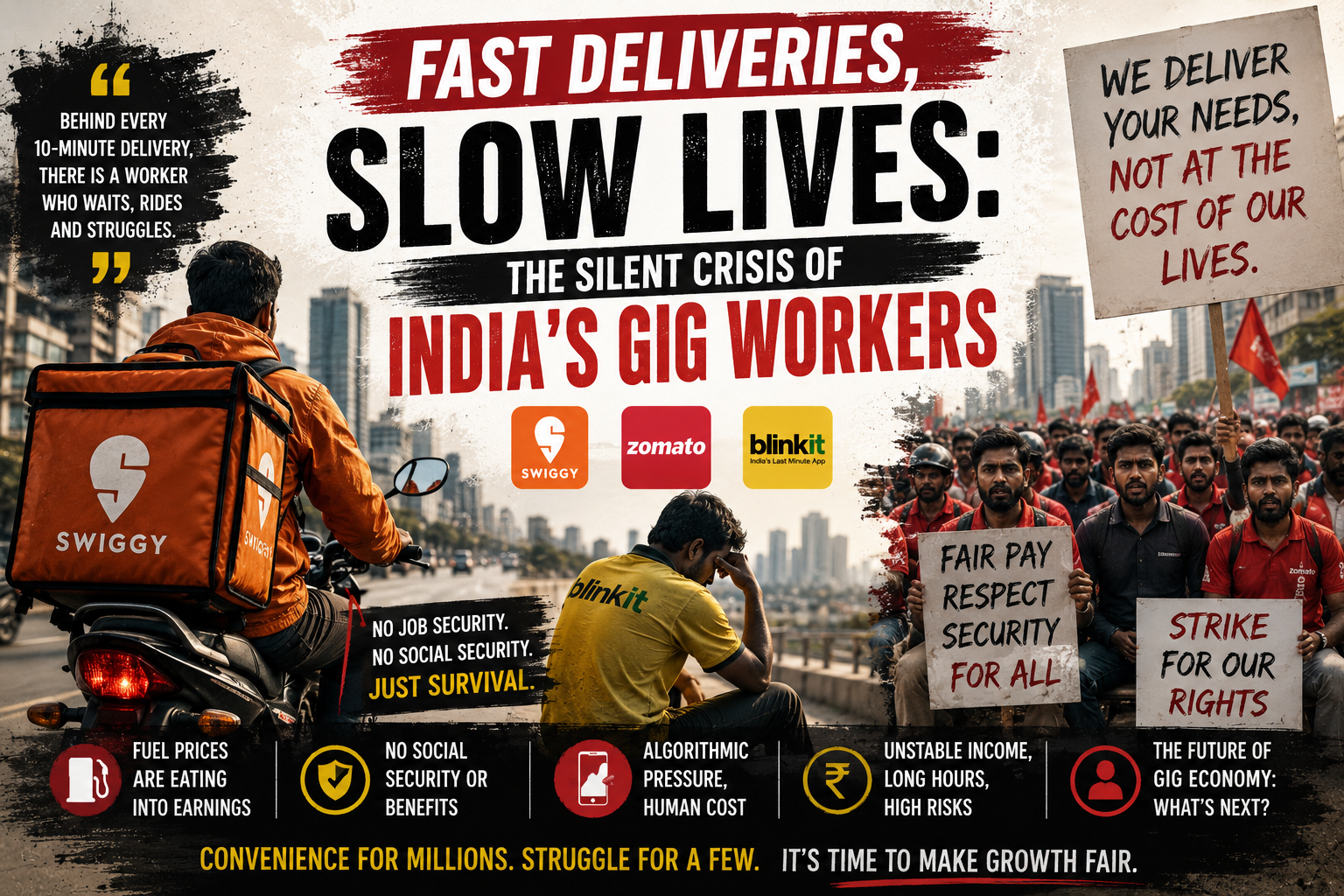
India’s gig economy has transformed urban life. Food arrives within minutes, groceries are delivered around the clock, and instant convenience has become a defining feature of modern cities.
Behind this speed, however, millions of gig workers are facing mounting pressure, financial instability, and growing uncertainty about their future.
Recent delivery partner protests involving workers associated with platforms like Swiggy, Zomato, and Blinkit have once again highlighted the deep structural challenges within India’s rapidly expanding gig economy.
For many workers, the promise of flexible employment is increasingly being replaced by exhaustion, rising expenses, and algorithm-driven stress.
The Rise of India’s Gig Economy
Over the past decade, app-based work has become one of the fastest-growing employment sectors in India.
Millions now work as:
- Food delivery partners
- Ride-hailing drivers
- Grocery delivery workers
- Warehouse associates
- Freelance service providers
The model expanded rapidly due to:
- Smartphone penetration
- Digital payments
- Urban convenience culture
- Rising unemployment
- Flexible work opportunities
For companies, gig work reduced operational costs. For consumers, it created unprecedented convenience.
But for workers themselves, the system is becoming increasingly difficult to sustain.
Fuel Prices Are Crushing Earnings
One of the biggest concerns among delivery workers is the rising cost of fuel.
Petrol prices, vehicle maintenance, insurance costs, and daily operational expenses continue to increase, while worker payouts in many cases have either stagnated or declined.
Workers argue that:
- Incentive structures are becoming harder to achieve
- Base payouts per order are too low
- Longer delivery distances reduce profitability
- Waiting time often goes unpaid
Many delivery workers say they are working longer hours simply to maintain previous income levels.
For two-wheeler-based workers, fuel costs alone now consume a significant portion of daily earnings.
Algorithmic Pressure Is Reshaping Work
One of the least visible but most powerful forces affecting gig workers is algorithmic management.
Unlike traditional jobs with human supervisors, gig workers are largely controlled by app-based systems that track:
- Delivery speed
- Acceptance rates
- Customer ratings
- Online hours
- Performance scores
Workers often describe feeling trapped by constantly changing incentive rules and unpredictable order allocation systems.
Many claim that refusing orders or taking breaks can negatively affect future earnings through reduced visibility within platform algorithms.
This has created an environment where workers feel pressured to:
- Stay online for extended periods
- Accept difficult or distant orders
- Prioritize speed over safety
- Work during extreme weather conditions
The demand for “10-minute delivery culture” has intensified this pressure further.
No Social Security, Limited Protection
Despite powering billion-dollar platforms, most gig workers still lack traditional employee protections.
In many cases, workers do not receive:
- Health insurance
- Paid leave
- Retirement benefits
- Job security
- Accident compensation
- Stable monthly income
Since many companies classify workers as “independent partners” rather than employees, labor protections often remain limited.
This legal gray area has become one of the biggest debates surrounding the future of platform-based work in India.
During emergencies, accidents, or health crises, workers are frequently left financially vulnerable.
The Human Cost Behind Convenience
The pressure of long working hours and unstable earnings is also creating emotional and psychological strain.
Workers report:
- Physical exhaustion
- Sleep deprivation
- Anxiety over ratings
- Income uncertainty
- Unsafe working conditions
- Social isolation
Extreme heatwaves, heavy rains, traffic congestion, and road accidents add further risk to daily operations.
Many gig workers say the public sees only fast deliveries — not the difficult realities behind them.
Consumer Expectations Are Fueling the Crisis
Modern urban consumers increasingly expect:
- Instant delivery
- Low delivery fees
- 24/7 availability
- Faster service
The competition between platforms to offer quicker deliveries has intensified pressure across the system.
Experts warn that ultra-fast delivery culture may not be economically or socially sustainable in the long run if worker welfare continues to remain secondary.
The race for convenience is now raising ethical questions about labor exploitation in the digital economy.
The Future of India’s Gig Economy
India’s gig workforce is expected to grow significantly over the next decade.
Experts believe the sector will continue expanding because of:
- Urbanization
- Digital commerce
- AI-powered logistics
- Consumer demand
- Flexible workforce models
However, the future of the industry may depend on whether governments and companies address growing concerns around:
- Fair wages
- Social protection
- Fuel compensation
- Worker rights
- Algorithm transparency
- Safety standards
Several countries worldwide are already debating stronger labor protections for app-based workers.
India may eventually face similar pressure to formally redefine gig work within labor laws.
Perispective
India’s gig economy reflects the contradictions of modern digital capitalism.
Consumers enjoy unprecedented convenience, startups achieve massive valuations, and platforms expand rapidly – yet the workers powering this system often remain financially insecure and socially unprotected.
The real challenge is not whether gig platforms should exist, but whether growth can continue without exhausting the workforce behind it.
Because the future of work cannot be built entirely on speed, ratings, and algorithms while ignoring human sustainability.
Fast deliveries may define modern cities – but slow lives, unstable incomes, and invisible struggles are becoming the hidden cost of convenience.
About The Author