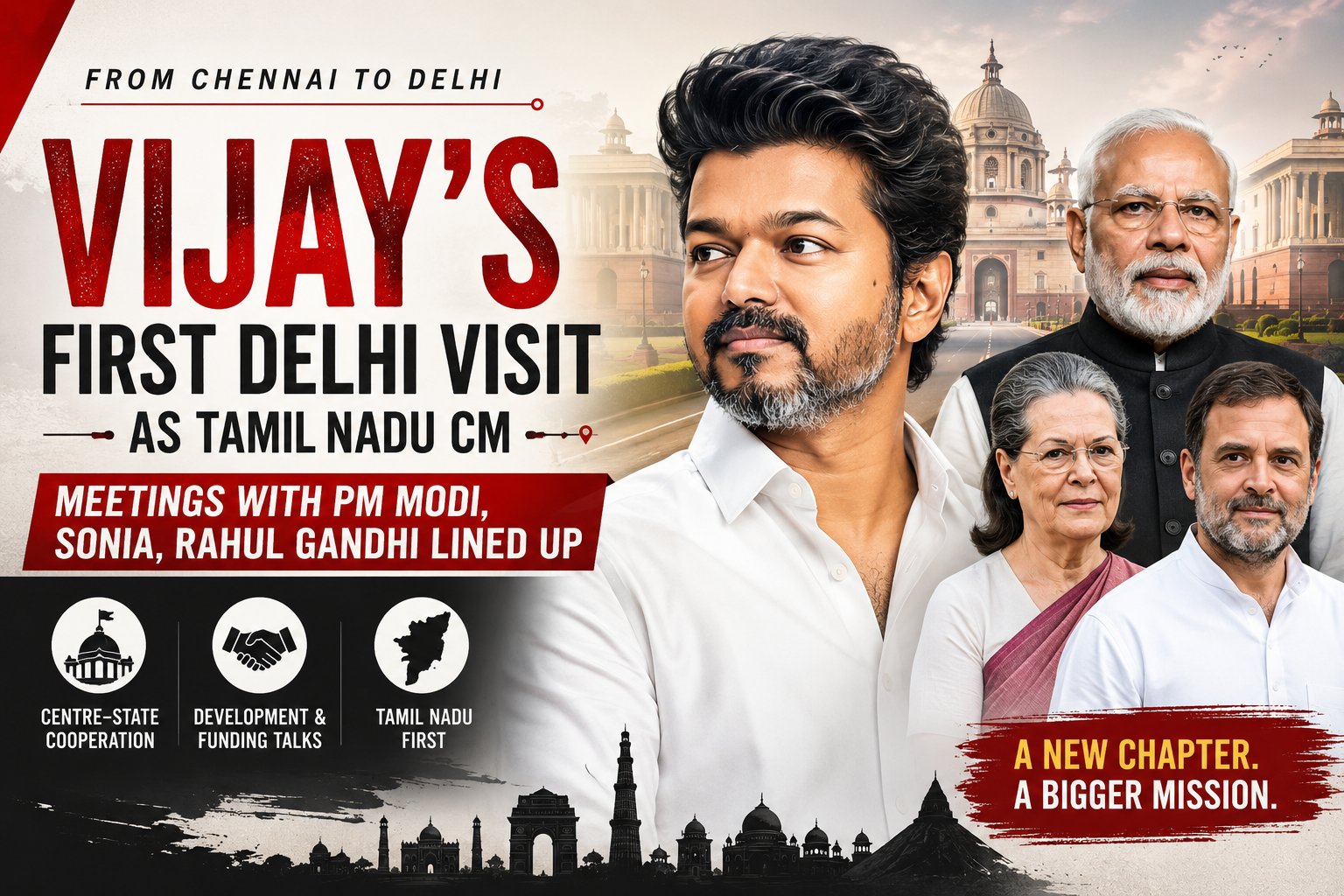
New Delhi/Chennai – In what could become one of the most closely watched political developments of the year, Tamil Nadu Chief Minister C. Joseph Vijay is arriving in New Delhi today for his first official visit to the national capital after assuming office. More than a ceremonial appearance, the trip carries the weight of governance, political messaging, Centre–State relations and the future direction of one of India’s most influential states.
The visit has generated nationwide attention because of the rare political balance it represents. On one side is a scheduled engagement with Prime Minister Narendra Modi and senior Union ministers. On the other are expected meetings with Congress leaders Sonia Gandhi and Rahul Gandhi – a combination that political observers believe reflects Vijay’s early attempt to position himself as a regional leader willing to engage across ideological lines.
This visit comes just weeks after Vijay’s dramatic rise to the Chief Minister’s office, an outcome that disrupted decades of traditional political dominance in Tamil Nadu and marked one of the most significant political transitions in recent state history.
More Than a Courtesy Call – A Governance Test
Officially, the Delhi visit is being presented as an administrative and development-focused engagement. But politically, every meeting on the schedule carries symbolism.
According to reports, Vijay is expected to place before the Union Government a memorandum outlining Tamil Nadu’s financial priorities, pending allocations, compensation demands and requests linked to infrastructure development and state welfare programmes.
Among the issues likely to be raised are:
- Release of pending central funds
- Financial support for development programmes
- Approval for infrastructure and investment projects
- Coordination on welfare delivery
- State-specific policy concerns highlighted during the election campaign
For a newly elected Chief Minister, the first Delhi visit often becomes an early indicator of governing style. Will the leadership adopt confrontation, cooperation or calibrated negotiation?
Vijay appears to be choosing engagement.
Meeting PM Modi: Centre–State Equations Under Spotlight
The meeting with Prime Minister Narendra Modi will naturally attract the highest attention.
During Vijay’s oath-taking earlier this month, PM Modi publicly congratulated the new Chief Minister and reiterated that the Centre would continue working with the Tamil Nadu government for public welfare.
Now, both leaders are expected to move from political goodwill to administrative realities.
Tamil Nadu remains one of India’s most economically significant states and has historically maintained an assertive position on fiscal federalism, industrial policy and state autonomy. Political analysts suggest that the outcome of these discussions could influence future cooperation on infrastructure, investment and public spending.
For Vijay, this meeting also presents an opportunity to demonstrate that his transition from public figure to administrator is backed by policy seriousness.
Why the Congress Meetings Matter
Equally significant are the expected meetings with Sonia Gandhi and Rahul Gandhi.
At first glance, the meetings may appear routine political outreach. Yet the timing gives them larger meaning.
Rahul Gandhi had earlier congratulated Vijay’s rise to power and described it as a sign of generational political change.
Vijay’s decision to include Congress leadership in his Delhi engagement suggests that his administration wants to maintain open political channels across the national spectrum while prioritising governance outcomes.
Observers say this may also reflect a broader political reality: regional leaders today increasingly need simultaneous engagement with the Centre and opposition leadership to protect state interests and maintain strategic flexibility.
Whether these discussions remain symbolic or evolve into deeper political coordination will become clearer over time.
A Carefully Designed National Introduction
For decades, Delhi visits by newly elected Chief Ministers have been treated as institutional formalities.
But this one feels different.
Vijay enters Delhi not simply as another state leader but as a political newcomer who converted celebrity influence into executive office at remarkable speed.
His rise has already triggered discussions nationally about changing voter behaviour, generational politics and the increasing influence of personality-driven political movements.
That makes every image, handshake and statement from this trip politically valuable.
Political communication experts note that first impressions in Delhi often define narratives for years.
If the meetings project administrative confidence and cooperative federalism, Vijay strengthens his image as a governance-focused leader.
If tensions emerge, the narrative could quickly shift toward confrontation.
Beyond Politics: Tamil Identity and Symbolism
The visit is also expected to include a cultural dimension.
Reports indicate that Vijay may inaugurate a statue of Tamil poet-saint Thiruvalluvar at Jawaharlal Nehru University, an event carrying symbolic significance beyond politics.
Such gestures often serve multiple purposes:
- Celebrating regional identity
- Expanding cultural visibility nationally
- Reinforcing emotional connection with supporters
For Tamil Nadu politics especially, cultural symbolism has long remained inseparable from political communication.
Expectations Back Home
While national media tracks political optics, expectations inside Tamil Nadu remain practical.
Voters who backed Vijay’s transition into governance will be watching for outcomes rather than headlines.
Questions being asked include:
- Will more funds reach the state?
- Will infrastructure approvals accelerate?
- Will investment commitments increase?
- Can the administration maintain autonomy while building productive ties with Delhi?
Those answers may not emerge immediately.
But the process begins now.
A Defining Moment for a New Government
Every new government eventually faces a moment where campaign energy gives way to administrative reality.
For Vijay, today may be that moment.
His first Delhi visit is not merely about meetings. It is about establishing credibility, defining working relationships and showing how a new political leadership intends to operate inside India’s federal system.
The symbolism of meeting PM Modi and Congress leadership on the same visit sends a clear signal: governance may require conversation across political lines.
Whether that translates into tangible outcomes for Tamil Nadu will determine how this visit is remembered.
For now, all eyes remain on Delhi.
As Vijay walks into the national capital for the first time as Chief Minister, the message is unmistakable -electoral victory opens the door, but governance decides the legacy.
About The Author