Adapt or Become Obsolete: Why Human Institutions Face Their Biggest Test in the Age of AI
Artificial Intelligence is transforming healthcare, law, education and governance faster than institutions can adapt. Explore why institutional redesign, policy evolution and AI-ready systems are becoming essential for the future.
The world has experienced transformative moments before.
Industrial revolutions changed labor. The internet changed communication. Smartphones changed human behavior.
But Artificial Intelligence may become something fundamentally different.
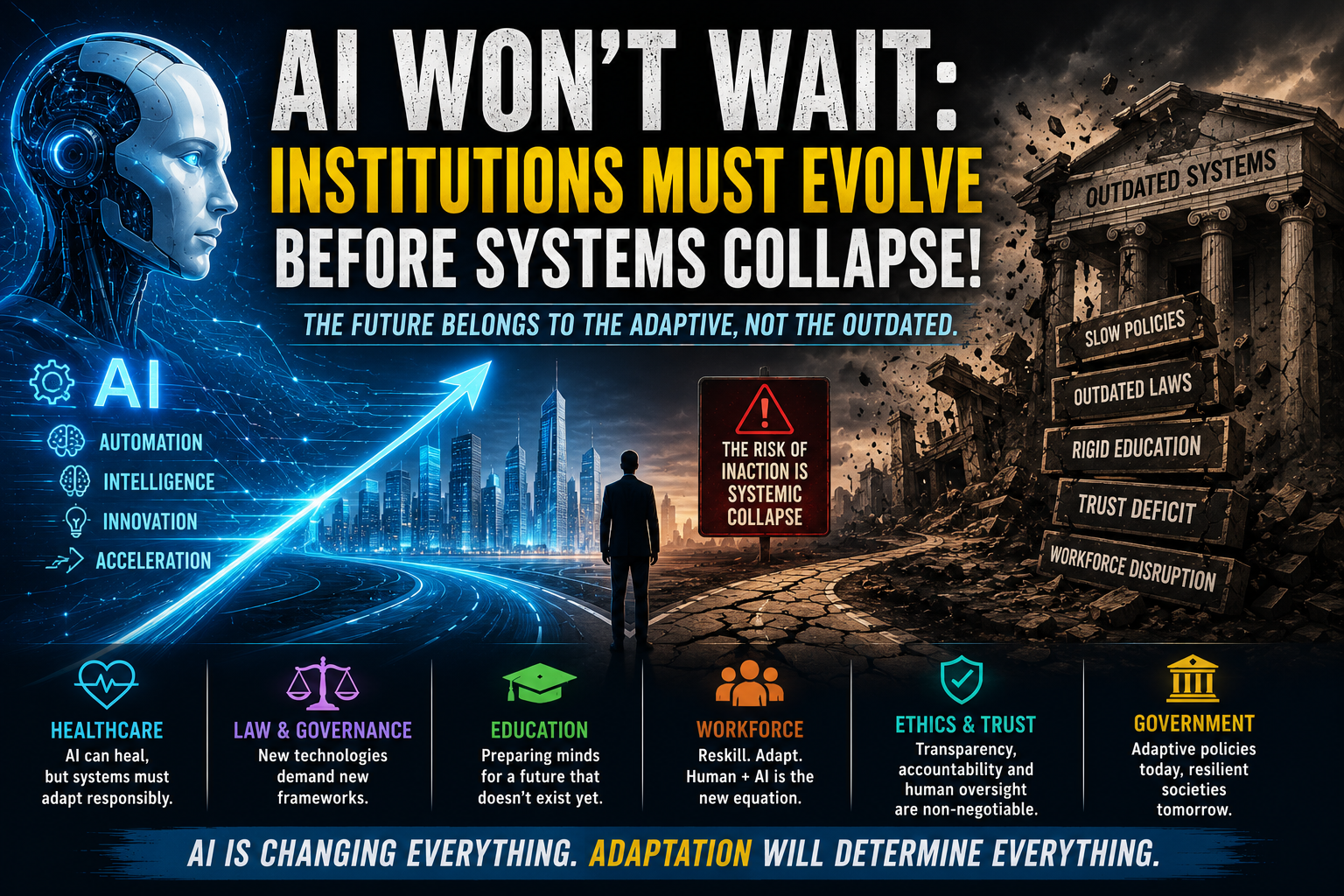
Unlike earlier technological waves that unfolded across decades, AI is evolving at a pace that compresses change into months, sometimes weeks. Entire workflows are being redesigned, decision-making is being automated and industries are being reimagined faster than many governments, schools, courts and institutions can react.
That growing gap is creating a new challenge—not technological capability, but institutional readiness.
The question is no longer whether Artificial Intelligence will reshape society.
It already is.
The question now is whether the institutions governing society can evolve quickly enough to remain functional, trusted and relevant.
Institutions Were Built for Stability-AI Is Built for Acceleration
Modern institutions were designed in a different era.
Healthcare systems evolved around physical infrastructure and human expertise.
Education systems were built for standardized learning and predictable career pathways.
Legal systems developed around precedent and deliberate review.
Government structures matured through gradual policy cycles.
These models worked reasonably well because social and technological change moved at a pace institutions could absorb.
Artificial Intelligence disrupts that assumption.
AI does not wait for legislation.
It does not pause for curriculum reform.
It does not slow down for administrative approval.
Its capabilities improve continuously through computation, data, feedback and adoption.
That creates an unprecedented mismatch between how institutions function and how technology evolves.
Healthcare: When Algorithms Move Faster Than Regulation
Healthcare may become one of the clearest examples of this transformation.
AI systems are increasingly being deployed across diagnostics, imaging, workflow optimization, predictive analysis and personalized care.
Intelligent tools can process enormous datasets faster than human teams and identify patterns that may improve outcomes.
Yet institutional frameworks remain cautious—and often slow.
Questions continue to emerge:
Who is accountable when AI-assisted decisions go wrong?
How should patient consent evolve?
What standards define clinical reliability?
How should regulators evaluate continuously learning systems?
Healthcare institutions now face a balancing act between innovation and trust.
Moving too slowly may delay life-saving improvements.
Moving too quickly may create risks that undermine confidence.
The challenge is no longer technical capability.
It is governance capability.
Education Is Preparing Students for Jobs That May Not Exist
Education systems are entering a period of unusual pressure.
For generations, schools and universities were designed to prepare learners for relatively stable career structures.
Today, that assumption is weakening.
Artificial Intelligence is changing how people work, create, communicate and learn.
Knowledge itself is becoming more accessible and increasingly automated.
Traditional education systems now face difficult questions:
What skills remain uniquely human?
Should memorization remain central?
How should institutions teach adaptability?
How should students learn to collaborate with intelligent systems?
The future may reward capabilities such as:
Critical thinking
Problem framing
Emotional intelligence
Systems understanding
Ethical reasoning
Creativity
Cross-disciplinary learning
Educational transformation is no longer optional.
Institutions that move too slowly may produce graduates equipped for yesterday’s economy.
Law and Governance Are Entering Unknown Territory
Legal systems traditionally move carefully.
That caution protects rights and prevents instability.
But AI introduces scenarios that existing frameworks were never designed to address.
Questions emerging globally include:
Who owns AI-generated content?
How should autonomous decisions be regulated?
What constitutes algorithmic accountability?
How should liability work in intelligent systems?
What protections are required for digital rights?
Governments face a difficult balancing act.
Too much regulation could suppress innovation.
Too little regulation could weaken public trust.
Policy cycles that once took years may increasingly need adaptive structures capable of responding continuously.
This shift may redefine governance itself.
Automation Is Not Eliminating Work-It Is Redesigning It
One of the most misunderstood debates around AI concerns employment.
History shows technology often changes work more than it eliminates it.
But this transition may feel different because of speed.
AI is entering not only repetitive physical work but also cognitive tasks.
Functions once considered protected-writing, analysis, coding, design, administration—are being transformed.
That does not automatically mean mass replacement.
It means job structures are changing.
Workers increasingly face three realities:
Certain tasks become automated
New responsibilities emerge
Continuous learning becomes necessary
The workforce challenge is becoming institutional.
Can governments redesign labor policies?
Can universities adapt quickly?
Can organizations retrain at scale?
The future of employment may depend less on protecting existing roles and more on enabling transition.
Trust Could Become the Most Valuable Resource
Technology adoption ultimately depends on trust.
People trust hospitals.
People trust courts.
People trust schools.
People trust public institutions.
If AI becomes more capable while institutions remain less prepared, trust gaps may emerge.
Examples include:
Unclear AI decisions
Data privacy concerns
Lack of transparency
Inconsistent regulation
Perceived unfairness
When institutions fail to explain how systems work, public confidence weakens.
That makes institutional legitimacy a strategic advantage.
Organizations that combine AI capability with human accountability may become the most resilient.
The Governance Model of the Future May Look Different
The institutions that thrive in the AI era may not necessarily be the largest.
They may be the most adaptive.
Future-ready institutions could increasingly operate with:
Continuous Policy Updates
Rules that evolve dynamically rather than through decade-long cycles.
Human + AI Decision Models
Intelligent assistance combined with accountable human oversight.
Distributed Expertise
Cross-disciplinary teams replacing isolated departments.
Experimental Culture
Testing and iteration becoming standard operating models.
Ethical Infrastructure
Embedding transparency and accountability into design.
This is less about digitization.
It is about institutional redesign.
Why Speed Alone Is Not the Answer
There is a temptation to believe adaptation means moving faster.
But speed without direction creates instability.
Institutions must evolve responsibly.
That means asking difficult questions:
What decisions should remain human?
What values should guide automation?
How do societies protect fairness?
How do institutions remain inclusive?
Technology alone cannot answer these questions.
Institutions exist precisely because societies need frameworks larger than technology.
AI may accelerate possibilities.
Human systems still determine outcomes.
Developing Economies May Face Unique Opportunities
Emerging economies could experience AI disruption differently.
Unlike mature systems burdened by legacy structures, developing nations may have opportunities to leapfrog traditional models.
Digital public infrastructure, mobile-first ecosystems and younger populations may accelerate adoption.
But opportunity does not eliminate risk.
Countries that fail to invest in:
Education reform
AI literacy
legal modernization
digital governance
institutional capability
may widen inequality rather than reduce it.
The next decade may reward institutional imagination as much as technological investment.
Corporate Institutions Are Also Being Tested
Businesses often adapt faster than public institutions.
But even organizations now face structural pressure.
Executives are confronting difficult questions:
How much should AI influence decisions?
How should governance evolve?
How do companies preserve culture?
What does leadership look like when intelligence becomes distributed?
The strongest organizations may not be those with the most AI tools.
They may be those that redesign processes, incentives and leadership models around continuous adaptation.
The Coming Decade Will Reward Evolution
For centuries, institutional strength was measured by stability.
That definition is changing.
The strongest institutions of the future may not be those that resist change.
They may be those capable of evolving while preserving trust.
Artificial Intelligence is forcing societies to rethink assumptions that once felt permanent.
Work.
Education.
Governance.
Authority.
Expertise.
None of these concepts disappear.
But all of them may evolve.
And that evolution is already underway.
The Real Competition Is Not Human vs Machine
Public conversations often frame AI as a contest between people and technology.
That misses the deeper reality.
The real challenge is whether institutions designed for gradual change can adapt to exponential change.
Artificial Intelligence will continue advancing.
Algorithms will improve.
Systems will become more capable.
The question is whether governments, schools, courts, companies and cultural frameworks can evolve at comparable speed.
Because resilience in the AI era may not belong to the strongest institutions.
It may belong to the most adaptive.
And history rarely waits for systems that refuse to evolve.
AI Conversationalist, Global Marketer, TEDx Speaker, Member-Board Of Studies-CDSW, AI Governance, Mentor Onboarded CCMB-Atal Incubation Center, Entrepreneurship Coach