From Peon to Mogul: The Extraordinary Success Story of the Man Who Made India Stick Together
Discover the inspiring success journey of Balvant Parekh, the visionary founder behind Fevicol and Pidilite, who rose from humble beginnings to build one of India’s most trusted consumer brands and a multi-thousand-crore business empire.
And a few are measured by something far more powerful-becoming part of everyday language.
In India, people don’t always ask for adhesive.
They ask for Fevicol.
That kind of brand power is rare. But what makes this story extraordinary is that the man behind it did not begin life with inherited wealth, business privilege or corporate backing.
He began with uncertainty.
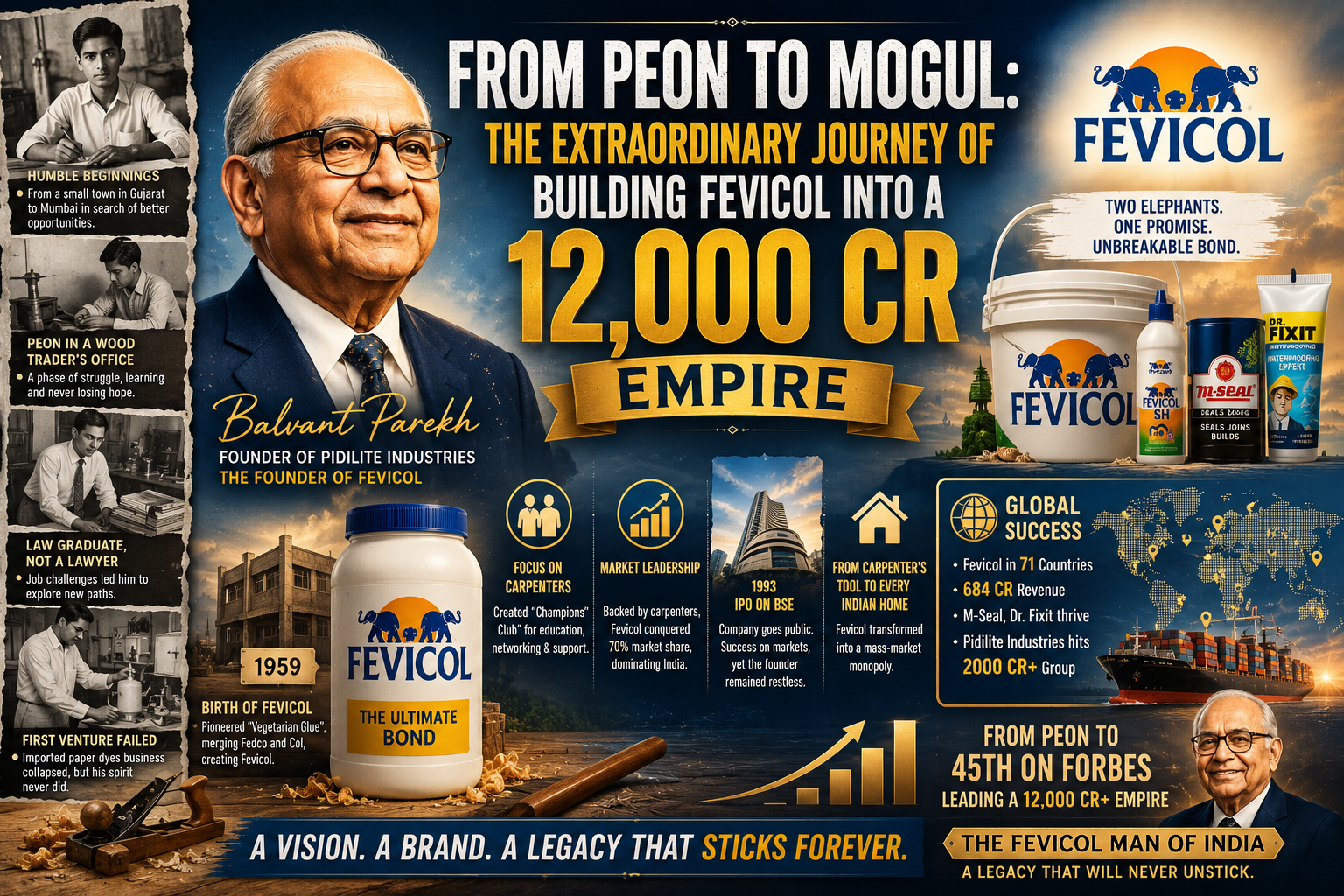
His name was Balvant Parekh-the founder of Pidilite Industries and the visionary who transformed a practical product into one of India’s most iconic business success stories.
Today, Fevicol is recognized across homes, workshops and industries. But behind that familiar white adhesive lies decades of persistence, failures, observation and disciplined execution.
This is not just a story of building a company.
It is the story of building trust.
Humble Beginnings in Gujarat
Long before boardrooms and stock markets entered his life, Balvant Parekh’s world looked very different.
Born in Gujarat, he grew up in modest circumstances where education was viewed as a path toward opportunity.
He later moved to Mumbai and completed his law degree.
For most people, that should have been the beginning of a legal career.
But life had different plans.
Employment opportunities were limited.
Career options became uncertain.
Instead of stepping into a courtroom, Parekh stepped into survival mode.
He took different jobs to support himself-including working in a wood trader’s office in an entry-level role.
There was nothing glamorous about those years.
But those years gave him something far more valuable:
Exposure to real markets.
Real customers.
Real problems.
That experience would later become the foundation of an empire.
When the First Dream Failed
Entrepreneurs are often remembered for the business that succeeded.
Rarely for the ones that failed.
Before Fevicol, Balvant Parekh explored trading opportunities including importing products such as paper dyes and industrial materials.
The business did not work.
The venture struggled.
Eventually it collapsed.
Suddenly, there was uncertainty again.
Income disappeared.
The future became unclear.
For many people, failure creates caution.
For Parekh, failure created insight.
He realized something important:
People rarely pay for products.
They pay for solving inconvenience.
That lesson changed everything.
Starting Again-The Birth of Pidilite
After setbacks in trading, Parekh shifted toward chemicals.
Together with close associates and family support, he began building a small industrial business.
The company was founded with a practical vision:
Create useful products that solve everyday problems.
That business later became Pidilite Industries.
At the beginning, there was no guarantee of success.
No one expected that a small chemicals business would one day become one of India’s strongest consumer brands.
The breakthrough came from observation.
The Opportunity Hidden Inside Every Carpenter’s Toolbox
During those years, carpenters across India relied heavily on traditional adhesives.
The process was inconvenient.
Preparation took time.
Consistency was unreliable.
Most users accepted these limitations because alternatives were limited.
Parekh saw something others ignored.
He didn’t ask:
“How do I sell glue?”
He asked:
“How do I make life easier for the people using it?”
That shift in thinking led to the creation of Fevicol in 1959.
At first glance, it looked like another industrial product.
But it represented something larger.
Convenience.
Reliability.
Trust.
Fevicol’s Secret-Win the Worker First
One of Balvant Parekh’s most brilliant business decisions had nothing to do with manufacturing.
It was understanding influence.
Instead of advertising directly to consumers, Fevicol focused on carpenters.
Because carpenters made the buying decision.
If carpenters trusted the product-
households eventually would.
The company built relationships with professionals.
Supported communities.
Created engagement initiatives.
Developed long-term loyalty.
This wasn’t traditional marketing.
This was ecosystem building before the term became popular.
And it worked.
From Product to Habit
Great products create customers.
Great brands create habits.
Fevicol slowly expanded beyond workshops.
It entered homes.
Furniture stores.
Schools.
Construction sites.
Retail shelves.
Then something remarkable happened.
People stopped asking for glue.
They started asking for Fevicol.
That transition is one of the rarest achievements in business.
The brand became bigger than the category.
Advertising That Became Culture
Fevicol’s advertising became legendary.
Instead of technical demonstrations, the brand focused on storytelling.
Humor.
Memorable visuals.
Simple messages.
Over time, Fevicol advertisements became cultural references.
The positioning was consistent:
Strong bonds.
Reliable results.
Enduring trust.
Few Indian brands achieved this level of emotional association.
Fevicol wasn’t competing only on chemistry.
It was competing on memory.
Building More Than One Business
Many entrepreneurs become dependent on one success.
Balvant Parekh expanded.
Pidilite gradually built a portfolio across categories.
Products evolved into:
Consumer adhesives
Construction chemicals
Waterproofing solutions
Repair products
Industrial applications
Specialty chemicals
Brands like M-Seal and Dr. Fixit strengthened the ecosystem.
This diversification transformed Pidilite from a product company into a platform business.
That shift made long-term growth possible.
The IPO That Didn’t End the Journey
In 1993, Pidilite entered public markets.
For many founders, listing becomes the finish line.
For Parekh, it was another beginning.
The company had scale.
Recognition.
Market trust.
But he wanted more.
He wanted Fevicol to move from professional use to everyday Indian life.
That meant:
Better packaging.
Wider distribution.
Mass accessibility.
Brand expansion.
Growth remained customer-led.
Dominating Without Losing Trust
Over time, Fevicol became one of India’s most dominant adhesive brands.
But market leadership is difficult to maintain.
Success creates competition.
Pidilite responded not through price wars-but through consistency.
Product quality.
Distribution depth.
Brand equity.
Professional loyalty.
Consumer familiarity.
This strategy helped build extraordinary staying power.
That is why decades later, Fevicol still remains one of India’s strongest household brands.
Taking an Indian Brand Global
Success eventually moved beyond India.
Pidilite expanded internationally.
Its products reached global markets.
Operations extended across geographies.
What started in Indian workshops became part of international industrial ecosystems.
This expansion proved something important.
World-class brands do not need to originate in traditional global business capitals.
They can begin anywhere.
Even from modest beginnings.
Leadership That Stayed Grounded
One of the most respected aspects of Balvant Parekh’s journey was his leadership philosophy.
He never projected success as personal genius.
He emphasized teams.
Customers.
Distributors.
Professionals.
Relationships.
Those who worked with him often described him as practical, disciplined and deeply connected to the market.
His leadership style reflected something simple:
Listen before you scale.
Why Balvant Parekh’s Story Still Matters Today
In a world obsessed with overnight success, this journey offers a different lesson.
Success is rarely sudden.
It usually looks like:
Years of uncertainty.
Failed attempts.
Small wins.
Repeated experimentation.
Market learning.
Customer obsession.
Persistence.
Balvant Parekh did not invent a glamorous industry.
He built value where others saw routine.
That may be the most powerful entrepreneurial lesson of all.
The Fevicol Man of India
Balvant Parekh passed away in 2013.
But his legacy never left.
Every time furniture gets repaired.
Every time a carpenter reaches for adhesive.
Every time someone casually says-
“Use Fevicol.”
His story continues.
Not because he built a company.
But because he built belief.
A law graduate who never became a lawyer.
A worker who experienced uncertainty.
An entrepreneur who survived failure.
A visionary who turned a practical product into a trusted institution.
From peon to mogul.
From observation to innovation.
From struggle to scale.
Balvant Parekh didn’t just build Fevicol.
He built one of India’s strongest examples of how resilience, insight and customer trust can create a legacy that sticks across generations.
AI Conversationalist, Global Marketer, TEDx Speaker, Member-Board Of Studies-CDSW, AI Governance, Mentor Onboarded CCMB-Atal Incubation Center, Entrepreneurship Coach