From Scrap Dreams to Global Markets: How Anil Agarwal Built an Indian Metals Empire and Opened the Doors of London
Discover the inspiring success journey of Anil Agarwal—from leaving school and building Sterlite to creating Vedanta and becoming the first Indian entrepreneur to list a company on the London Stock Exchange.
It is built quietly-through difficult decisions, failed experiments, long periods of uncertainty and moments when ambition appears larger than available resources.
Few Indian business stories reflect that reality better than the journey of Anil Agarwal.
Today, he is recognized globally as the founder of Vedanta and one of India’s most influential industrial entrepreneurs.
But decades before global listings and billion-dollar businesses, his journey began with something far simpler:
A young man leaving home with an ambition larger than his circumstances.
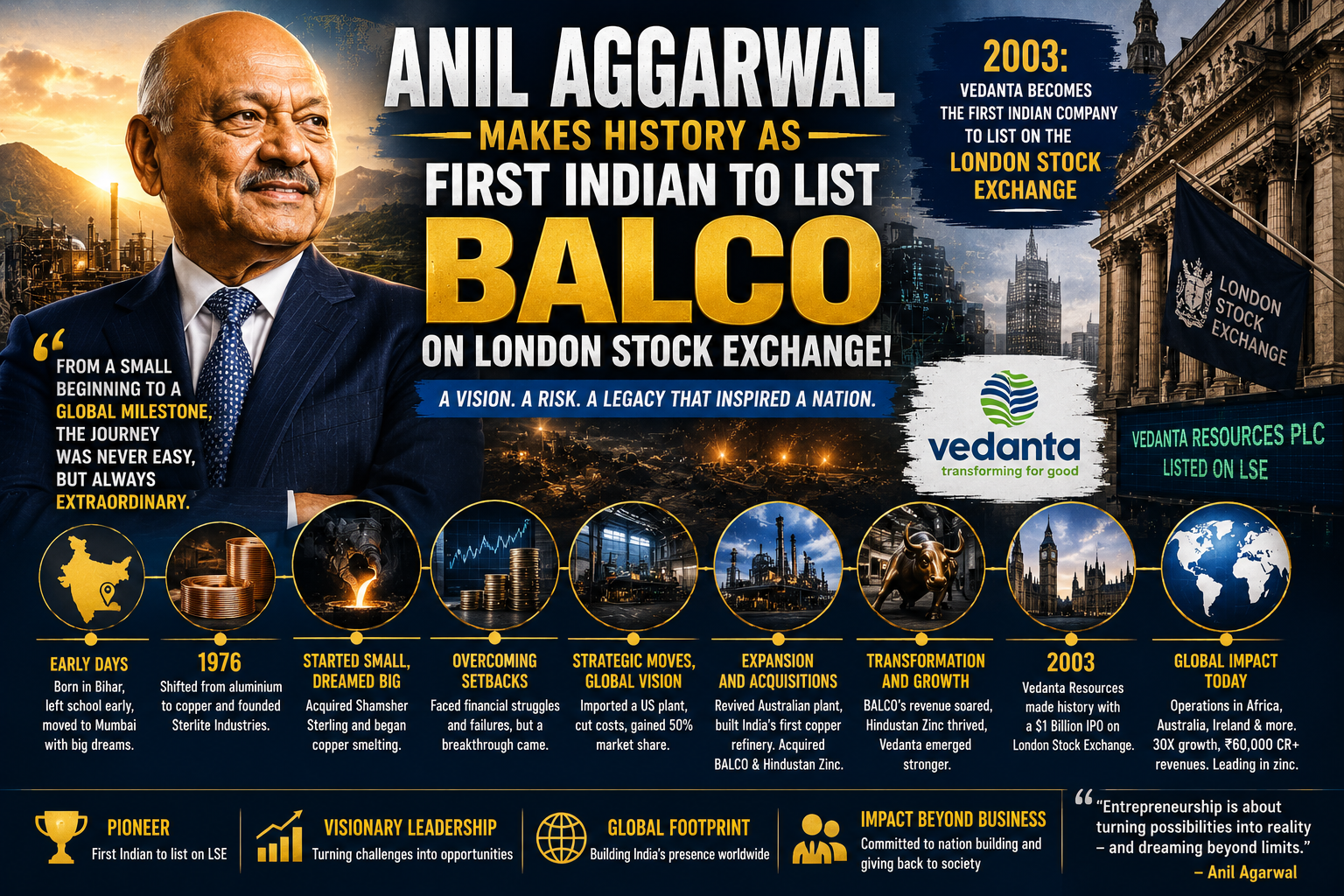
That journey would eventually lead to one of the defining moments in Indian corporate history-becoming the first Indian entrepreneur to list a company on the London Stock Exchange through Vedanta Resources in 2003.
This is the story behind that journey.
A Small Beginning With a Big Appetite for Opportunity
Anil Agarwal was born into a business family in Bihar, but his path was never designed to become conventional.
Unlike the structured corporate journeys that dominate headlines today, his route was shaped by early exposure to trade, commerce and industrial activity.
He eventually moved to Mumbai to pursue entrepreneurial opportunities and entered the business world at a young age.
There was no large institutional backing.
No established industrial platform.
Just an ambition to build.
That ambition would define every chapter that followed.
Finding Opportunity Where Others Saw Commodity
Many founders begin by creating new categories.
Agarwal entered one of the oldest sectors in the world-metals.
He initially worked around aluminum-related trade and later shifted toward copper.
That shift became transformational.
In 1976, he founded Sterlite, laying the foundation of what would eventually evolve into the Vedanta ecosystem.
At the time, India’s industrial economy looked very different.
Capital was scarce.
Manufacturing expansion was difficult.
Global competition was limited.
Building scale required conviction.
Agarwal’s strategy became increasingly clear:
Acquire capability.
Improve efficiency.
Scale aggressively.
Failure Arrived Before Scale
Business success stories often compress decades into a few headlines.
But the early years brought setbacks.
Funding constraints.
Execution challenges.
Unsuccessful experiments.
Periods where growth remained uncertain.
Those struggles forced a change in thinking.
Instead of trying to build everything from scratch, Agarwal increasingly focused on acquisition-led expansion.
That decision later became one of his biggest strengths.
He believed underperforming industrial assets could become value generators if managed differently.
That philosophy would shape the next stage of growth.
The Acquisition Playbook That Changed Everything
One of the defining characteristics of Agarwal’s journey was his willingness to take difficult bets.
Over time, his group expanded through strategic acquisitions.
Industrial assets that others viewed cautiously became opportunities.
The business gradually expanded across metals and mining.
Acquisitions and restructuring became tools for transformation rather than expansion alone.
That playbook later extended into larger industrial opportunities.
Building India’s Copper Story
A major turning point came through copper.
Vedanta expanded aggressively into copper operations and developed large-scale refining capability.
The company emerged as one of India’s most significant players in metals and industrial materials.
This phase reflected something deeper than production growth.
It demonstrated operational philosophy:
Global scale.
Cost competitiveness.
Long-term positioning.
Industrial confidence.
The strategy strengthened the company’s ability to think internationally.
BALCO Changed the Conversation
One of the most talked-about milestones in Agarwal’s journey came in 2001.
His group acquired a controlling stake in Bharat Aluminium Company Limited (BALCO).
The acquisition attracted enormous attention because BALCO had been viewed as a major state-owned industrial asset.
Vedanta acquired 51 percent for approximately ₹551.5 crore.
The move represented more than expansion.
It signaled confidence that Indian industrial assets could become globally competitive.
Over time, BALCO became one of the major pillars of the group’s metals business.
The Hindustan Zinc Bet
Shortly after BALCO, another major move followed.
Vedanta acquired a majority position in Hindustan Zinc Limited.
Again, the market questioned the scale of ambition.
Again, the group moved forward.
These acquisitions helped create a diversified metals platform.
Copper.
Aluminum.
Zinc.
Industrial infrastructure.
What emerged was not a collection of businesses.
It became an integrated industrial strategy.
The Decision That Changed Indian Corporate History
By the early 2000s, Agarwal had another ambition.
He wanted global capital.
But accessing international markets at that scale was difficult.
So he made a bold decision.
Move toward London.
In 2003, Vedanta Resources Plc was incorporated and listed on the London Stock Exchange.
It became the first Indian company to secure a full listing on the LSE-marking a historic milestone for Indian business.
The listing raised over $1 billion and received demand significantly above target.
For Indian entrepreneurs, the message was powerful:
Indian companies could compete for global capital.
Why London Mattered More Than Prestige
Many viewed the London listing as symbolic.
But for Agarwal, it was strategic.
Listing internationally brought:
Access to larger investors
Global credibility
Capital flexibility
International visibility
Acquisition opportunities
Years later, Agarwal reflected publicly on the effort involved-meeting companies, bankers and advisors to make the listing happen.
The move reshaped how Indian business imagined international markets.
Expansion Across Continents
Following the London milestone, Vedanta accelerated global growth.
Operations and investments expanded internationally.
The company strengthened positions across mining and metals.
Over time, the broader business footprint extended across regions including Africa and other global markets.
Growth became increasingly multinational.
The entrepreneur who once pursued opportunity in Mumbai was now building across continents.
Scale Brought New Challenges
Growth stories are rarely linear.
As Vedanta expanded, the company also encountered scrutiny, operational complexity and evolving stakeholder expectations.
Industrial businesses operate in environments shaped by regulation, markets, commodity cycles and public expectations.
Managing scale became as important as creating it.
That challenge continues to shape leadership decisions today.
Recent restructuring initiatives reflect continuing efforts to simplify and unlock value across the business ecosystem.
Reinvention Instead of Resting
Even after building one of India’s largest resources groups, reinvention remained central.
Vedanta announced plans to separate businesses into focused entities to create more operational agility and unlock shareholder value.
The strategy reflects a consistent pattern in Agarwal’s journey:
Build.
Scale.
Restructure.
Build again.
The Philosophy Behind the Empire
Beyond valuations and assets, Agarwal often speaks about entrepreneurship in unusually simple language.
Dream bigger.
Move faster.
Think globally.
Take risks.
That philosophy explains why the journey remains relevant.
This was never only about mining.
It was about possibility.
A belief that Indian businesses did not have to remain regional players.
Success Beyond Wealth
One of the lesser-discussed dimensions of Agarwal’s public narrative has been his emphasis on giving.
He has publicly expressed intentions toward large-scale philanthropic commitments over time.
That perspective reflects an idea increasingly visible among global entrepreneurs:
Success creates responsibility.
Building wealth becomes one chapter.
Creating impact becomes another.
The Legacy of a Door That Opened
Today, there are many Indian companies with international ambitions.
Global listings no longer feel impossible.
Cross-border capital feels accessible.
But in 2003, that path looked very different.
Someone had to attempt it first.
Someone had to prove that an Indian industrial company could stand in global financial markets and compete.
That milestone became part of Anil Agarwal’s legacy.
Not because he built the biggest company.
Not because he avoided failure.
But because he refused to think within traditional limits.
From leaving school early.
To building Sterlite.
To transforming metals.
To acquiring industrial giants.
To listing in London.
His journey remains a reminder that extraordinary business stories rarely begin with perfect conditions.
AI Conversationalist, Global Marketer, TEDx Speaker, Member-Board Of Studies-CDSW, AI Governance, Mentor Onboarded CCMB-Atal Incubation Center, Entrepreneurship Coach