Beyond Bottled Water: How Jayanti Chauhan Reimagined Bisleri into a ₹23,000 Crore Consumer Powerhouse
Discover the inspiring journey of Jayanti Chauhan, the visionary leader who reinvented Bisleri from a bottled water company into a diversified beverage powerhouse valued at ₹23,000 crore through innovation, distribution excellence, and bold strategic decisions.
The Next Chapter of an Indian Icon Was Written by a Young Woman Who Refused to Think Small
For decades, Bisleri was synonymous with bottled water in India.
Whether at railway stations, airports, hotels, roadside eateries, corporate offices, or family road trips, the green-and-white label had become a trusted companion for millions. In many ways, the brand had become larger than its product category itself.
Yet behind that success lay a hidden challenge.
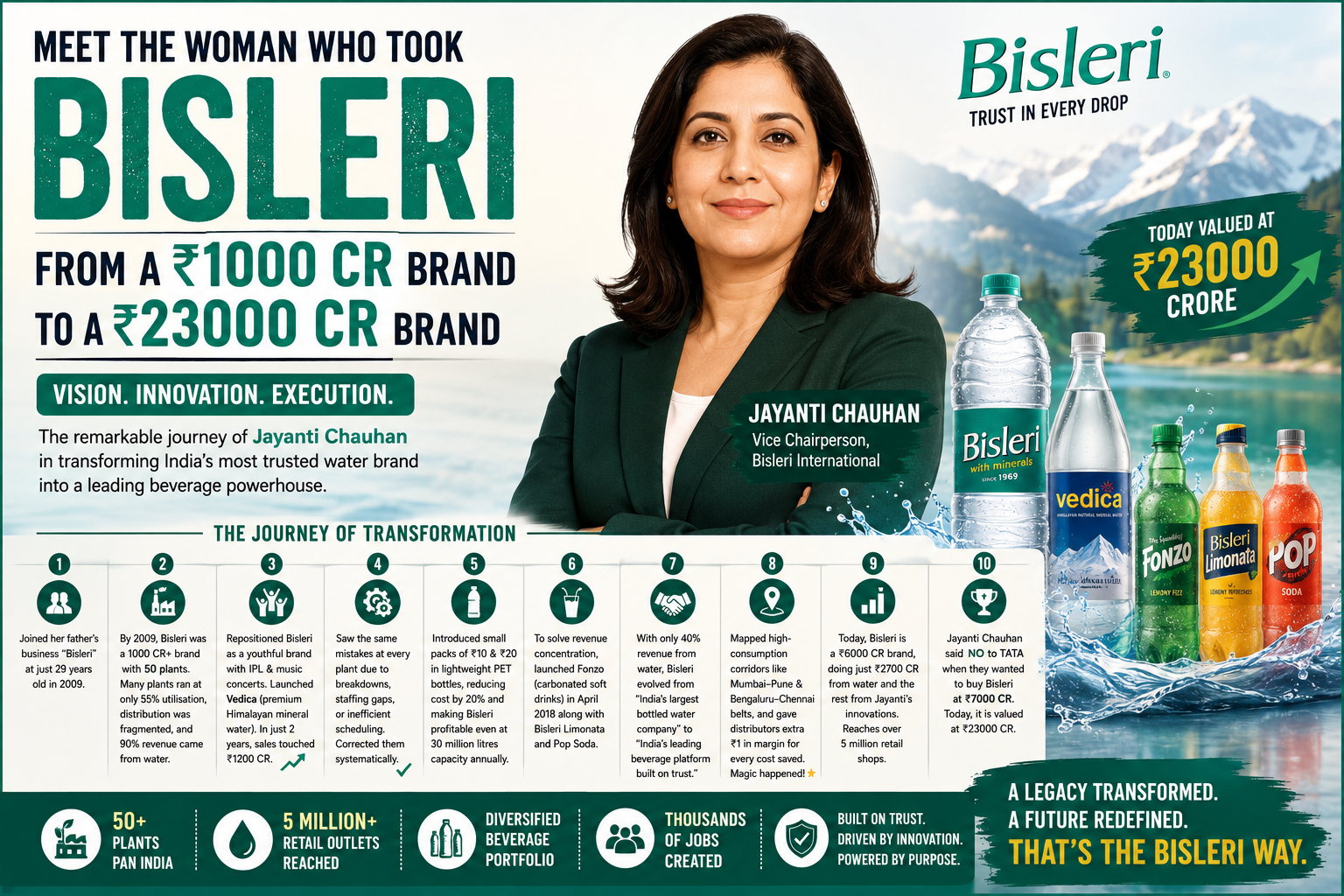
By 2009, Bisleri had already crossed the ₹1,000 crore milestone and operated around 50 manufacturing plants across the country. It was the undisputed leader in packaged drinking water. But beneath the surface, the company faced structural issues that could limit future growth.
Most manufacturing units were running significantly below capacity. Distribution networks were fragmented. Nearly 90 percent of revenue came from a single category—water.
The company was successful, but vulnerable.
That was when a 29-year-old Jayanti Chauhan stepped into the business.
What followed over the next decade would become one of the most remarkable transformation stories in Indian consumer-brand history.
Today, Bisleri is valued at nearly ₹23,000 crore and has evolved from a packaged-water company into a diversified beverage powerhouse. At the center of that transformation stands Jayanti Chauhan, a leader who combined innovation, operational discipline, and long-term vision to reinvent one of India’s most trusted brands.
Inheriting a Giant, Not a Finished Story
When Jayanti Chauhan joined Bisleri in 2009, she was entering a business built by her father, the late Ramesh Chauhan, one of India’s most respected entrepreneurs.
Many assumed she was inheriting a finished success story.
But Jayanti saw something different.
She recognized that even strong brands can stagnate if they stop evolving.
While Bisleri dominated the bottled-water market, it was heavily dependent on a single revenue stream. Any disruption in consumer preferences, competition, regulations, or supply chains could affect growth.
Rather than celebrating the company’s existing achievements, she began asking difficult questions.
How could Bisleri become more efficient?
How could manufacturing productivity improve?
How could the company reduce dependence on water sales?
How could a trusted legacy brand remain relevant to younger consumers?
These questions would eventually reshape the entire organization.
Understanding the Real Challenge
The numbers revealed a worrying reality.
Many manufacturing facilities were operating at approximately 55 percent utilization.
This meant that expensive infrastructure investments were not generating their full potential returns.
Each plant represented substantial capital expenditure, yet revenue generation often lagged behind expectations.
In simple terms, Bisleri possessed the assets required for rapid growth, but it was not extracting maximum value from them.
Jayanti understood that growth would not come merely from opening new plants or expanding geographical reach.
The answer lay in improving productivity, efficiency, and profitability.
This operational mindset became a defining characteristic of her leadership style.
Reinventing the Brand for a New Generation
One of Jayanti’s earliest observations was that Bisleri enjoyed widespread trust but lacked emotional engagement with younger consumers.
The brand was viewed as reliable but not necessarily aspirational.
To change this perception, she launched a series of marketing initiatives aimed at repositioning Bisleri as a youthful, energetic, and contemporary brand.
The company strengthened its presence through partnerships with major sporting events, particularly the Indian Premier League.
Music festivals, youth-centric events, and entertainment platforms became important touchpoints for the brand.
The objective was simple.
Bisleri should not merely be seen as bottled water.
It should represent an active lifestyle.
This repositioning helped refresh the brand image and establish stronger connections with younger demographics.
The Birth of Vedica
While strengthening the core business, Jayanti also looked toward premiumization.
Consumer preferences in India were changing rapidly.
Rising incomes and evolving lifestyles were creating demand for premium products across categories.
Recognizing this trend, she introduced Vedica, a premium Himalayan mineral water brand.
The move represented more than a product launch.
It signaled Bisleri’s intention to compete across multiple price segments rather than relying solely on mass-market offerings.
Vedica allowed the company to enter the premium beverage space and attract consumers seeking higher-end experiences.
The strategy worked.
Within a relatively short period, Bisleri’s sales climbed from approximately ₹1,000 crore to nearly ₹1,200 crore.
The success reinforced Jayanti’s belief that innovation and brand diversification could unlock significant growth opportunities.
Looking Beyond Revenue Growth
While sales were increasing, Jayanti remained focused on deeper operational issues.
She discovered recurring inefficiencies across manufacturing facilities.
Breakdowns, staffing shortages, maintenance gaps, scheduling challenges, and inconsistent productivity were affecting performance.
These problems appeared repeatedly across different locations.
Many leaders might have accepted such inefficiencies as inevitable.
Jayanti chose a different approach.
She initiated efforts to standardize operations, improve maintenance systems, optimize workforce management, and enhance production planning.
The goal was not merely to increase output.
It was to maximize return on investment from every facility.
By addressing operational weaknesses systematically, Bisleri began extracting more value from existing assets.
This focus on efficiency would later become a major competitive advantage.
The Small-Pack Revolution
One of the most impactful innovations under Jayanti’s leadership involved product packaging.
She recognized that affordability and accessibility remained crucial drivers of growth in India.
Millions of consumers wanted trusted packaged drinking water but were highly price sensitive.
To address this opportunity, Bisleri expanded its focus on smaller, affordable packs priced at ₹10 and ₹20.
The company also introduced lighter PET bottles, reducing packaging costs significantly.
This seemingly simple change produced multiple benefits.
Lower material costs improved profitability.
Lighter bottles reduced transportation expenses.
Affordable price points increased accessibility.
Retail penetration improved.
Most importantly, profitability became achievable even at lower production volumes.
The initiative demonstrated how thoughtful innovation can simultaneously benefit both businesses and consumers.
Solving the Revenue Concentration Problem
Despite operational improvements and product innovation, one challenge remained.
Water still contributed the overwhelming majority of company revenue.
Depending excessively on a single category could limit growth potential and expose the company to unnecessary risk.
The solution was bold.
Bisleri would evolve from a water company into a beverage company.
This strategic shift would fundamentally alter the company’s future trajectory.
Entering the Soft Drinks Market
In April 2018, Bisleri took a significant step toward diversification with the launch of new beverage offerings.
Products such as Fonzo, Bisleri Limonata, and Pop Soda expanded the company’s portfolio beyond packaged water.
The launch represented a major strategic milestone.
Rather than competing solely in hydration, Bisleri entered the broader beverage ecosystem.
This move unlocked entirely new revenue streams and consumer segments.
The timing was particularly important.
India’s beverage market was growing rapidly, driven by urbanization, changing lifestyles, and increasing disposable incomes.
By entering adjacent categories, Bisleri positioned itself to participate in that growth.
The company was no longer simply India’s largest bottled-water company.
It was becoming a beverage platform built on trust.
Building a Distribution Engine
For any consumer brand, products alone are not enough.
Distribution determines success.
Jayanti understood this reality better than most.
Even the most innovative products fail if they cannot reach consumers efficiently.
She therefore focused heavily on strengthening Bisleri’s distribution network.
Her team identified high-consumption corridors across India, including routes such as Mumbai-Pune and Bengaluru-Chennai.
These regions represented dense concentrations of consumers, businesses, travelers, and retail outlets.
The company optimized logistics and supply-chain planning to improve market coverage.
One particularly innovative initiative involved aligning distributor incentives with operational efficiency.
Rather than imposing top-down directives, Jayanti ensured distributors shared the benefits of cost savings.
For every rupee saved through improved efficiency, distributors received additional incentives.
The approach created a partnership model rather than a transactional relationship.
The results were remarkable.
Distribution expanded rapidly, market penetration improved, and sales accelerated.
Scaling Across India
As operational efficiency improved and product categories expanded, Bisleri’s reach grew dramatically.
Today, the brand is available in more than five million retail outlets across India.
This extensive distribution footprint represents one of the company’s greatest strengths.
From metropolitan cities to rural markets, Bisleri products are widely accessible.
The scale provides significant advantages.
New product launches can be introduced quickly.
Brand visibility remains high.
Consumer trust is reinforced through consistent availability.
Competitors face substantial barriers to matching such reach.
This distribution network became a key pillar supporting Bisleri’s transformation.
Creating a New Revenue Mix
Perhaps the most important outcome of Jayanti’s strategy was the evolution of Bisleri’s revenue structure.
At one point, approximately 90 percent of company revenue came from water.
Over time, diversification significantly altered this balance.
New beverage categories contributed growing shares of revenue.
Premium products expanded margins.
Value-added offerings strengthened profitability.
As a result, Bisleri reduced its dependence on a single category.
Reports indicate that water eventually accounted for only around 40 percent of overall revenue, while the remaining contribution came from diversified beverage offerings.
This shift transformed the company’s risk profile and growth potential.
It also validated Jayanti’s long-term vision.
From ₹1,000 Crore to ₹6,000 Crore
The financial impact of these initiatives was substantial.
Under Jayanti Chauhan’s leadership, Bisleri experienced significant revenue growth.
The company evolved from a ₹1,000 crore brand into a business generating approximately ₹6,000 crore in revenues.
Such growth was not driven by a single breakthrough.
Instead, it resulted from a combination of strategic initiatives:
Brand repositioning.
Premiumization.
Operational excellence.
Distribution expansion.
Product diversification.
Cost optimization.
Each initiative reinforced the others, creating a powerful cycle of growth and value creation.
The Decision That Changed Everything
One of the most discussed chapters in Bisleri’s recent history involves acquisition interest from the Tata Group.
Reports suggested that Tata sought to acquire Bisleri in a deal valued around ₹7,000 crore.
Many entrepreneurs would have viewed such an offer as an ideal exit opportunity.
Jayanti Chauhan saw things differently.
She believed the company’s future potential exceeded its current valuation.
Rather than pursuing a sale, the leadership chose to continue building the business independently.
The decision reflected confidence in the brand’s long-term prospects.
Time appears to have validated that belief.
Today, Bisleri’s estimated valuation is significantly higher, approaching ₹23,000 crore.
The contrast highlights the value that strategic patience can create.
Leadership Beyond Numbers
Financial metrics tell only part of Jayanti Chauhan’s story.
Her leadership also reflects a broader shift occurring within Indian business.
Increasingly, women are assuming leadership roles across industries and demonstrating exceptional capability in driving transformation.
Jayanti’s success challenges outdated assumptions regarding family businesses and succession.
She did not simply inherit a company.
She reinvented it.
Her contributions extend far beyond maintaining a legacy.
She actively expanded, diversified, and strengthened it.
That distinction is important.
Great leaders preserve what works while building what comes next.
Lessons from the Bisleri Transformation
Several powerful lessons emerge from Jayanti Chauhan’s journey.
First, even market leaders must continue evolving. Past success does not guarantee future relevance.
Second, operational excellence matters as much as innovation. Sustainable growth requires both creativity and discipline.
Third, diversification reduces risk and creates new opportunities.
Fourth, distribution remains one of the most powerful competitive advantages in consumer businesses.
Fifth, leadership requires courage to make long-term decisions even when short-term alternatives appear attractive.
These lessons resonate far beyond the beverage industry.
They apply to startups, family businesses, multinational corporations, and entrepreneurs alike.
The Future of Bisleri
As India continues its economic transformation, consumer preferences will evolve further.
Health-conscious beverages, premium products, sustainability initiatives, and digital commerce will shape future growth opportunities.
Bisleri enters this future from a position of strength.
It possesses a trusted brand, extensive distribution, diversified product offerings, and strong consumer recognition.
Much of this foundation reflects Jayanti Chauhan’s strategic vision.
Her work has positioned the company not merely to participate in future growth but to help define it.
A Legacy Rewritten
The story of Bisleri is often told through the lens of its founder, Ramesh Chauhan, whose entrepreneurial vision created one of India’s most iconic brands.
Yet every great legacy requires a new generation capable of carrying it forward.
Jayanti Chauhan accomplished precisely that.
She inherited a successful company but refused to become its caretaker.
Instead, she became its architect of transformation.
By modernizing operations, diversifying revenue streams, strengthening distribution, introducing innovative products, and reimagining the brand for a new generation, she helped elevate Bisleri from a ₹1,000 crore packaged-water leader into a consumer powerhouse valued at nearly ₹23,000 crore.
Her journey demonstrates that true leadership is not about preserving the past exactly as it was.
It is about respecting a legacy while having the courage to reinvent it for the future.
In doing so, Jayanti Chauhan has secured her place among India’s most influential business leaders and created a blueprint for how iconic brands can thrive in a rapidly changing world.
AI Conversationalist, Global Marketer, TEDx Speaker, Member-Board Of Studies-CDSW, AI Governance, Mentor Onboarded CCMB-Atal Incubation Center, Entrepreneurship Coach