The Founder Who Refused to Stay Defeated: How Three Business Failures Led Manas Human to Build a Global Technology Powerhouse
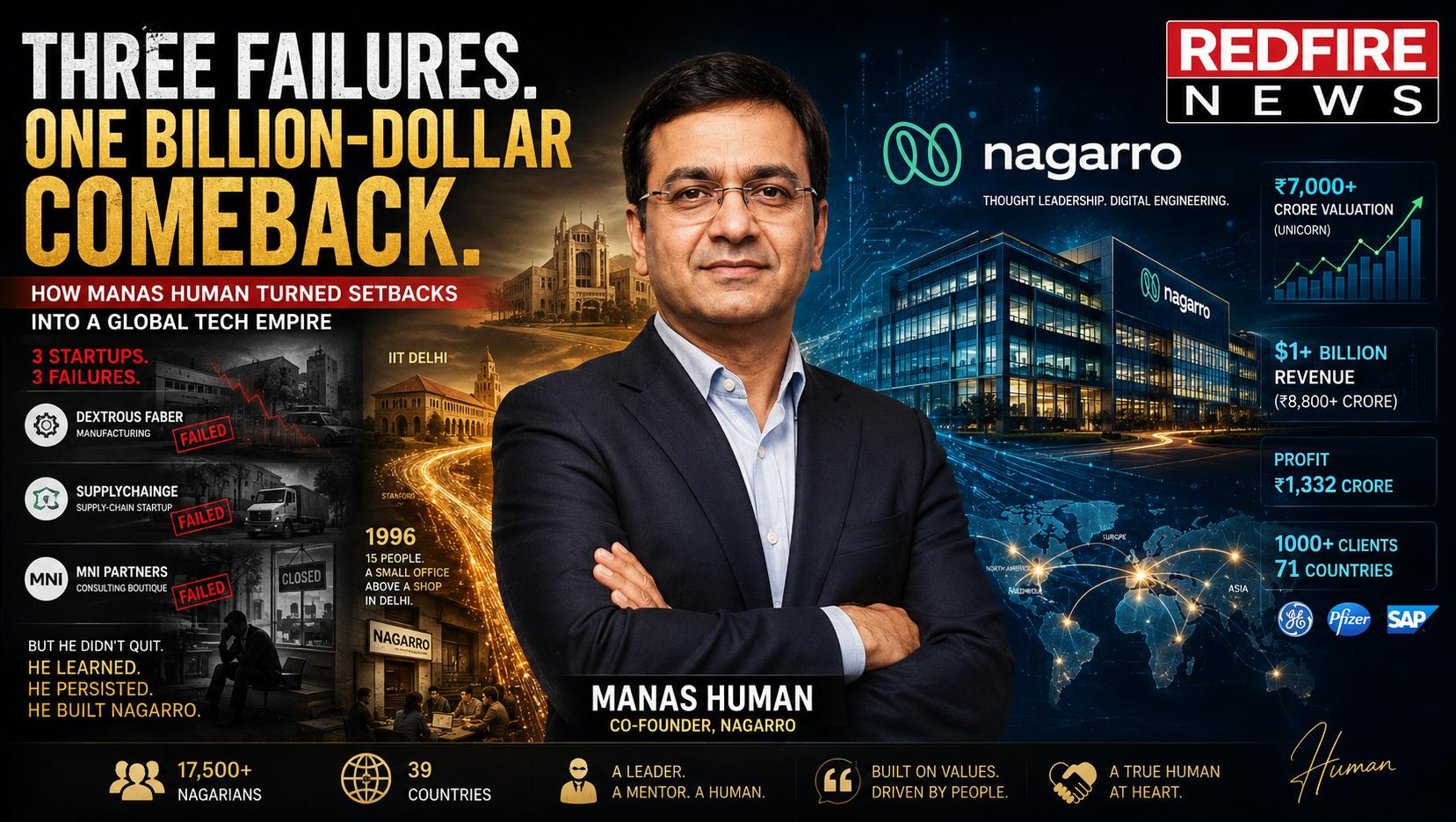
Despite failing in three ventures after graduating from IIT Delhi and Stanford, Manas Human refused to quit. His persistence led to the creation of Nagarro, a global technology company valued at over ₹7,000 crore and serving clients across 71 countries.
In the startup world, success stories often begin with a brilliant idea, a breakthrough moment, and rapid growth. But some of the most inspiring entrepreneurial journeys begin with disappointment, uncertainty, and repeated failure.
The story of Manas Human belongs to that rare category.
Before he became the co-founder of a global technology giant worth thousands of crores, Human experienced something many entrepreneurs fear the most-failure. Not once. Not twice. But three times.
What makes his story remarkable is not his education, though it was exceptional. He graduated from the prestigious IIT Delhi and later studied at Stanford University, institutions that have produced some of the world’s brightest minds.
Yet degrees from elite institutions did not guarantee success.
Instead, Human faced setbacks, struggled to find customers, and watched multiple ventures collapse before eventually creating Nagarro, a company that today generates over ₹8,800 crore in annual revenue and serves more than 1,000 clients across 71 countries.
His journey proves a powerful truth: success is rarely a straight line.
When Elite Education Was Not Enough
Many people assume that graduates from institutions such as IIT Delhi and Stanford have a smooth path to success.
Reality, however, can be very different.
Armed with world-class education and ambitious dreams, Manas Human entered the entrepreneurial world determined to build something meaningful. Like many first-time founders, he believed hard work, intelligence, and determination would naturally lead to success.
But the market had other plans.
His first venture, Dextrous Faber, focused on manufacturing. The business failed to gain the momentum needed for long-term sustainability.
Undeterred, he launched another company called SupplyChainge, a startup focused on supply-chain solutions. Once again, the venture struggled and eventually failed.
Many entrepreneurs would have stopped after two unsuccessful attempts.
Human did not.
He tried again through MNI Partners, a consulting boutique. Unfortunately, this venture also failed to create the breakthrough he was seeking.
Three failures.
Three setbacks.
Three reminders that entrepreneurship is one of the most difficult paths anyone can choose.
For many founders, this would have marked the end of the road.
For Manas Human, it became the foundation of something much bigger.
A Final Attempt That Changed Everything
By the mid-1990s, Human found himself at a crossroads.
He had already experienced repeated disappointment. Investors were difficult to convince. Customers were hard to acquire. Building trust in the marketplace seemed nearly impossible.
Yet he still believed there was one more opportunity worth pursuing.
Together with four of his batchmates from IIT Delhi, who were based in Munich, Germany, Human decided to take one final shot at entrepreneurship.
The vision was simple.
Global companies increasingly needed software engineering talent, and India possessed a growing pool of highly skilled engineers.
What if they could bridge that gap?
With only 15 employees and limited resources, the founders rented a modest office above a small shop in Delhi.
There were no luxury workspaces.
No venture capital headlines.
No billion-dollar valuations.
Just a small team with a big dream.
In 1996, Nagarro was born.
Few people could have predicted that this humble beginning would eventually evolve into one of the world’s most respected digital engineering firms.
The Early Struggle Nobody Talks About
Starting Nagarro was difficult.
Growing it was even harder.
The founders initially focused on serving European clients. Germany, in particular, appeared to offer significant opportunities for software services.
However, winning contracts proved extremely challenging.
Potential clients were reluctant to trust a small Indian company they had never heard of.
Competition was intense.
Margins were thin.
Many deals were lost.
At times, the company struggled simply to secure customers.
The team often found themselves lowering prices to remain competitive, which reduced profitability and made growth difficult.
Human realized that competing purely on cost would never create a sustainable business.
If Nagarro wanted to survive, it needed to be different.
That realization would become the turning point in the company’s history.
Finding the Winning Formula
Instead of positioning Nagarro as another generic outsourcing provider, Human and his team decided to focus on customization and innovation.
Rather than selling standard IT services, they began developing tailored software solutions designed around specific customer needs.
This approach transformed the company’s market position.
Clients no longer viewed Nagarro as a low-cost outsourcing vendor.
Instead, they saw a strategic technology partner capable of solving complex business problems.
Financial institutions needed customized digital platforms.
Nagarro’s expertise started attracting clients across Europe and North America.
For the first time, sustainable growth seemed possible.
The company had discovered its identity.
Building a Global Delivery Engine
As customer demand increased, Nagarro faced another challenge.
How could it scale efficiently while maintaining quality and affordability?
The answer came through a carefully planned global delivery model.
The company established a major delivery center in Gurgaon, which would eventually become Nagarro’s largest engineering hub.
The Gurgaon operation allowed Nagarro to access India’s expanding technology talent pool while maintaining cost competitiveness.
At the same time, international expansion accelerated.
As global corporations began partnering with Nagarro, the company expanded beyond India.
Delivery centers were established in Romania and the United States.
The company’s geographical footprint continued growing.
More importantly, its reputation improved.
Major international brands started placing their trust in Nagarro.
Among them were global names such as Lufthansa, Audi, and BMW.
Landing such clients represented more than business success.
It signaled credibility.
For a company that had once struggled to secure its first customers, this was a remarkable transformation.
Entering a New Era of Growth
The 2000s became a decade of rapid expansion.
Technology was reshaping industries around the world.
Organizations increasingly needed software, analytics, digital transformation capabilities, and engineering expertise.
Nagarro was positioned perfectly to benefit from this shift.
The company expanded its services while continuing to focus on customer-centric innovation.
New engineering practices were introduced.
Digital capabilities improved.
Analytics services were added.
The client portfolio diversified.
Revenue grew steadily.
By 2010, Nagarro had reached a significant milestone.
Annual revenue crossed approximately ₹105 crore.
The company employed around 840 engineers.
Its presence extended across five offices in the United States, Mexico, Germany, Sweden, and India.
Growth rates were impressive.
Customer acquisition increased by nearly 50 percent.
Existing customers expanded their spending significantly, demonstrating confidence in the company’s capabilities.
The business had finally achieved scale.
But an even bigger moment was approaching.
The Acquisition That Validated the Vision
For many entrepreneurs, acquisition represents recognition that years of hard work have created real value.
In Nagarro’s case, that recognition arrived in 2011.
On July 14, 2011, German technology group Allegro acquired 100 percent of Nagarro’s shares.
The acquisition marked a major milestone.
It validated the founders’ strategy, execution, and perseverance.
Importantly, Nagarro continued operating as a separate entity.
Its culture remained intact.
Its entrepreneurial spirit survived.
Rather than disappearing into a larger organization, the company gained additional resources and opportunities to accelerate growth.
For Human and his co-founders, the acquisition was proof that persistence pays off.
The same entrepreneur who had endured three failed startups had now built a company attractive enough for an international technology group to acquire.
Reinventing Itself Again
Many companies become complacent after achieving success.
Nagarro chose a different path.
As technology evolved, the company continued reinventing itself.
Cloud computing emerged as a dominant force.
Mobile technologies transformed business operations.
Enterprise software became increasingly sophisticated.
Digital transformation became a strategic priority for organizations worldwide.
Nagarro expanded aggressively into these areas.
The company strengthened its capabilities in cloud services, mobility solutions, enterprise software, and digital engineering.
This willingness to evolve allowed it to remain relevant in a rapidly changing technology landscape.
Instead of protecting old business models, Nagarro embraced innovation.
That decision positioned the company for its next major milestone.
The Road to Unicorn Status
The global technology sector experienced extraordinary growth during the late 2010s.
Digital adoption accelerated.
Organizations increased investments in software and engineering services.
Demand for technology talent surged.
Nagarro benefited from these trends.
Years of disciplined execution, customer trust, and international expansion culminated in a historic achievement.
On December 16, 2020, Nagarro SE began trading on the Frankfurt Stock Exchange.
The listing represented far more than a financial event.
It was the culmination of a journey that had started above a small shop in Delhi with only 15 employees.
The market rewarded Nagarro’s performance and potential.
The company achieved unicorn status and reached a valuation of approximately ₹7,000 crore.
For Manas Human, the milestone carried profound significance.
It demonstrated that even repeated failure cannot stop someone who refuses to quit.
A Billion-Dollar Enterprise
Today, Nagarro stands among the world’s leading digital engineering firms.
The company generates more than $1 billion in annual revenue, equivalent to roughly ₹8,800 crore.
Its profitability is equally impressive, with profits exceeding ₹1,332 crore.
The organization serves more than 1,000 clients across 71 countries.
Its customer roster includes some of the most respected corporations in the world, including General Electric, Pfizer, and SAP.
From manufacturing and healthcare to automotive and financial services, Nagarro’s solutions support businesses across numerous industries.
What began as a small software development company has evolved into a global technology powerhouse.
The Legacy Beyond Revenue
While revenue figures, valuations, and stock market listings attract headlines, perhaps the most meaningful aspect of Manas Human’s journey lies elsewhere.
Throughout Nagarro’s growth, Human emphasized people and culture.
The company refers to its employees as “Nagarians,” reflecting a strong sense of community and belonging.
Today, Nagarro has nurtured approximately 17,500 professionals across 39 countries.
These individuals represent diverse backgrounds, cultures, languages, and experiences.
Yet they are united by a shared commitment to innovation and collaboration.
Human’s leadership philosophy has consistently emphasized empathy, trust, and human-centered growth.
In an era where many organizations focus solely on profits, he has demonstrated that building a successful business and caring for people can go hand in hand.
That may be his greatest achievement.
Lessons from a Relentless Entrepreneur
The journey of Manas Human offers valuable lessons for aspiring entrepreneurs.
First, prestigious degrees do not guarantee success. Even graduates of IIT Delhi and Stanford must earn their victories through perseverance and execution.
Second, failure is not the opposite of success. Often, it is part of the process.
Human’s three failed ventures taught him lessons that ultimately contributed to Nagarro’s success.
Third, differentiation matters. Nagarro succeeded when it stopped competing purely on price and started creating unique value for customers.
Finally, resilience remains one of the most important entrepreneurial qualities.
The difference between failure and success is frequently the willingness to keep going when others stop.
Had Manas Human quit after his third failed startup, Nagarro would never have existed.
Thousands of jobs would never have been created.
A billion-dollar company would never have been built.
And one of India’s most inspiring business stories would never have been written.
Today, Nagarro’s success stands as a powerful reminder that setbacks do not define a person. What defines them is how they respond. Manas Human responded with courage, persistence, and vision—and in doing so, transformed repeated failures into a global technology success story worth thousands of crores.
AI Conversationalist, Global Marketer, TEDx Speaker, Member-Board Of Studies-CDSW, AI Governance, Mentor Onboarded CCMB-Atal Incubation Center, Entrepreneurship Coach