The Founder Who Lost Twice, Won Big on the Third Attempt, and Returned ₹100 Crore to the Campus That Shaped Him
Discover the inspiring journey of Ritesh Arora, the IIT Bombay graduate who failed twice before building BrowserStack into India's most valuable SaaS company and later donated ₹100 crore to his alma mater for student hostels.
Success stories often appear straightforward when viewed from the outside. A founder builds a company, raises funding, becomes a billionaire, and earns industry recognition. What is rarely visible are the failed experiments, abandoned ideas, sleepless nights, and moments of self-doubt that precede the breakthrough.
The story of Ritesh Arora, co-founder and CEO of BrowserStack, belongs to that category.
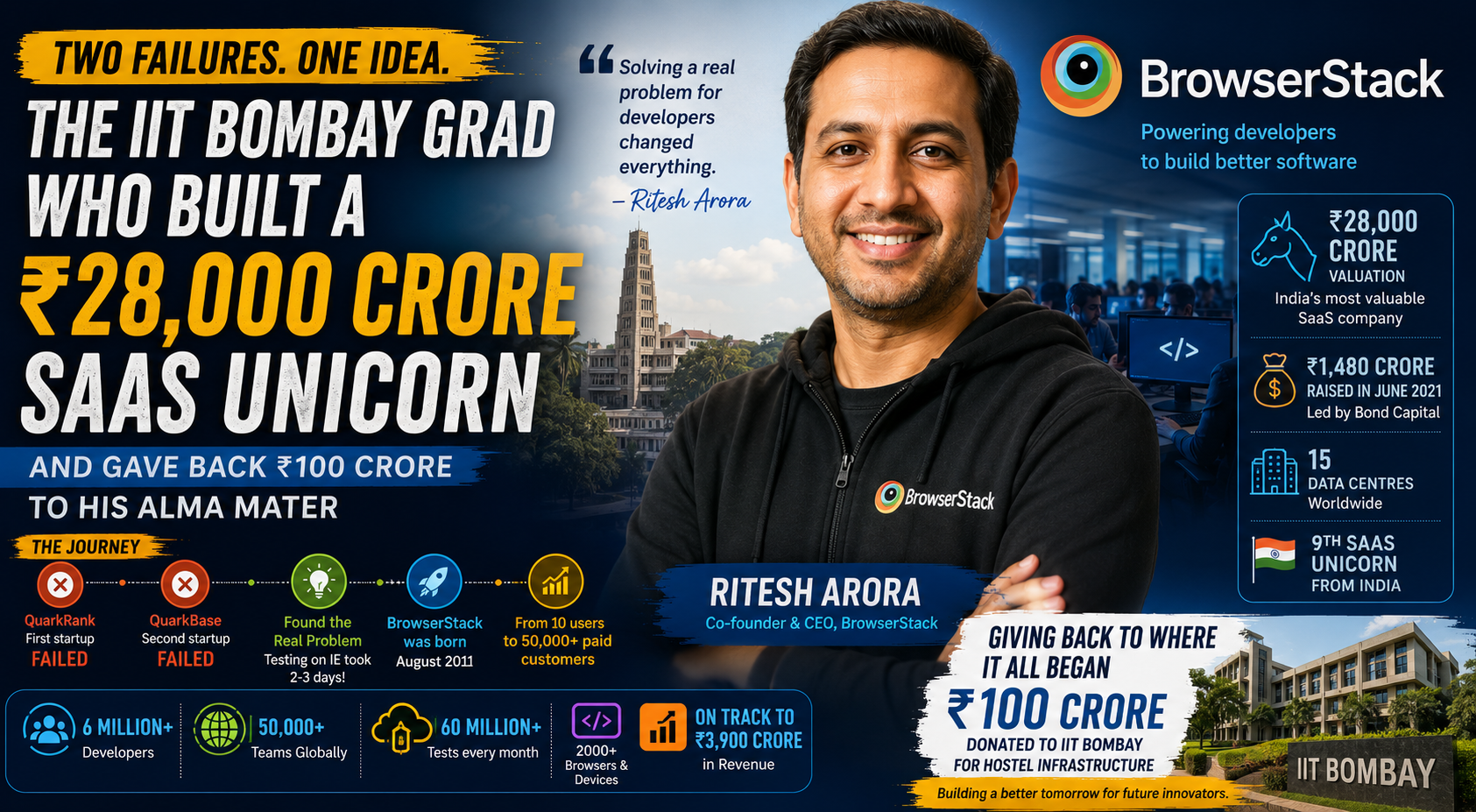
Today, BrowserStack is one of India’s most successful software-as-a-service (SaaS) companies, serving millions of developers worldwide and valued at approximately ₹28,000 crore. The company powers testing infrastructure for some of the world’s largest technology teams and has become a global benchmark for cloud-based software testing.
Yet before creating BrowserStack, Ritesh Arora experienced something many entrepreneurs fear.
He failed.
Not once.
But twice.
Most founders struggle to recover from one unsuccessful startup. Ritesh Arora chose to start over repeatedly until he discovered a problem worth solving and a business model capable of scaling globally.
His journey from failed ventures to building India’s most valuable SaaS company is a remarkable example of resilience, product thinking, and long-term vision.
Adding another inspiring chapter to the story, he later donated ₹100 crore to IIT Bombay, helping improve hostel infrastructure for future generations of students.
Entrepreneurship Started Early
Growing up in Surat, Gujarat, Ritesh Arora was surrounded by a business-oriented environment.
Coming from a family involved in business, he developed an interest in entrepreneurship at a young age. Unlike many students who focus solely on academics, Ritesh was fascinated by the idea of creating products and solving real-world problems.
When he joined Indian Institute of Technology Bombay to study computer science, that entrepreneurial mindset became even stronger.
The institute exposed him to talented peers, cutting-edge technology, and a culture of innovation. It was also where he met Nakul Aggarwal, who would later become his co-founder.
Together, they began exploring startup ideas long before graduation.
The First Startup Failure
In their final year at IIT Bombay, Ritesh and Nakul launched their first startup called QuarkRank.
The idea revolved around sentiment analysis and machine learning, technologies that were still emerging in the business world at the time.
Their ambition was impressive.
They wanted to build an intelligent engine capable of analyzing user sentiment and extracting meaningful insights from online content.
Technically, the concept was strong.
Commercially, it was not.
The founders quickly discovered that having advanced technology does not automatically translate into a sustainable business.
They lacked a clear revenue model.
Customers were difficult to identify.
The market was not mature enough to support the product.
Eventually, QuarkRank failed.
For many young entrepreneurs, such an outcome would have been discouraging enough to abandon startup ambitions altogether.
But Ritesh viewed failure differently.
Instead of treating it as defeat, he treated it as education.
Another Attempt, Another Setback
Most founders who experience failure spend years before trying again.
Ritesh Arora needed only two years.
Determined to continue building, he launched another venture called QuarkBase.
The startup aimed to solve technology-related challenges and build software products that could scale.
However, despite strong effort and technical competence, QuarkBase faced difficulties similar to those encountered by the first venture.
Customer acquisition remained challenging.
Product-market fit was weak.
Revenue growth failed to materialize.
After approximately eighteen months, the company shut down.
Two startups.
Two failures.
At a stage when many people would have pursued stable corporate careers, Ritesh took a different path.
He stepped back.
For nearly a year, he avoided rushing into another startup.
Instead, he spent time consulting, observing the industry, and understanding where genuine opportunities existed.
That pause proved transformative.
Discovering a Universal Problem
Sometimes the best business ideas emerge from everyday frustration.
While working on a consulting project, Ritesh encountered a challenge that software developers around the world were experiencing.
Testing websites on Internet Explorer was a nightmare.
Developers often needed virtual machines configured with specific browser versions.
Setting up these environments could take days.
Network limitations made the process even slower.
Teams lost valuable development time simply trying to prepare testing environments.
The problem seemed mundane.
Yet it affected millions of developers globally.
Ritesh realized something important.
If he was experiencing the issue, thousands of others probably were too.
Unlike his previous ventures, this challenge had a clearly defined customer base and an obvious need.
The opportunity was hiding in plain sight.
Building a Prototype in Three Days
Inspired by the idea, Ritesh and Nakul moved quickly.
Within just three days, they created a simple web interface connected to old Internet Explorer browser images.
The concept was elegant.
Instead of requiring developers to configure complex local environments, they could simply access browsers through the cloud.
The solution dramatically reduced setup time and simplified testing workflows.
The founders recognized that they had discovered something valuable.
In August 2011, BrowserStack was officially born.
Unlike many startups that spend months perfecting products before launch, BrowserStack entered the market quickly.
The founders wanted real-world feedback.
And they got it.
Early Growth Without Marketing
BrowserStack started as a free online tool.
The founders shared it within developer communities and technology forums.
One of their most successful moves involved posting the product on Hacker News, where developers actively discussed emerging technologies.
The response exceeded expectations.
Within the first day, BrowserStack attracted ten users.
That number soon became hundreds.
Then thousands.
Within just three weeks, the platform had grown to approximately 10,000 users.
For the first time in his entrepreneurial journey, Ritesh experienced genuine product-market fit.
People were not merely interested in the product.
They genuinely needed it.
Yet he remembered the lessons from his earlier failures.
This time, he would not delay monetization.
The Business Model That Changed Everything
One of the biggest reasons earlier ventures struggled was the absence of a sustainable business model.
BrowserStack would be different.
The founders introduced a simple subscription-based pricing structure.
Users could pay monthly fees ranging from approximately ₹500 to ₹1,000 depending on their requirements.
The pricing was affordable, transparent, and easy to understand.
More importantly, customers were willing to pay.
Revenue began growing almost immediately.
Within four months, BrowserStack crossed ₹10 lakh in monthly recurring revenue.
By the end of its first year, the company was operating at an annualized revenue run rate of approximately ₹5 crore.
The transformation was remarkable.
After two failed startups, Ritesh had finally discovered the formula that combined technology, customer demand, and revenue generation.
Expanding Beyond Browser Testing
Success brought new opportunities.
Developers increasingly wanted more than basic browser access.
They needed comprehensive testing infrastructure.
Recognizing this demand, BrowserStack expanded its offerings.
The company introduced live testing capabilities.
It added automated testing features.
It expanded support for thousands of browser-device combinations.
Most importantly, it enabled testing on real devices hosted in the cloud.
This distinction became a major competitive advantage.
Many competitors relied heavily on emulators.
BrowserStack provided access to actual devices, delivering more accurate testing results.
The market responded enthusiastically.
Global Adoption Accelerates
As software development became increasingly global, BrowserStack’s user base expanded rapidly.
Within just four years, the platform was serving customers across more than 135 countries.
Over 40,000 companies adopted the service.
Developers from startups, enterprises, and technology giants relied on BrowserStack to ensure their applications functioned correctly across devices and browsers.
The company grew largely through product-led adoption.
Users discovered value quickly.
Satisfied customers recommended the platform to colleagues.
Word-of-mouth became a powerful growth engine.
The product itself became the company’s most effective marketing tool.
Scaling to Enterprise Levels
By 2018, BrowserStack had evolved from a promising startup into a global technology infrastructure provider.
The platform was processing more than 60 million tests every month.
Its customer base included approximately 25,000 paying users.
Enterprise clients increasingly adopted the service for mission-critical workflows.
To support global growth, BrowserStack expanded internationally.
The company established a stronger presence in the United States.
It recruited senior executives.
It invested heavily in infrastructure and customer support.
Investors took notice.
In 2018, BrowserStack raised approximately ₹318 crore in funding led by Accel.
The investment valued the company at nearly ₹3,200 crore.
The once-struggling founder was now leading one of India’s fastest-growing software businesses.
Building a Global Cloud Testing Leader
BrowserStack continued investing aggressively in product innovation.
The company expanded its testing infrastructure to support over 2,000 browser-device combinations.
It established multiple data centers worldwide.
It improved automation capabilities.
It enhanced security and enterprise compliance features.
These investments helped BrowserStack strengthen its position as a leader in cloud testing.
Developers increasingly viewed the platform as essential infrastructure rather than an optional tool.
The company’s growth reflected this shift.
Millions of users joined the ecosystem.
Paid subscriptions continued increasing.
Enterprise adoption accelerated.
The Unicorn Moment
The defining milestone arrived on June 16, 2021.
BrowserStack announced a massive funding round of approximately ₹1,480 crore led by Bond Capital.
The investment valued the company at approximately ₹28,000 crore.
With that announcement, BrowserStack became India’s ninth SaaS unicorn.
More importantly, it emerged as the country’s most valuable SaaS company at the time.
The achievement represented more than financial success.
It validated a decade-long journey built on persistence, customer obsession, and product excellence.
For Ritesh Arora, the moment carried special significance.
The entrepreneur who had failed twice had now built one of India’s most successful software companies.
Growth Continues
Today, BrowserStack serves more than six million developers globally.
Its solutions support over 50,000 teams across industries.
The company operates extensive infrastructure spanning multiple regions and data centers.
Annual revenue is estimated to be approaching ₹3,900 crore.
Its platform has become a critical component of modern software development workflows.
As organizations accelerate digital transformation, demand for reliable testing solutions continues growing.
BrowserStack remains well-positioned to benefit from that trend.
Giving Back to IIT Bombay
While BrowserStack’s business achievements are impressive, one of the most admired aspects of Ritesh Arora’s journey is his commitment to giving back.
In a remarkable gesture, he dedicated ₹100 crore to IIT Bombay for hostel infrastructure development.
The contribution reflects gratitude toward the institution that played a pivotal role in shaping his career.
For generations of students, hostel life represents much more than accommodation.
It is where friendships form, ideas emerge, collaborations begin, and entrepreneurial journeys often take shape.
By supporting hostel development, Ritesh is investing in future innovators who may one day create transformative companies of their own.
The donation also highlights a growing trend among successful entrepreneurs who recognize the importance of strengthening educational institutions.
Lessons from Ritesh Arora’s Journey
Several powerful lessons emerge from this story.
First, failure is not final. Two unsuccessful startups did not prevent future success.
Second, solving real problems matters more than chasing trends. BrowserStack succeeded because it addressed a genuine pain point experienced by developers worldwide.
Third, business models matter. A great product becomes sustainable only when customers are willing to pay for it.
Fourth, speed is important. The initial prototype was built in just three days, enabling rapid market validation.
Fifth, product-led growth can outperform traditional marketing when customer value is strong.
Finally, success becomes more meaningful when shared. Ritesh’s contribution to IIT Bombay demonstrates how entrepreneurial achievements can create lasting societal impact.
A Legacy Beyond Valuation
Today, BrowserStack stands as one of India’s greatest SaaS success stories.
Its valuation, revenues, and global reach are impressive by any standard.
Yet perhaps the most inspiring aspect of Ritesh Arora’s journey is not the ₹28,000 crore valuation.
It is the persistence behind it.
Two failed startups could have ended his entrepreneurial ambitions.
Instead, they became stepping stones.
The frustrations of developers became an opportunity.
A simple cloud testing tool became a global platform.
And a student who once dreamed of building technology products now helps millions of developers build better software.
In many ways, Ritesh Arora’s story proves that entrepreneurship is not about avoiding failure.
It is about learning from failure long enough to eventually create something extraordinary.
From IIT Bombay classrooms to boardrooms around the world, his journey continues to inspire a new generation of founders who believe that every setback can become the foundation of a much bigger success story.
AI Conversationalist, Global Marketer, TEDx Speaker, Member-Board Of Studies-CDSW, AI Governance, Mentor Onboarded CCMB-Atal Incubation Center, Entrepreneurship Coach