From a Village Farmer’s Son to India’s Infrastructure Titan: The Man Who Built a ₹67,500 Crore Empire and Never Forgot His Roots
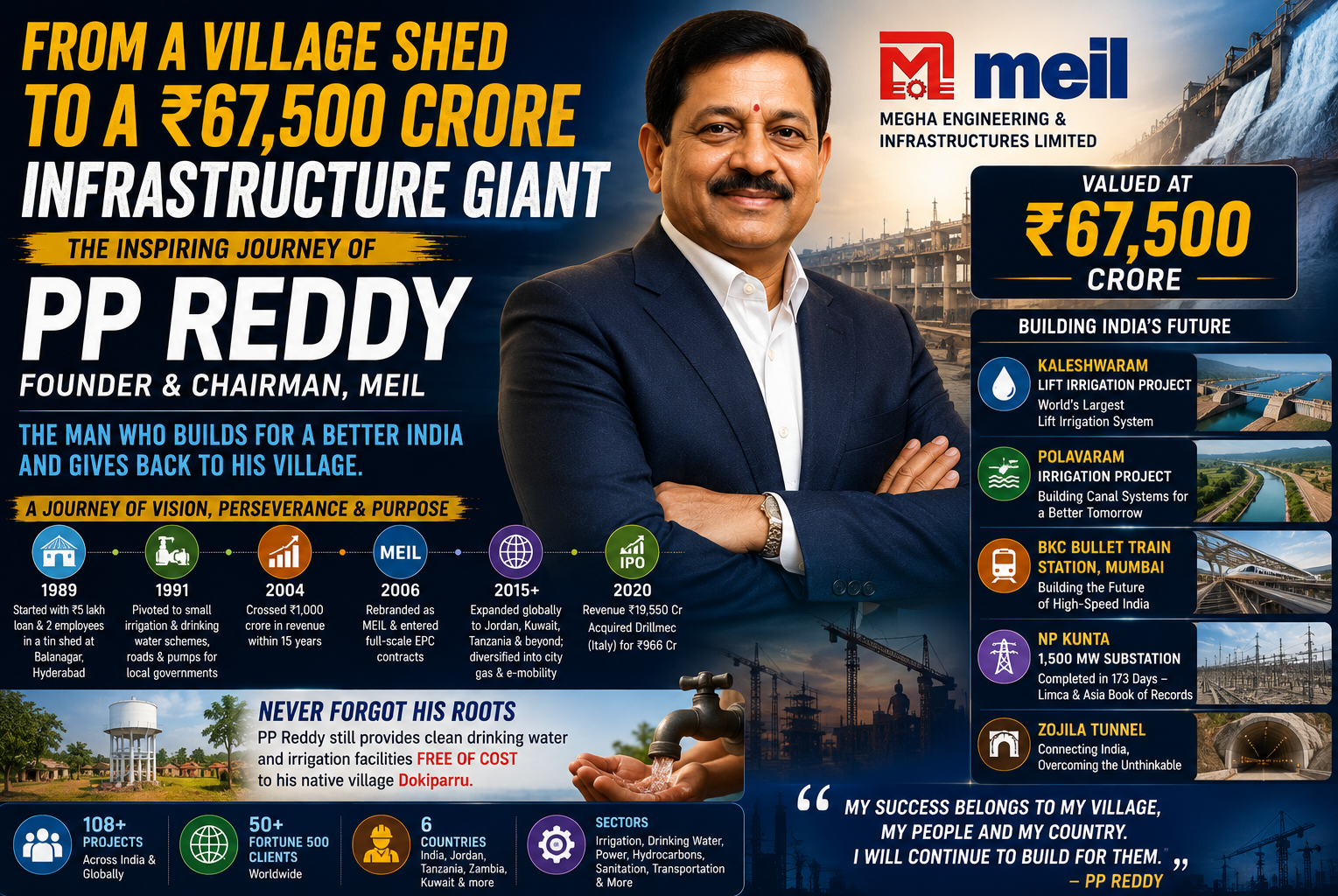
Discover the inspiring journey of Padma Shri PP Reddy, founder of MEIL, who started with a ₹5 lakh loan and two employees in Hyderabad and built a ₹67,500 crore infrastructure powerhouse executing some of India's largest irrigation, energy, and transportation projects.
In India’s business landscape, there are entrepreneurs who build successful companies, and then there are visionaries who transform entire regions through their work. Few stories embody this distinction better than that of Padma Shri PP Reddy, the founder of Megha Engineering & Infrastructures Limited (MEIL), a company that began in a humble tin shed and grew into one of India’s largest infrastructure conglomerates.
Today, MEIL is valued at approximately ₹67,500 crore and operates across sectors ranging from irrigation and drinking water to hydrocarbons, transportation, sanitation, energy, and international infrastructure development. Its projects span multiple countries and include some of the largest engineering works ever undertaken in India.
Yet behind the corporate success lies a deeply personal story.
It is a story of a young boy growing up in a farming family in Andhra Pradesh, watching his father struggle with irrigation challenges and crop losses. It is a story of perseverance through years without orders, of calculated risks, strategic pivots, and a commitment to solving problems that affect ordinary people.
Most importantly, it is a story of a man who never forgot where he came from.
Even today, despite becoming one of India’s wealthiest entrepreneurs, PP Reddy continues to provide clean drinking water and irrigation facilities free of cost in his native village.
His journey is not merely about building a company.
It is about building solutions.
A Childhood Shaped by Agriculture
The story begins in Dokiparru, a village in Krishna district of Andhra Pradesh.
Born as Pamireddy Pitchi Reddy, he grew up in a farming family where agriculture was not just a profession but a way of life.
Like countless farmers across India, his father worked tirelessly in the fields. However, success was often determined not by effort but by water availability.
Young Reddy witnessed the harsh realities of agriculture firsthand.
Inadequate irrigation infrastructure frequently led to significant crop losses. Farmers invested months of hard work only to see yields reduced because water could not reach fields efficiently.
These experiences left a lasting impression on him.
While many children dreamt of urban careers, PP Reddy became fascinated by the idea of solving water-related challenges.
He believed better infrastructure could transform the lives of farmers.
Years later, that belief would become the foundation of a business empire.
A Modest Beginning with Big Dreams
By the late 1980s, India was undergoing economic and industrial transformation.
Infrastructure needs were growing rapidly, especially in water management and irrigation.
Recognizing an opportunity, PP Reddy decided to start his own venture.
In 1989, armed with a modest loan of approximately ₹5 lakh and supported by just two employees, he established a small company in a tin shed located in Balanagar, Hyderabad.
The enterprise was called Megha Engineering Enterprises.
The objective was straightforward.
Supply pumps, pipes, and related equipment for water projects.
The company had limited resources, minimal infrastructure, and virtually no brand recognition.
Yet it possessed something far more valuable.
A founder determined to succeed.
The Difficult Early Years
The initial phase of the business was anything but easy.
For nearly two years, the company struggled to secure meaningful orders.
Clients were hesitant to trust a small and relatively unknown enterprise.
Cash flows remained tight.
Opportunities were scarce.
Many entrepreneurs might have considered closing operations during such a period.
PP Reddy chose persistence instead.
He continued meeting customers, understanding market requirements, and improving the company’s capabilities.
Eventually, the breakthrough arrived.
The company received an order for 10-horsepower water pump motors.
Financially, it was not a transformative contract.
Psychologically, it was enormous.
The order validated the company’s existence and provided proof that customers were willing to trust its products.
However, Reddy understood something important.
Relying solely on equipment sales would limit future growth.
A larger opportunity existed.
The Strategic Pivot That Changed Everything
In 1991, PP Reddy made one of the most important decisions of his entrepreneurial journey.
Rather than focusing exclusively on supplying pumps and equipment, he chose to expand into small irrigation projects, drinking water schemes, and infrastructure work for local governments.
The move required significant investment.
He reinvested savings into building capabilities that would enable the company to execute complete projects rather than merely supply components.
This strategic pivot transformed the business model.
Instead of competing as a vendor, Megha began positioning itself as a solutions provider.
Government agencies increasingly sought partners capable of delivering integrated infrastructure solutions.
The company responded effectively.
Over time, project sizes grew.
Capabilities expanded.
Reputation strengthened.
Within approximately fifteen years, the business had generated revenue exceeding ₹1,000 crore.
For a company that started in a tin shed, the achievement was remarkable.
But PP Reddy believed the best was yet to come.
The Birth of MEIL
As the company evolved, its ambitions expanded beyond traditional engineering services.
The scale and complexity of projects increased dramatically.
To reflect this transformation, the organization underwent a significant rebranding exercise in 2006.
Megha Engineering Enterprises became Megha Engineering & Infrastructures Limited, widely known today as MEIL.
The new identity represented more than a name change.
It signaled a strategic shift toward large-scale Engineering, Procurement, and Construction (EPC) projects.
MEIL now pursued contracts involving dams, canals, lift irrigation systems, power plants, transmission infrastructure, pipelines, and urban development.
The company was no longer a regional engineering contractor.
It was becoming a national infrastructure force.
Entering India’s Largest Infrastructure Projects
The years that followed marked a period of extraordinary growth.
India’s infrastructure requirements expanded rapidly, creating opportunities for companies capable of executing large and complex projects.
MEIL emerged as one of the industry’s most aggressive and capable participants.
Its expertise in irrigation and water management positioned it well for some of the country’s most ambitious initiatives.
One of the defining milestones came with involvement in the Kaleshwaram Lift Irrigation Project in Telangana.
The project is widely regarded as one of the world’s largest lift irrigation systems.
Its objective was transformative.
Move vast quantities of water across elevations to support agriculture, drinking water supply, and regional development.
Executing such a project required exceptional engineering capabilities.
MEIL rose to the challenge.
The success further elevated the company’s national profile.
The Polavaram Opportunity
Another major milestone arrived in 2018 through participation in the Polavaram Irrigation Project.
The project represents one of India’s most significant multipurpose river development initiatives.
Its objectives include irrigation, flood control, hydroelectric generation, and drinking water supply.
MEIL played a crucial role in constructing canal systems associated with the project.
The assignment reinforced the company’s position as one of India’s leading infrastructure organizations capable of handling projects of national importance.
For PP Reddy, these projects represented more than business opportunities.
They reflected the realization of a lifelong ambition to improve water accessibility for communities and farmers.
Diversifying Beyond Irrigation
While irrigation remained central to its identity, MEIL recognized the importance of diversification.
The company steadily expanded into adjacent sectors.
Energy became a major focus area.
MEIL entered power generation, transmission, and distribution infrastructure.
It also expanded into city gas distribution networks and hydrocarbon projects.
In 2015, the company took another forward-looking step by entering the electric mobility space through Electra.
The move demonstrated an ability to anticipate emerging industry trends.
As transportation systems evolved globally, MEIL positioned itself to participate in the future of sustainable mobility.
This diversification reduced dependence on any single sector and strengthened long-term growth prospects.
Becoming a Global Infrastructure Player
MEIL’s ambitions were never confined to India.
As capabilities expanded, the company began pursuing opportunities overseas.
Projects in Jordan, Kuwait, Tanzania, Zambia, and other international markets helped establish a global presence.
The expansion required adaptation to different regulatory environments, customer expectations, and operational challenges.
Yet MEIL successfully leveraged its engineering expertise to compete internationally.
By 2020, the company had transformed into a diversified infrastructure conglomerate generating revenue of approximately ₹19,550 crore.
The journey from a two-person operation to a multinational enterprise was extraordinary.
Still, the company continued pushing forward.
A Landmark International Acquisition
One of the most significant moments in MEIL’s evolution occurred in 2020.
The company acquired Drillmec, the oil and gas division of Italy-based Trevi Group, for approximately ₹966 crore.
The acquisition represented a major strategic milestone.
It provided access to advanced technologies, global capabilities, and international markets within the oil and gas sector.
More importantly, it demonstrated that an Indian engineering company could successfully acquire and integrate globally recognized industrial assets.
The move further enhanced MEIL’s reputation as a serious international player.
Engineering Feats and Record-Breaking Projects
MEIL continued securing high-profile assignments across India.
Among the most notable was the Zojila Tunnel project awarded in 2020.
The tunnel is expected to significantly improve connectivity between regions of strategic and economic importance.
Another major project involved the Bandra-Kurla Complex bullet train station in Mumbai.
As India advances high-speed rail infrastructure, projects of this nature represent critical national investments.
The company’s execution capabilities became increasingly recognized.
One remarkable example was the construction of the 1,500 MW NP Kunta substation in Andhra Pradesh.
MEIL completed the project in just 173 days.
The achievement earned recognition in both the Limca Book of Records and the Asia Book of Records.
Such accomplishments reinforced the organization’s reputation for speed, quality, and execution excellence.
Building a Modern Infrastructure Empire
Today, MEIL operates across a diverse portfolio of sectors.
These include sanitation, drinking water, hydrocarbons, energy, transportation, irrigation, and urban infrastructure.
The company manages more than 100 projects across India and international markets.
Its workforce includes thousands of engineers, technicians, project managers, and specialists.
Its infrastructure touches the lives of millions of people.
Whether through drinking water supply, irrigation networks, energy infrastructure, or transportation systems, MEIL plays a significant role in supporting economic development.
The company’s valuation has reached approximately ₹67,500 crore.
This places it among India’s most valuable privately held infrastructure enterprises.
The Man Behind the Company
Despite enormous success, PP Reddy remains closely connected to his roots.
His personal wealth is estimated at approximately ₹37,300 crore.
Yet those who know his story often point to his humility and community focus as defining characteristics.
The village of Dokiparru still occupies a special place in his heart.
Remembering the water challenges he witnessed during childhood, he continues supporting initiatives that provide clean drinking water and irrigation infrastructure to local residents free of charge.
The gesture reflects a philosophy that has guided much of his career.
Infrastructure should improve lives.
Success should create opportunities for others.
And prosperity should be shared with communities that helped shape one’s journey.
Lessons from PP Reddy’s Journey
Several powerful lessons emerge from this remarkable story.
First, great businesses often begin by solving personal problems. PP Reddy’s exposure to agricultural challenges inspired a lifelong mission.
Second, persistence matters. The company survived years without meaningful orders before achieving success.
Third, strategic pivots can transform outcomes. Expanding from equipment supply to infrastructure execution changed the trajectory of the business.
Fifth, never forget your roots. Despite extraordinary success, PP Reddy continues supporting his native village.
More Than an Entrepreneur
The story of PP Reddy is not simply about building wealth.
It is about building infrastructure that enables development.
It is about turning childhood observations into lifelong purpose.
And it is about proving that global enterprises can emerge from humble beginnings.
From a small village in Andhra Pradesh to boardrooms managing projects across continents, his journey reflects the power of vision combined with determination.
The tin shed in Balanagar may have been modest.
The dream that emerged from it was anything but.
Today, that dream stands as a ₹67,500 crore testament to what is possible when an entrepreneur dedicates his life to solving real-world problems.
And perhaps the most inspiring part is that even after building one of India’s largest infrastructure companies, PP Reddy still measures success the same way he did as a young boy in Dokiparru-by the number of people whose lives become better because water reaches their fields and homes.
AI Conversationalist, Global Marketer, TEDx Speaker, Member-Board Of Studies-CDSW, AI Governance, Mentor Onboarded CCMB-Atal Incubation Center, Entrepreneurship Coach