Public Welfare Schemes in India: How Government Initiatives Are Transforming Lives from Villages to Cities
Explore how India's public welfare schemes are improving healthcare, housing, financial inclusion, and food security while empowering millions of citizens across rural and urban regions.
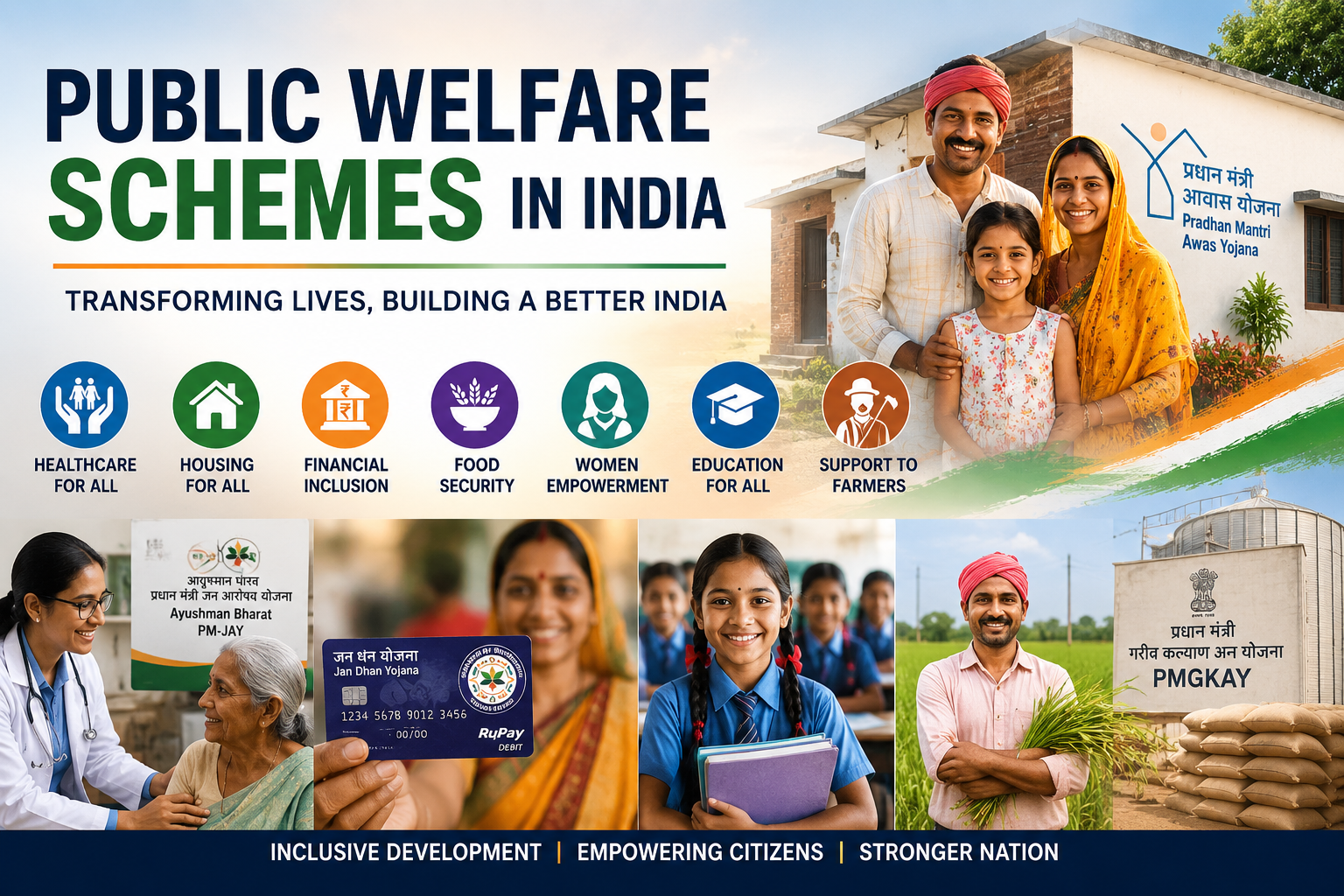
Public welfare schemes have become one of the most powerful instruments for social and economic transformation in India. Designed to improve access to healthcare, housing, food security, financial services, education, and livelihoods, these initiatives aim to ensure that development reaches every section of society, particularly the poor, marginalized, and vulnerable communities.
Over the past decade, welfare programmes have evolved from traditional subsidy-based models to technology-driven, beneficiary-centric systems that emphasize transparency, direct benefit transfers, and accountability. Today, millions of Indians are receiving support through various flagship schemes that address fundamental needs and improve quality of life.
Why Public Welfare Schemes Matter
India’s vast population and socio-economic diversity present unique challenges. While rapid economic growth has created new opportunities, many households still struggle with poverty, inadequate healthcare, unemployment, and lack of access to basic services.
Public welfare schemes serve as a bridge between economic growth and social equity. Their primary objectives include:
Reducing poverty and inequality
Enhancing access to healthcare and education
Promoting financial inclusion
Ensuring food and nutrition security
Supporting women, farmers, artisans, and vulnerable groups
Improving housing and sanitation infrastructure
These programmes contribute significantly to the broader vision of inclusive and sustainable development.
Strengthening Financial Inclusion Through Jan Dhan Yojana
One of the most transformative welfare initiatives in recent years has been the Pradhan Mantri Jan Dhan Yojana (PMJDY), which aims to provide banking access to every household.
The scheme has helped millions open zero-balance bank accounts, enabling direct transfer of government benefits and reducing dependence on intermediaries. As of early 2026, India has crossed 57 crore Jan Dhan accounts, with a majority belonging to women and residents of rural and semi-urban areas. This has significantly expanded the formal financial ecosystem and improved economic participation among underserved communities.
Financial inclusion has also created opportunities for savings, insurance coverage, pension schemes, and access to credit for small entrepreneurs and self-help groups.
Affordable Healthcare Through Ayushman Bharat
Healthcare expenses often push vulnerable families into debt. To address this challenge, Ayushman Bharat – Pradhan Mantri Jan Arogya Yojana (PM-JAY) was launched to provide cashless healthcare coverage for eligible families.
The scheme offers health coverage of up to ₹5 lakh per family annually for secondary and tertiary care hospitalization. Millions of beneficiaries across India have accessed treatment through an extensive network of empanelled hospitals.
Government data indicates that more than 42 crore Ayushman Cards have been generated, while hospital admissions under the programme continue to increase, highlighting the growing impact of the initiative on public health outcomes.
For economically weaker sections, such schemes provide crucial financial protection against medical emergencies and critical illnesses.
Housing for All: Transforming Rural and Urban Landscapes
Access to safe and dignified housing remains a fundamental requirement for human development. The Pradhan Mantri Awas Yojana (PMAY) has emerged as a key intervention to address housing shortages among low-income families.
Under PMAY-Gramin, the government has expanded efforts to provide pucca houses with basic amenities to eligible rural households. Additional housing targets have been approved to extend support through 2029, reflecting the continued focus on improving living conditions in rural India.
The scheme has particularly benefited women, Scheduled Castes, Scheduled Tribes, and other socially disadvantaged groups by promoting ownership and housing security.
Improved housing infrastructure also contributes to better health, sanitation, education outcomes, and overall community development.
Ensuring Food Security for Millions
Food security remains a cornerstone of social welfare policy in India. Government initiatives aimed at ensuring access to affordable food grains have played a critical role in supporting vulnerable households.
Large-scale food distribution programmes continue to provide essential grains to millions of beneficiaries every month, helping reduce hunger and nutritional insecurity among economically weaker sections. These efforts have been especially important during periods of economic uncertainty and inflation.
Food security programmes not only support household consumption but also strengthen social stability and resilience.
Empowering Women Through Welfare Programmes
Women have emerged as major beneficiaries of several welfare schemes, particularly those focused on financial inclusion, housing ownership, healthcare access, and livelihood opportunities.
The integration of women into banking systems through Jan Dhan accounts has increased their financial independence. Housing schemes that prioritize ownership in women’s names have further strengthened their social and economic status.
Additionally, various self-help group initiatives and skill development programmes continue to create pathways for entrepreneurship and income generation among women in rural and urban communities.
Technology and Transparency in Welfare Delivery
One of the most significant changes in India’s welfare ecosystem has been the adoption of technology.
Digital platforms, Aadhaar-based verification, Direct Benefit Transfer (DBT) mechanisms, and online beneficiary databases have improved efficiency while reducing leakages and duplication.
Technology-driven governance has enabled governments to reach beneficiaries more accurately, ensuring that assistance reaches intended recipients in a timely manner.
This digital transformation has become a cornerstone of modern welfare administration and public service delivery.
Challenges That Still Need Attention
Despite notable progress, several challenges remain:
Awareness gaps among eligible beneficiaries
Digital literacy barriers in remote regions
Last-mile delivery issues
Inclusion errors and documentation hurdles
Regional disparities in implementation
Addressing these challenges will require stronger grassroots engagement, improved monitoring mechanisms, and greater collaboration between governments, civil society organizations, and local communities.
The Road Ahead
India’s public welfare architecture continues to evolve in response to changing social and economic realities. Future welfare programmes are expected to focus increasingly on digital empowerment, skill development, healthcare accessibility, women’s participation, sustainable livelihoods, and climate resilience.
As the country moves toward its long-term development goals, welfare schemes will remain critical tools for ensuring that growth benefits every citizen, regardless of geography, income, or social background.
Conclusion
Public welfare schemes are more than government programmes; they are instruments of social transformation. By improving access to healthcare, housing, banking, food security, and essential services, these initiatives are helping millions of Indians build better futures.
While challenges remain, the expanding reach of welfare programmes demonstrates how targeted interventions can improve lives, reduce inequalities, and strengthen the foundation for inclusive national development. As implementation continues to improve, public welfare schemes will remain central to India’s journey toward equitable and sustainable progress.