From Empty Sales Calls to a ₹16,668 Crore Empire: The IIT Graduate Who Refused to Quit
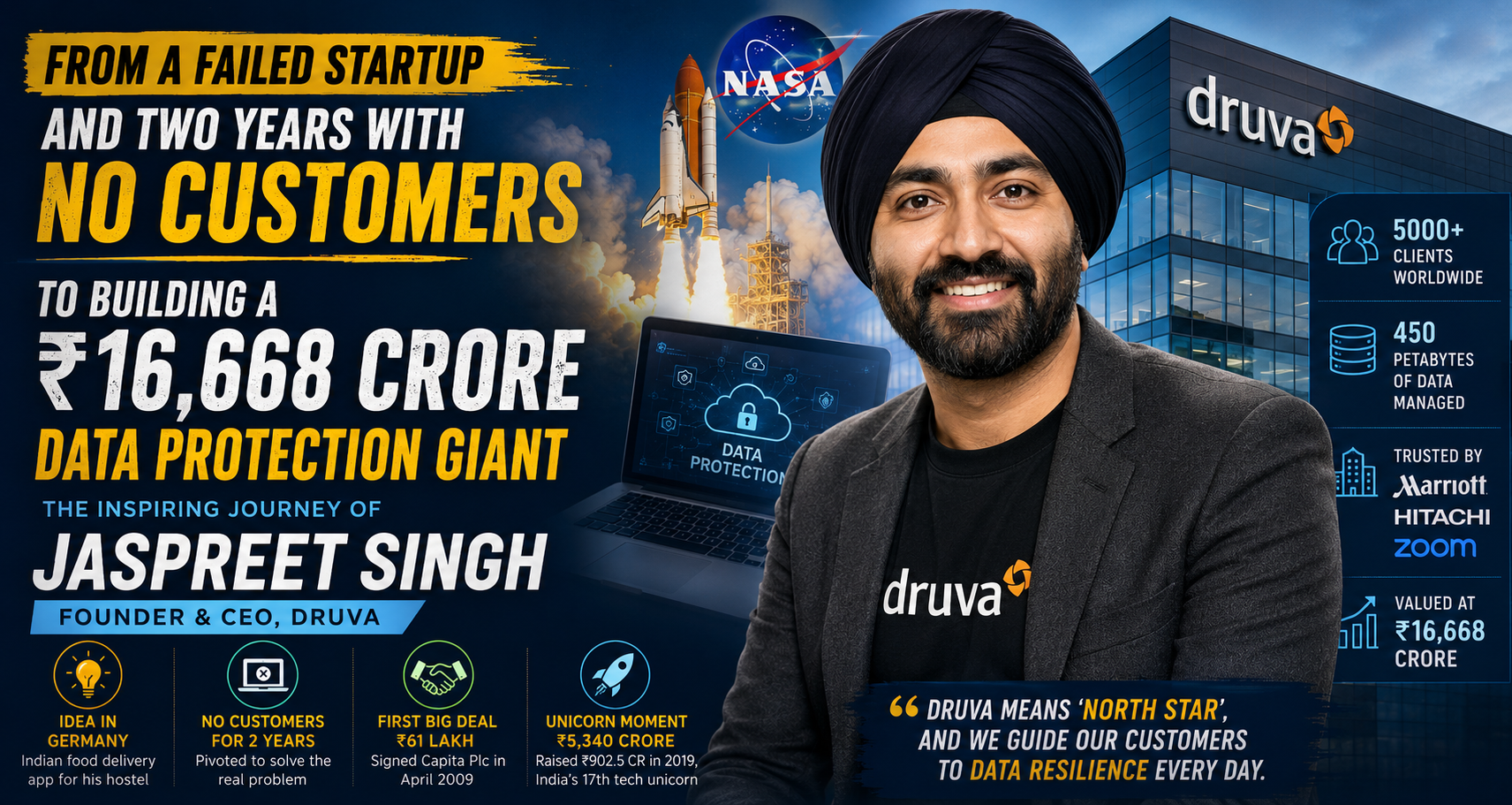
Discover the inspiring journey of Jaspreet Singh, founder of Druva, who went from a failed startup and two years without customers to building a ₹16,668 crore cloud data protection company serving NASA, Marriott, Zoom, and thousands of global enterprises.
In the startup world, success stories often highlight billion-dollar valuations, famous investors, and headline-making funding rounds. What they rarely show are the lonely years before success arrives—the months spent waiting for customers, the doubts that creep in after repeated rejection, and the difficult decisions founders must make when their original idea fails.
The story of Jaspreet Singh, founder of Druva, is one such tale.
Today, Druva is one of India’s most successful global software companies, valued at approximately ₹16,668 crore and trusted by more than 5,000 organizations worldwide. Its customers include some of the most recognizable names across industries, from NASA and Marriott to Hitachi and Zoom.
Yet the company that now protects hundreds of petabytes of critical business data once struggled to find a single paying customer.
For more than two years after launch, Druva’s founder faced what many entrepreneurs fear most: building a product that nobody wanted to buy.
Instead of giving up, he changed direction, reinvented the technology, and transformed a struggling startup into one of India’s most celebrated technology unicorns.
An Entrepreneurial Spark in Germany
Long before Druva existed, Jaspreet Singh was already experimenting with entrepreneurship.
While studying engineering and participating in a student exchange program in Germany, he noticed a simple but relatable problem. Students living in hostels often struggled to access Indian food, especially when homesickness kicked in.
Rather than merely complain about the situation, Jaspreet decided to build a solution.
He launched a small Indian food delivery application designed specifically for students in his hostel.
The venture did not succeed commercially. The market was limited, operations were challenging, and the business eventually faded away.
However, the experience planted an important seed.
For the first time, Jaspreet experienced the thrill and challenge of building something from scratch. More importantly, he learned that failure often reveals opportunities that success cannot.
That lesson would become invaluable later.
Discovering a Hidden Business Problem
After completing his studies, Jaspreet entered the enterprise software industry and worked closely with organizations managing large volumes of data.
During this period, he noticed a growing problem that most businesses were overlooking.
Employees were increasingly creating important business data on laptops and personal devices. Critical documents, project files, customer information, and operational records were being generated outside traditional corporate servers.
Yet very few companies had effective ways to protect that information.
The available solutions were largely designed for IT administrators managing centralized infrastructure. Industry giants such as Veritas, EMC, and IBM Tivoli offered powerful products, but they were complex, expensive, and not built for a workforce that was becoming increasingly mobile.
Businesses faced a growing risk.
If an employee lost a laptop, suffered a system crash, or accidentally deleted files, valuable corporate information could disappear forever.
Jaspreet believed this challenge would only become bigger as companies embraced mobility and digital transformation.
He saw an opportunity that others had missed.
Building a Company with Personal Savings
Most startup founders begin with a vision.
Jaspreet Singh began with a vision and approximately ₹30 lakh in savings.
Pooling his resources with colleague Milind, whom he knew from Veritas, he rented a small room in suburban Pune and started building a company focused on disaster recovery and data protection.
He was only 26 years old.
The year was 2008.
The company’s name was Druva.
The name itself carried significance. Derived from the Sanskrit word for the North Star, Druva symbolized guidance, reliability, and a constant point of reference.
The founders hoped their software would become exactly that for organizations struggling to protect valuable information.
However, building a product was easier than convincing customers to buy it.
Two Years Without Customers
The early years of Druva tested Jaspreet’s resilience more than any business school case study ever could.
For nearly two years after launching the company, customers simply did not arrive.
Sales meetings ended without contracts.
Demonstrations generated interest but not commitments.
The startup had technology, ambition, and determination—but no revenue.
Many entrepreneurs would have considered shutting down operations at this stage.
Instead, Jaspreet chose to listen carefully to what potential customers were saying.
Their feedback revealed a critical insight.
Organizations did not want complicated enterprise-wide backup systems.
They wanted a simple way to protect employee laptops.
This realization changed everything.
The Pivot That Saved Druva
Recognizing the market’s actual needs, Jaspreet and his team made a bold decision.
They pivoted.
Rather than focusing on traditional disaster recovery software, Druva concentrated on solving the specific challenge of laptop data protection.
The technical hurdle was significant.
Nearly 80 percent of critical employee-generated data existed on laptops. Backing up such large volumes of information across networks could consume enormous bandwidth and create operational challenges.
To solve this problem, Druva developed innovative technologies including deduplication and incremental synchronization.
Instead of repeatedly transferring identical data, the software intelligently identified changes and transmitted only the necessary information.
This dramatically reduced bandwidth requirements while improving efficiency.
The new product, called Insync, offered exactly what businesses needed.
Simple deployment.
Reliable backups.
Efficient performance.
Reduced infrastructure burden.
For the first time, Druva had a solution customers were eager to purchase.
The First Major Breakthrough
Persistence finally paid off.
In April 2009, Druva secured its first major enterprise customer.
The client was Capita Plc, a service provider working with the UK government.
The deal was valued at approximately ₹61 lakh.
For many established technology companies, such a contract might seem modest.
For Druva, it represented validation.
The market opportunity was real.
Customers were willing to pay.
The business model worked.
The company’s confidence grew rapidly.
Building on the momentum, Druva launched Phoenix, a solution focused on protecting remote servers and expanding beyond endpoint backup.
The broader vision of enterprise data protection was beginning to take shape.
Investors also started noticing the company’s potential.
Soon, Druva raised approximately ₹22 crore in funding led by Peak XV Partners, providing the resources needed to accelerate product development and market expansion.
Winning One of the World’s Toughest Customers
Every startup dreams of landing a marquee customer.
Druva landed one of the most demanding organizations in the world.
By 2011, NASA faced significant challenges related to data security and information management. Reports indicated thousands of computer security incidents and vulnerabilities across its infrastructure.
Protecting mission-critical information was not merely important-it was essential.
Druva saw an opportunity.
The company approached NASA with its data protection capabilities.
For a young startup from Pune, competing for the attention of one of the world’s most sophisticated organizations was an ambitious move.
Yet ambition paid off.
NASA became a customer.
The achievement dramatically enhanced Druva’s credibility.
Soon, other prestigious organizations followed.
Luxury giant Louis Vuitton adopted Druva’s solutions.
Global document technology leader Xerox also joined the customer base.
These wins demonstrated that Druva’s technology could meet the requirements of highly demanding global enterprises.
Investors responded enthusiastically.
In 2011, the company raised approximately ₹55 crore in funding led by Nexus Venture Partners.
The growth story was accelerating.
Becoming a Cloud Pioneer
As technology evolved, Jaspreet Singh recognized another major shift on the horizon.
Cloud computing was transforming enterprise IT.
Organizations increasingly wanted software delivered as a service rather than installed and maintained on-premises.
Once again, Druva moved early.
The company transformed itself from a traditional software provider into a cloud-native data management platform.
This strategic decision positioned Druva ahead of many competitors that remained tied to legacy infrastructure models.
The benefits were substantial.
Customers could deploy solutions faster.
Operational costs declined.
Scalability improved.
Management became simpler.
Most importantly, Druva could serve organizations globally without requiring extensive physical infrastructure deployments.
Scaling Across Millions of Devices
By 2013, the results of Druva’s cloud-first strategy were becoming evident.
The company had grown to approximately 2,100 customers.
Its software managed data across nearly 1.7 million devices worldwide.
This represented remarkable growth for a company that had once struggled to secure a single customer.
Yet Jaspreet believed the opportunity remained much larger.
Organizations increasingly relied on digital operations.
Data volumes continued to grow exponentially.
Cybersecurity threats became more sophisticated.
Regulatory requirements intensified.
Every trend strengthened the need for reliable data protection and recovery solutions.
Druva continued investing aggressively in innovation.
Customer satisfaction scores exceeded 82, reflecting strong product-market fit and growing trust among enterprise users.
By 2016, the company had expanded to approximately 4,000 customers.
Investors once again demonstrated confidence by providing around ₹339 crore in additional funding.
The Kubernetes Era
Technology never stands still.
As enterprises embraced containerized applications and Kubernetes environments, new data protection challenges emerged.
Many software companies struggled to adapt.
Druva chose a different path.
The company expanded its capabilities to support Kubernetes backup and recovery, ensuring that customers could protect next-generation cloud-native applications.
This move reinforced Druva’s reputation as an innovation-driven organization capable of anticipating market shifts rather than merely reacting to them.
The strategy helped the company remain relevant as enterprise technology stacks evolved.
For Jaspreet Singh, the lesson remained consistent.
Success comes not from protecting the past but from preparing for the future.
The Unicorn Moment
The defining milestone arrived on June 19, 2019.
Druva announced a major funding round of approximately ₹902.5 crore led by Viking Global Investors.
The investment transformed the company into India’s 17th technology unicorn.
Its valuation crossed approximately ₹5,340 crore.
For Indian entrepreneurs, unicorn status often represents validation on a global stage.
For Jaspreet Singh, it symbolized something deeper.
The company had overcome years of uncertainty, multiple technology transitions, and intense competition to emerge as a global leader.
What began in a small rented room in Pune had evolved into one of India’s most valuable enterprise software businesses.
Building a Global Data Protection Leader
Today, Druva operates at a scale that would have seemed unimaginable during its early years.
The company serves more than 5,000 organizations worldwide.
Its platform manages approximately 450 petabytes of data.
To understand the magnitude of that figure, one petabyte equals one million gigabytes.
The volume of information protected by Druva reflects the trust organizations place in its technology.
Its customer portfolio includes respected global brands such as Marriott, Hitachi, and Zoom.
These organizations rely on Druva to safeguard critical business information, ensure regulatory compliance, and recover rapidly from cyber incidents or operational disruptions.
The company’s valuation has climbed to approximately ₹16,668 crore, making it one of India’s most successful enterprise software firms.
Leadership Beyond Technology
While Druva’s technological achievements are impressive, Jaspreet Singh’s leadership journey offers equally important lessons.
His success was not built on a single breakthrough moment.
Instead, it emerged from consistent decision-making over many years.
He embraced failure without allowing it to define him.
He listened carefully to customer feedback rather than stubbornly defending his original assumptions.
He adapted to changing technology landscapes.
He invested in innovation before markets fully demanded it.
Most importantly, he maintained belief in a long-term vision during periods when immediate results were absent.
These qualities distinguish enduring entrepreneurs from temporary success stories.
Lessons for Aspiring Entrepreneurs
The Druva story contains powerful lessons for founders, business leaders, and professionals.
First, failure can be an education rather than a defeat. Jaspreet’s food delivery startup failed, but it sparked his entrepreneurial mindset.
Second, solving real problems matters more than building sophisticated technology. Druva succeeded only after addressing a genuine customer pain point.
Third, persistence often separates successful companies from failed ones. Two years without customers would have ended many startups.
Fourth, adaptability is essential. The pivot to laptop data protection changed the company’s future.
Fifth, innovation must be continuous. Druva repeatedly reinvented itself as technology evolved.
Following the North Star
The word “Druva” means North Star-a fixed point that guides travelers through uncertainty.
The name has proven remarkably fitting.
Over nearly two decades, Jaspreet Singh has guided his company through market shifts, technological revolutions, competitive pressures, and startup challenges.
From a failed student venture in Germany to a ₹16,668 crore global technology powerhouse, his journey reflects the power of resilience, innovation, and vision.
Today, Druva protects some of the world’s most valuable information assets.
Yet perhaps its greatest achievement lies in proving that world-class enterprise software can be built from India and trusted by organizations across the globe.
For aspiring entrepreneurs, the message is clear.
A lack of customers today does not determine tomorrow’s outcome.
Sometimes, the road to building a multi-billion-rupee company begins with years of uncertainty, a willingness to pivot, and the courage to keep moving toward your North Star.
AI Conversationalist, Global Marketer, TEDx Speaker, Member-Board Of Studies-CDSW, AI Governance, Mentor Onboarded CCMB-Atal Incubation Center, Entrepreneurship Coach