From Rubber to Riches: The Visionary Behind MRF’s ₹23,000 Crore Triumph
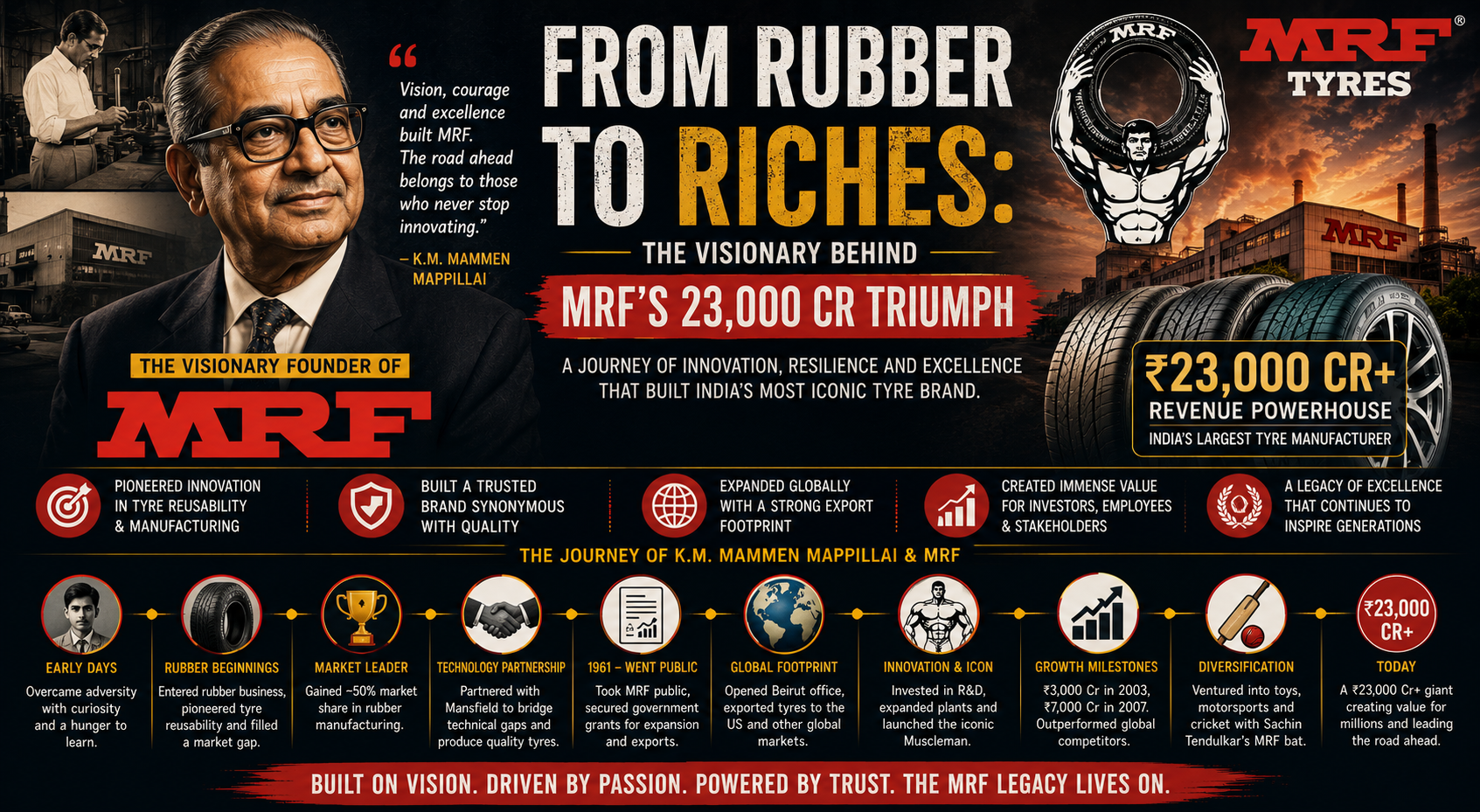
Discover the inspiring journey of K.M. Mammen Mappillai, the visionary founder who transformed MRF from a small rubber manufacturing business into a ₹23,000 crore tyre giant. Learn how innovation, resilience, and strategic leadership made MRF India's most iconic tyre brand.
How K.M. Mammen Mappillai Built One of India’s Most Valuable Manufacturing Success Stories
India’s entrepreneurial history is filled with inspiring stories of visionaries who transformed humble beginnings into industrial empires. Few stories, however, are as remarkable as that of K.M. Mammen Mappillai, the man who laid the foundation for what would become MRF-India’s largest tyre manufacturer and one of the country’s most respected corporate success stories.
Today, MRF is synonymous with reliability, performance, motorsports, cricket sponsorships, and world-class tyre manufacturing. The company commands enormous respect across global markets and has become one of India’s most valuable manufacturing enterprises, generating revenues exceeding ₹23,000 crore.
Yet the journey began not with tyres, billion-rupee investments, or massive factories. It started with a simple observation, a market gap, and an entrepreneur who refused to think small.
The rise of MRF is a story of resilience, foresight, innovation, and the unwavering determination of a visionary leader who believed that Indian manufacturing could compete with the very best in the world.
A Curious Mind Shaped by Adversity
Every entrepreneurial journey begins with a mindset.
For K.M. Mammen Mappillai, adversity became an unexpected teacher.
As a young man, he encountered challenges that shaped his character and sharpened his ability to identify opportunities where others saw limitations.
Rather than allowing obstacles to discourage him, he developed a deep sense of curiosity about business, manufacturing, and market needs.
This curiosity would eventually become the foundation of one of India’s most successful industrial enterprises.
Mappillai understood an important principle early in life: every challenge hides an opportunity for those willing to look deeper.
That philosophy would guide his entrepreneurial decisions for decades.
Discovering an Untapped Opportunity
During the early years of independent India, transportation infrastructure was expanding rapidly.
The number of vehicles on Indian roads was increasing, creating demand for tyres and tyre-related products.
However, tyre replacement costs remained high, and consumers often struggled with affordability.
Mappillai identified a critical gap in the market.
Instead of focusing immediately on manufacturing complete tyres, he explored solutions that would help extend tyre life.
This led him into rubber manufacturing and tyre retreading solutions.
The concept was simple yet powerful.
If vehicle owners could reuse and extend the life of their tyres, they would save money while maintaining performance.
The market responded positively.
What began as a niche opportunity soon evolved into a rapidly growing business.
The Birth of MRF
MRF, originally known as Madras Rubber Factory, began as a small venture focused on rubber products.
At a time when India’s industrial ecosystem was still developing, building a manufacturing company required extraordinary courage.
Infrastructure limitations, capital constraints, technological challenges, and limited access to expertise created significant barriers.
Yet Mappillai remained determined.
His approach differed from many entrepreneurs of the era.
Rather than focusing solely on short-term profits, he prioritized product quality, customer trust, and operational excellence.
These principles became the cornerstone of MRF’s culture.
Over time, the company’s reputation grew steadily.
Customers recognized the reliability of its products.
The business expanded accordingly.
Dominating the Rubber Market
One of the earliest indicators of MRF’s success was its rapid rise in the rubber manufacturing segment.
Mappillai’s foresight allowed the company to establish a dominant position in its category.
Industry observers noted that MRF eventually secured a significant share of the rubber products market, helping establish the brand as a trusted name among consumers and businesses alike.
The company’s growth was driven by a simple formula:
Consistent quality
Reliable performance
Customer-centric innovation
Operational efficiency
These factors enabled MRF to build strong foundations long before it entered large-scale tyre manufacturing.
The Bold Move into Tyre Manufacturing
As India’s automotive sector expanded, Mappillai recognized a larger opportunity.
The future belonged to tyre manufacturing.
However, producing world-class tyres required advanced technology and expertise that were not readily available in India at the time.
Many entrepreneurs would have viewed this challenge as a barrier.
Mappillai saw it as a strategic opportunity.
Understanding the importance of global knowledge, he sought international partnerships to accelerate learning and improve manufacturing standards.
This decision would become one of the most important turning points in MRF’s history.
The Mansfield Partnership
To bridge technological gaps, MRF entered into a partnership with Mansfield Tire & Rubber Company.
The collaboration provided access to technical expertise, manufacturing knowledge, and global best practices.
The early years were far from easy.
Establishing quality standards, training teams, and building production capabilities required significant effort.
Mistakes were inevitable.
Challenges emerged regularly.
Yet Mappillai remained focused on long-term goals rather than short-term setbacks.
The partnership eventually enabled MRF to manufacture tyres that could compete with international brands.
This achievement marked a significant milestone for Indian manufacturing.
Going Public for Growth
One of Mappillai’s greatest strengths was his ability to think strategically about capital.
He understood that sustained growth required access to funding.
In 1961, MRF took the bold step of becoming a publicly listed company.
The move provided several advantages.
It enabled the company to raise capital for expansion, strengthen investor confidence, and position itself for long-term growth.
Government support and industrial development initiatives further accelerated the company’s progress.
The decision demonstrated Mappillai’s understanding of corporate strategy and financial planning.
Rather than remaining a small private business, MRF embraced the responsibilities and opportunities of becoming a public enterprise.
Taking Indian Manufacturing Global
Long before globalization became a buzzword, Mappillai believed Indian products could succeed internationally.
This belief drove MRF’s export ambitions.
The company established an office in Beirut, creating a gateway for international trade and market expansion.
MRF’s tyres eventually reached overseas markets, including the United States.
For an Indian manufacturing company during that era, such achievements were extraordinary.
Exports not only generated revenue but also enhanced the company’s credibility.
Global customers demanded high standards.
Meeting those standards elevated MRF’s capabilities and strengthened its reputation.
Battling Global Competition
Success inevitably attracts competition.
As MRF expanded, it faced challenges from established international tyre manufacturers with significantly larger resources and stronger global networks.
The company also encountered obstacles related to government contracts, procurement policies, and product suitability across different regions.
Many competitors believed Indian manufacturers would struggle to compete globally.
MRF proved them wrong.
Instead of retreating, the company doubled down on innovation, research, and manufacturing excellence.
Every challenge became an opportunity to improve.
This mindset helped transform MRF into a resilient and highly competitive enterprise.
Investing in Research and Development
One of Mappillai’s most important contributions was his commitment to research and development.
He understood that sustainable success required continuous innovation.
MRF invested heavily in rubber technology, product testing, engineering improvements, and manufacturing processes.
These investments yielded significant benefits.
The company developed better-performing tyres capable of handling India’s unique road conditions and climate challenges.
By focusing on innovation rather than imitation, MRF built products specifically designed for Indian consumers while maintaining international standards.
The strategy created a powerful competitive advantage.
Building Factories Across India
As demand increased, MRF expanded its manufacturing footprint.
New plants enabled the company to serve customers more efficiently while increasing production capacity.
Each facility represented more than just industrial infrastructure.
They symbolized MRF’s commitment to long-term growth.
The expansion generated employment opportunities, strengthened local economies, and reinforced the company’s position as a leader in Indian manufacturing.
Through disciplined execution and strategic planning, MRF transformed from a regional business into a national powerhouse.
The Birth of the Muscleman
Every great brand has a memorable identity.
For MRF, that identity came in the form of the iconic Muscleman.
The image symbolized strength, durability, power, and reliability.
Over the years, the Muscleman became one of the most recognizable brand symbols in India.
It reflected everything MRF stood for.
Consumers associated the brand with performance and trust.
The marketing success demonstrated Mappillai’s understanding that building a company involves more than manufacturing products—it also requires building emotional connections with customers.
Beyond Tyres: Diversification and Brand Building
MRF’s ambitions extended beyond tyre manufacturing.
The company diversified into multiple areas, including toys, sports sponsorships, motorsports, and related ventures.
These initiatives strengthened brand visibility and expanded consumer engagement.
One of the most memorable milestones came through cricket.
The MRF logo became synonymous with some of the world’s greatest batsmen.
Most notably, cricket legend Sachin Tendulkar wielded an MRF-branded bat during some of the most iconic moments of his career.
The association elevated MRF’s visibility to millions of sports fans worldwide.
It transformed a manufacturing brand into a cultural icon.
Becoming a ₹3,000 Crore Enterprise
By 2003, MRF had grown into a company generating approximately ₹3,000 crore in revenue.
The achievement reflected decades of disciplined execution and strategic leadership.
From a small rubber venture, MRF had evolved into one of India’s largest industrial enterprises.
The milestone validated Mappillai’s long-term vision.
More importantly, it demonstrated that Indian manufacturing could achieve world-class scale without compromising quality.
Surpassing Global Giants
The years that followed brought even greater achievements.
By 2007, MRF had reportedly crossed ₹7,000 crore in revenue.
The company expanded manufacturing operations nationwide and strengthened its competitive position against global brands.
Industry observers increasingly viewed MRF as a benchmark for excellence.
Its ability to compete successfully against international giants such as Michelin highlighted the strength of its strategy.
Rather than relying on protectionism or market advantages, MRF earned its success through innovation, quality, and operational excellence.
Creating Wealth and Opportunity
One of the most remarkable aspects of MRF’s journey is its impact on wealth creation.
As the company grew, it generated value for employees, investors, suppliers, distributors, and shareholders.
MRF’s stock eventually became one of the most valuable shares in the Indian stock market.
Its extraordinary rise created significant wealth for long-term investors and became a symbol of patient investing.
The company’s success story inspired countless entrepreneurs and business leaders across India.
A ₹23,000 Crore Manufacturing Giant
Today, MRF stands as a ₹23,000 crore industrial powerhouse and one of India’s most admired companies.
Its products serve millions of customers across multiple countries.
Its factories produce world-class tyres trusted by consumers, businesses, and motorsports enthusiasts.
Its brand represents strength, reliability, and excellence.
Most importantly, it serves as a reminder of what visionary leadership can achieve.
The Legacy of K.M. Mammen Mappillai
The story of K.M. Mammen Mappillai is not merely about tyres.
It is about recognizing opportunities before others see them.
It is about embracing challenges rather than avoiding them.
It is about believing that Indian businesses can compete globally.
From identifying a simple market gap in tyre reusability to building one of India’s most successful manufacturing companies, Mappillai’s journey exemplifies entrepreneurial excellence.
His leadership transformed MRF into more than a business.
He built an institution.
An institution that continues to create jobs, drive innovation, reward investors, and represent Indian manufacturing excellence on the global stage.
As MRF continues its journey into the future, the legacy of its visionary founder remains deeply embedded in every tyre produced, every milestone achieved, and every road traveled.
The rise of MRF proves that extraordinary success often begins with a simple idea, relentless perseverance, and a leader bold enough to dream beyond the limitations of his time.
AI Conversationalist, Global Marketer, TEDx Speaker, Member-Board Of Studies-CDSW, AI Governance, Mentor Onboarded CCMB-Atal Incubation Center, Entrepreneurship Coach