From Startup to Sensation: Suhasini Sampath’s Yoga Bar Journey Culminates in ITC’s Strategic Acquisition
Discover the inspiring journey of Suhasini Sampath, founder of Yoga Bar, who left a prestigious consulting career to build one of India’s top healthy snack brands. Learn how Yoga Bar scaled through challenges, survived COVID, and attracted ITC’s multi-stage acquisition deal.
Bengaluru: In India’s fast-evolving startup ecosystem, success stories are often defined by resilience, timing, and the courage to challenge conventions. Few journeys embody this better than that of Suhasini Sampath, the woman who transformed a simple idea into one of India’s fastest-growing healthy snack brands – Yoga Bar.
What began as a bold entrepreneurial experiment soon turned into a household name among health-conscious consumers. Today, Yoga Bar stands as one of India’s leading clean-label nutrition brands, and its remarkable growth eventually caught the attention of FMCG giant ITC, which initiated a strategic acquisition of the company in a phased deal.
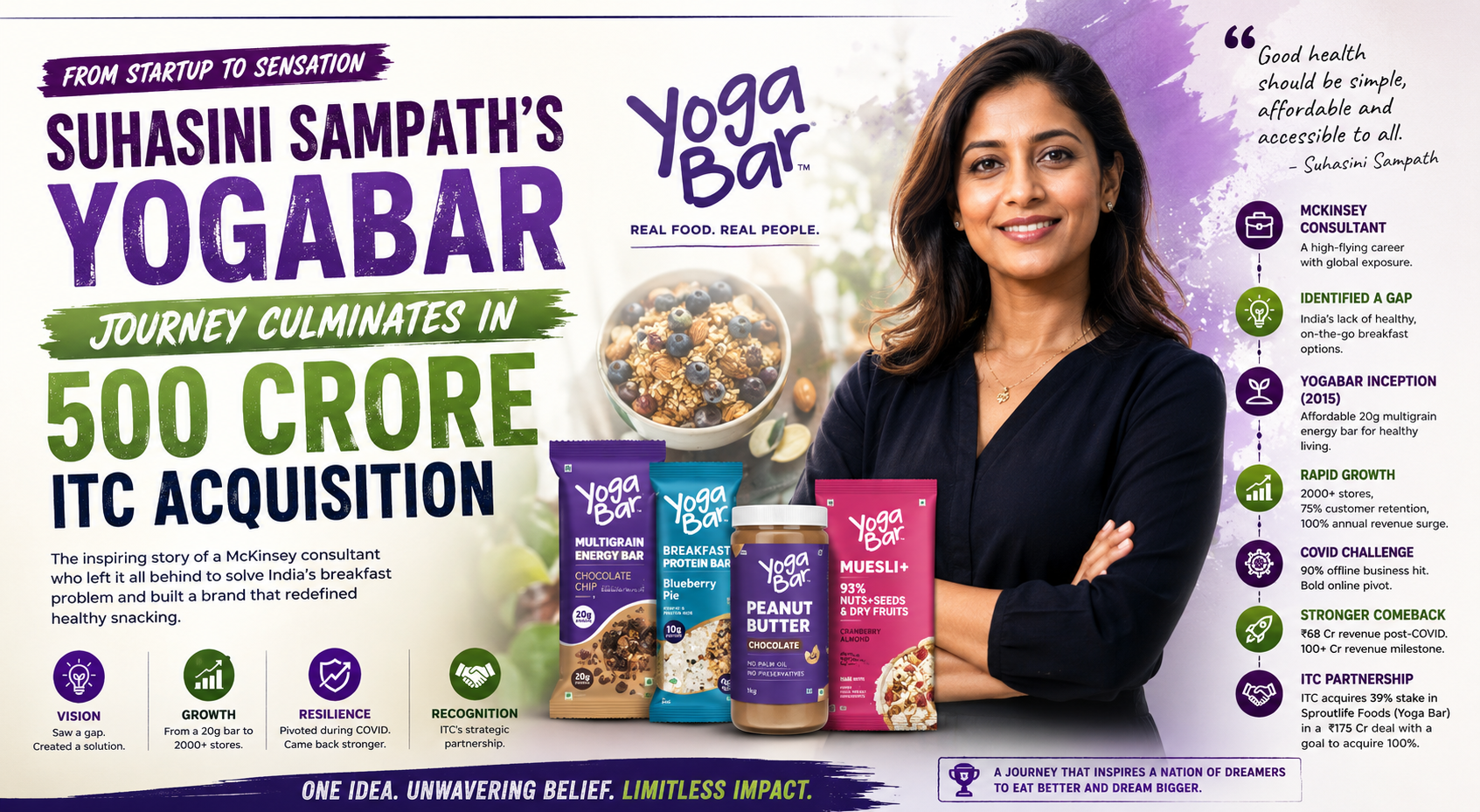
Though widely discussed as a ₹500 crore success story in startup circles, the reality is even more interesting. In 2023, ITC acquired a 39.42% stake in Sproutlife Foods, Yoga Bar’s parent company, for ₹175 crore, with plans to acquire the remaining stake in phases over the next few years, depending on valuation milestones. This strategic partnership signaled Yoga Bar’s evolution from startup to mainstream success.
A High-Flying Consultant Who Chose Entrepreneurship
Before becoming one of India’s most inspiring women entrepreneurs, Suhasini Sampath had a successful corporate career. A former McKinsey consultant, she worked in strategy and business consulting — a dream career many professionals aspire to build.
But despite professional success, Suhasini noticed something unusual during everyday life: India had a serious breakfast problem.
Busy professionals, students, and working families often skipped healthy breakfasts due to hectic schedules. Available packaged options were either unhealthy or lacked nutritional balance. While healthy snack bars had become common abroad, India still lacked affordable, clean-label alternatives.
Instead of accepting the market gap, Suhasini saw an opportunity.
Together with her sister Anindita Sampath Kumar, she decided to leave behind the security of corporate life and enter the uncertain world of entrepreneurship.
The move wasn’t glamorous.
There was no proven roadmap, no guaranteed customer base, and little understanding of how Indian consumers would respond to nutrition-focused products. Yet the sisters believed one thing deeply — India was ready for healthier food options.
That belief became the foundation of Yoga Bar.
The Birth of Yoga Bar: Solving India’s Breakfast Crisis
The idea behind Yoga Bar emerged from recognizing a simple but urgent problem — people needed healthy food on the go.
Founded in 2014–15 under Sproutlife Foods, Yoga Bar entered the market with an affordable 20-gram multigrain energy bar, designed to be both nutritious and convenient.
At a time when sugary snacks dominated shelves, Yoga Bar stood apart.
The brand focused on:
Clean ingredients
High-protein and high-fiber options
Minimal artificial preservatives
Convenience for busy lifestyles
Affordable healthy snacking
Rather than positioning itself as a luxury health brand, Yoga Bar focused on accessibility.
This proved to be a winning strategy.
Consumers increasingly sought healthier alternatives to traditional junk food, and Yoga Bar quickly built trust through transparency and product quality.
What started as a small startup gradually evolved into a recognizable health-food brand with a loyal customer base.
The Early Struggles: Building a Market That Barely Existed
Success did not happen overnight.
In fact, Yoga Bar entered a category that barely existed in India.
Unlike today’s booming health-food market, few consumers initially understood protein bars, healthy muesli, or nutritional snacks.
Suhasini and her team had to educate customers while simultaneously building demand.
The founders initially sold products through:
Gyms
Yoga studios
Health-conscious communities
Small retail outlets
Online marketplaces
It was a slow process.
Many investors were skeptical.
The market was niche, consumer behavior was uncertain, and scaling healthy products in India came with supply-chain challenges.
Yet Suhasini remained committed.
Her focus was never aggressive expansion at any cost. Instead, Yoga Bar prioritized product quality, customer retention, and trust-building.
That patience eventually paid off.
The brand began witnessing strong repeat purchases – with reports suggesting customer retention touching nearly 75%, a major milestone for any consumer startup.
Soon, Yoga Bar products reached 2,000+ stores, steadily building nationwide visibility.
Funding, Focus, and the Power of Sustainable Growth
Unlike many startups obsessed with rapid scaling, Yoga Bar took a relatively focused growth route.
The company raised nearly ₹70 crore in funding, helping strengthen manufacturing, supply chains, branding, and product innovation.
What made Yoga Bar different was its disciplined execution.
Instead of expanding recklessly, the company concentrated on becoming strong within the health-food segment.
The result?
Yoga Bar reportedly achieved 100% annual revenue growth, becoming one of India’s most promising nutrition brands.
Its product portfolio expanded rapidly beyond energy bars to include:
Muesli
Peanut butter
Protein bars
Healthy breakfast foods
Oats and nutrition-focused snacks
As health awareness increased among Indian consumers, Yoga Bar found itself perfectly positioned to ride the trend.
The timing could not have been better.
COVID-19 Nearly Disrupted Everything
Then came the biggest challenge.
The COVID-19 pandemic.
For many businesses, the lockdown period was devastating.
Yoga Bar was particularly vulnerable because nearly 90% of its business came through offline channels.
Retail stores shut down.
Movement restrictions increased.
Consumer purchasing behavior changed overnight.
For a startup dependent on physical retail, the crisis threatened years of hard work.
But this is where Suhasini Sampath’s leadership became most visible.
Instead of panicking, Yoga Bar pivoted quickly.
The company aggressively shifted toward online and direct-to-consumer channels, strengthening digital commerce and online sales.
This decision turned out to be transformational.
Rather than collapsing during the pandemic, Yoga Bar emerged stronger.
Post-COVID, the company reportedly touched nearly ₹68 crore in revenue, surprising even the founders themselves and proving that adaptability often matters more than perfect planning.
Crossing ₹100 Crore Revenue and ITC’s Entry
As Yoga Bar continued growing, bigger players began noticing.
India’s FMCG industry was rapidly shifting toward healthier consumption trends.
Consumers increasingly wanted:
Better ingredients
Protein-rich foods
Convenient nutrition
Low-sugar snacks
For ITC – already expanding its “Good For You” food portfolio -Yoga Bar represented a strong strategic fit.
In 2023, ITC announced a deal to acquire 39.42% stake in Sproutlife Foods for ₹175 crore, while laying out plans for a complete acquisition over 3–4 years through phased investments tied to valuation milestones.
The deal was seen as a major validation of Yoga Bar’s success.
While some startup discussions popularly valued the broader transaction near ₹500 crore, the initial confirmed acquisition was ₹175 crore for a minority stake, making the journey even more significant because it highlighted Yoga Bar’s long-term potential rather than a one-time exit.
For Suhasini Sampath, it was not merely a financial milestone.
It was proof that years of persistence had finally paid off.
More Than a Business Success Story
Suhasini Sampath’s journey is bigger than startup numbers or acquisition headlines.
It is a story about solving a real problem.
She entered a market that barely existed, educated consumers, survived investor skepticism, overcame supply-chain struggles, faced a pandemic, and still built a brand trusted by millions.
Most importantly, she succeeded without chasing shortcuts.
From having no established market and limited support systems to building a company that attracted one of India’s largest FMCG giants, her story reflects the changing face of Indian entrepreneurship.
For aspiring founders, especially women entrepreneurs, Yoga Bar’s rise offers a valuable lesson:
You do not always need to invent something revolutionary.
Sometimes, success comes from solving an everyday problem better than everyone else.
The Road Ahead
Today, Yoga Bar continues expanding across categories while leveraging ITC’s distribution strength and manufacturing ecosystem.
Industry experts believe the healthy-snacking market in India is still in its early stages, meaning Yoga Bar may only be getting started.
As India becomes more health conscious, demand for clean-label food brands is expected to grow sharply.
And when people look back at this transformation, one name will remain central to the story:
Suhasini Sampath – the former consultant who saw a breakfast crisis, trusted her instincts, and built a brand powerful enough to reshape India’s healthy eating habits.
Her journey proves that sometimes the biggest opportunities begin with the smallest daily frustrations — and the courage to do something about them.
AI Conversationalist, Global Marketer, TEDx Speaker, Member-Board Of Studies-CDSW, AI Governance, Mentor Onboarded CCMB-Atal Incubation Center, Entrepreneurship Coach