Kuldip Singh Dhingra: Architect of a ₹65,000+ Crore Turnaround for a Struggling Berger Paints
Discover the inspiring journey of Kuldip Singh Dhingra, who transformed Berger Paints into a ₹65,000+ crore market leader after acquiring control from the Vijay Mallya-linked era. Learn how innovation, resilience, and strategy powered one of India’s greatest business turnarounds.
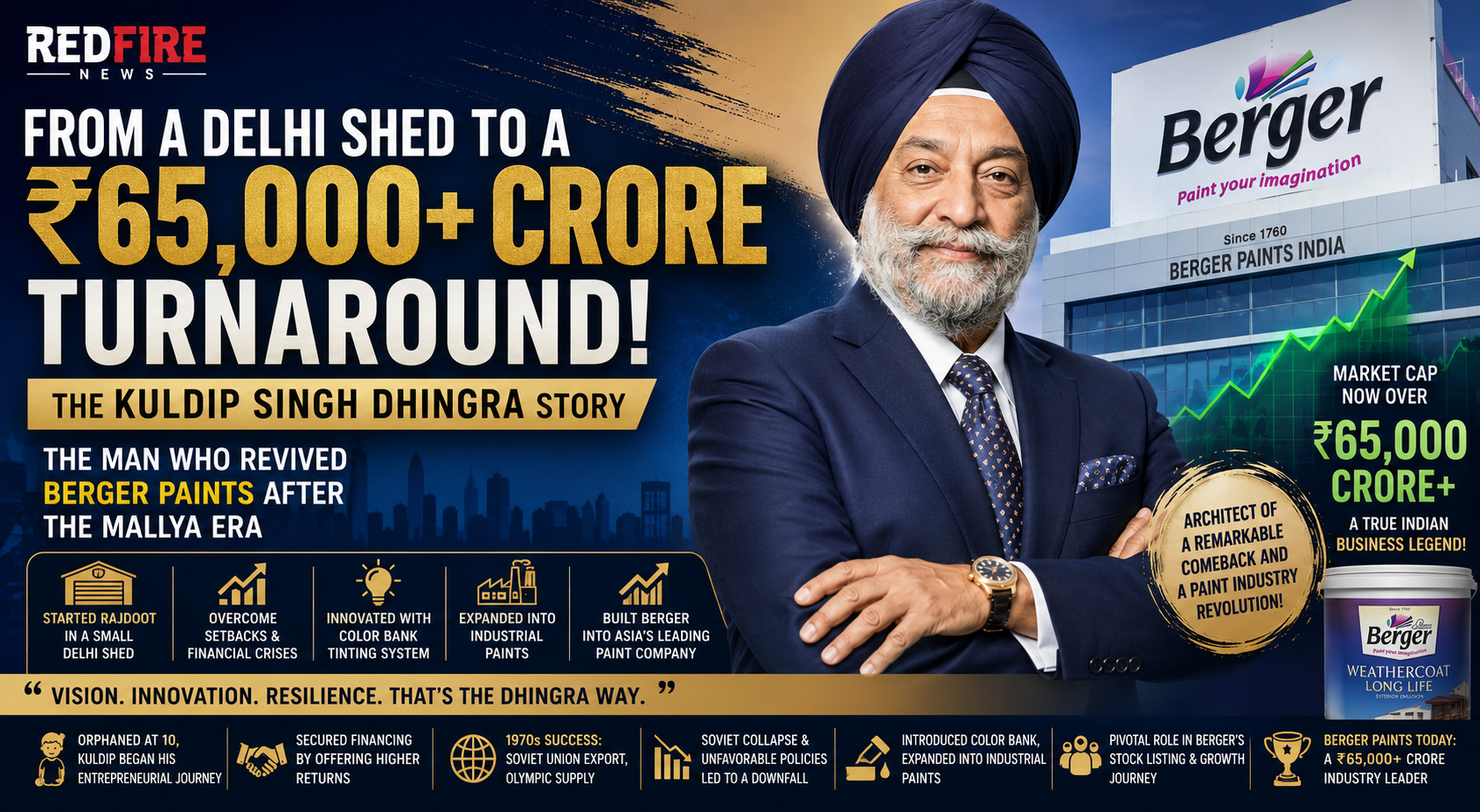
New Delhi/Kolkata: Every successful business story has a turning point – a moment when failure looks inevitable but someone sees possibility where others see collapse. For Kuldip Singh Dhingra, that moment came when he stepped into a struggling paint business that many had written off.
Today, Berger Paints India stands among Asia’s leading paint companies with a market capitalization exceeding ₹65,000 crore, a nationwide presence, and a dominant place in India’s booming decorative paint industry.
But the journey to this remarkable success did not begin in luxury boardrooms or inherited privilege.
It began in hardship.
It began with loss.
And it began in a small shed in Delhi.
Often described as one of India’s quietest business legends, Kuldip Singh Dhingra, alongside his brother Gurbaksh Singh Dhingra, built a business empire through grit, innovation, and strategic thinking.
While some narratives oversimplify the story as “saving Vijay Mallya’s company,” the reality is more nuanced and equally fascinating. The Dhingra brothers took charge of Berger Paints India, a company previously linked with the UB Group and Vijay Mallya era, and transformed it into a thriving enterprise through operational excellence and relentless focus.
This is the step-by-step journey of how one entrepreneur turned setbacks into extraordinary success.
Orphaned Young, But Never Defeated
Life tested Kuldip Singh Dhingra early.
Born into a family involved in paint trading, tragedy struck when he lost his parents at a young age. By the age of 10, he had experienced personal loss that could have easily shattered ambition.
But hardship often shapes extraordinary resilience.
Instead of surrendering to circumstances, Kuldip learned responsibility early.
The family’s modest business became both a necessity and an opportunity.
Together with his brother, he stepped into entrepreneurship at an age when most children are still figuring out school.
The brothers started Rajdoot Paints, operating from a small shed in Delhi, with limited resources but unlimited determination.
The early days were brutally difficult.
There was little capital.
Competition was intense.
The market favored established players.
But the Dhingra brothers had something powerful:
Persistence.
Teen Entrepreneur with an Unusual Financing Strategy
Starting a business without money is difficult.
Building one as a teenager is even harder.
Access to institutional financing was almost impossible.
Banks were hesitant.
Investors were absent.
But Kuldip Singh Dhingra found an unconventional solution.
According to business accounts of his early entrepreneurial phase, he reportedly secured financing by offering higher returns to local lenders, convincing people to trust his vision.
It was a risky move.
Failure could have destroyed the business before it even began.
But Kuldip believed deeply in the paint business.
He understood something many overlooked:
India’s housing and industrial sectors would continue growing, and paints would remain essential.
That long-term thinking helped Rajdoot survive its earliest struggles.
The brothers focused on quality, customer relationships, and disciplined operations.
Slowly, the business gained traction.
Rajdoot Paints: The Rise of a Small Brand
By the 1970s, Rajdoot Paints had started gaining momentum.
The company found a major opportunity through exports to the Soviet Union, a market that provided enormous demand for Indian products during that period.
This became a breakthrough moment.
Exports boosted revenues.
Business confidence increased.
Rajdoot began scaling operations rapidly.
At one stage, the company even reportedly became involved in supplying materials linked to major events such as the Olympics, helping establish credibility.
For the Dhingra brothers, it seemed like the beginning of long-term prosperity.
The company had survived the toughest phase.
Growth looked inevitable.
Then came a devastating setback.
When the Soviet Union Collapsed
The collapse of the Soviet Union in the early 1990s shook countless Indian exporters.
Rajdoot Paints was among the businesses deeply affected.
One of its biggest markets disappeared almost overnight.
At the same time, policy changes and growing competition increased pressure.
Suddenly, what looked like success began turning uncertain.
For many entrepreneurs, this would have been the breaking point.
But Kuldip Singh Dhingra was not someone who accepted defeat easily.
Instead of retreating, he pivoted.
And that decision changed everything.
The Berger Paints Opportunity
During this turbulent period, the Dhingra brothers saw a larger opportunity in the Indian paint industry.
Berger Paints India, which had earlier gone through ownership changes and associations with the UB Group led by Vijay Mallya, was struggling to unlock its full potential.
The paint sector itself was highly competitive.
Asian Paints dominated the market.
Kansai Nerolac was aggressively expanding.
New consumer expectations were emerging.
Many businesses struggled to keep pace.
Yet Kuldip saw something others missed:
A fundamentally strong brand with untapped potential.
The Dhingra family eventually gained control of Berger Paints India, beginning one of India’s most remarkable corporate transformation stories.
Importantly, this was not about rescuing Vijay Mallya’s larger business empire.
Rather, it involved reviving and rebuilding a paint company associated with the UB ecosystem and steering it toward long-term growth.
Innovation Becomes the Game-Changer
Kuldip Singh Dhingra understood that competing against giants required differentiation.
Price wars alone would never build leadership.
Innovation would.
One of Berger Paints’ most significant breakthroughs came through Color Bank tinting technology.
This innovation transformed how paints were sold.
Instead of offering only standard paint colors, customers could access thousands of customizable shades instantly.
This dramatically improved consumer experience.
Retailers benefited.
Homeowners gained flexibility.
The move helped Berger compete aggressively with established market leaders.
At a time when personalization was becoming important, Berger stayed ahead of the curve.
It was not merely selling paint anymore.
It was selling customization.
And customers loved it.
Expansion Beyond Decorative Paints
Kuldip Singh Dhingra also understood the importance of diversification.
Rather than relying solely on decorative paints, Berger expanded into:
Industrial coatings
Protective paints
Automotive coatings
Waterproofing solutions
Construction chemicals
This diversification reduced business risk while strengthening revenue streams.
Competing against giants like Asian Paints and Nerolac was never easy.
Yet Berger continued gaining market share.
The company built a reputation for quality and consistency.
It focused on innovation instead of imitation.
That mindset gradually transformed Berger into one of India’s most respected paint brands.
Berger’s Market Strategy and Stock Market Growth
Another crucial aspect of Kuldip Singh Dhingra’s leadership was financial discipline.
Berger Paints strengthened operations, improved efficiencies, and positioned itself for long-term public market growth.
Its stock listing became a pivotal milestone.
Investor confidence improved steadily.
As India’s housing market expanded and urbanization accelerated, paint demand surged.
Berger was perfectly positioned to capitalize.
The company expanded manufacturing.
Distribution widened.
Retail penetration deepened.
Consumer trust strengthened.
The results were extraordinary.
Over time, Berger Paints evolved into one of the top players in Asia’s paint industry.
Its market capitalization crossed ₹65,000 crore, turning what was once seen as a struggling business into a wealth-generating giant.
For Kuldip Singh Dhingra, this was not luck.
It was decades of disciplined execution.
Smart Branding and Competitive Positioning
Kuldip also understood the power of branding.
While competitors invested heavily in advertising, Berger carved out a unique identity.
AI Conversationalist, Global Marketer, TEDx Speaker, Member-Board Of Studies-CDSW, AI Governance, Mentor Onboarded CCMB-Atal Incubation Center, Entrepreneurship Coach