Suresh Narayanan: The Architect of Resilience Who Saved Maggi and Led Nestlé India’s Historic Comeback
Discover how Suresh Narayanan navigated the Maggi crisis, restored consumer trust, and engineered one of the greatest corporate comebacks in Indian business history for Nestlé India.
New Delhi: Corporate crises have the power to destroy decades of hard-earned trust within days. In the world of business, very few leaders get the opportunity to rescue an iconic brand from the brink of collapse and rebuild it stronger than before. One such leader is Suresh Narayanan, the man widely credited with steering Nestlé India through the most challenging period in its history and orchestrating the remarkable comeback of Maggi.
Today, Maggi remains one of India’s most beloved food brands, but in 2015, its future looked uncertain. A nationwide controversy led to product recalls, government scrutiny, consumer panic, and a complete halt in sales. What followed was one of the most dramatic corporate turnarounds in Indian business history.
At the center of that recovery stood Suresh Narayanan, whose calm leadership, strategic thinking, and unwavering belief in the brand helped restore trust and revive Nestlé India’s fortunes.
His story is not just about saving a product. It is about resilience, leadership under pressure, and the power of rebuilding confidence when everything seems lost.
The Unexpected Call That Changed Everything
Every major business turnaround has a defining moment.
For Suresh Narayanan, that moment reportedly began with a silent phone, multiple missed calls, and an urgent message from Nestlé leadership asking him to call back immediately.
At the time, Narayanan was serving in an international leadership role within Nestlé’s global operations.
The message was clear.
Nestlé India was facing a crisis unlike anything the company had experienced before.
Maggi, one of the company’s flagship brands and a product deeply embedded in Indian households, had become the subject of intense scrutiny.
What initially appeared to be a regulatory challenge soon escalated into a full-scale corporate emergency.
Narayanan was called back to India to help navigate the storm.
Few could have predicted the magnitude of the challenge waiting for him.
The Maggi Crisis That Shocked India
For decades, Maggi was more than just a noodle brand.
It was a cultural phenomenon.
From school children and college students to working professionals and families, Maggi occupied a special place in Indian kitchens.
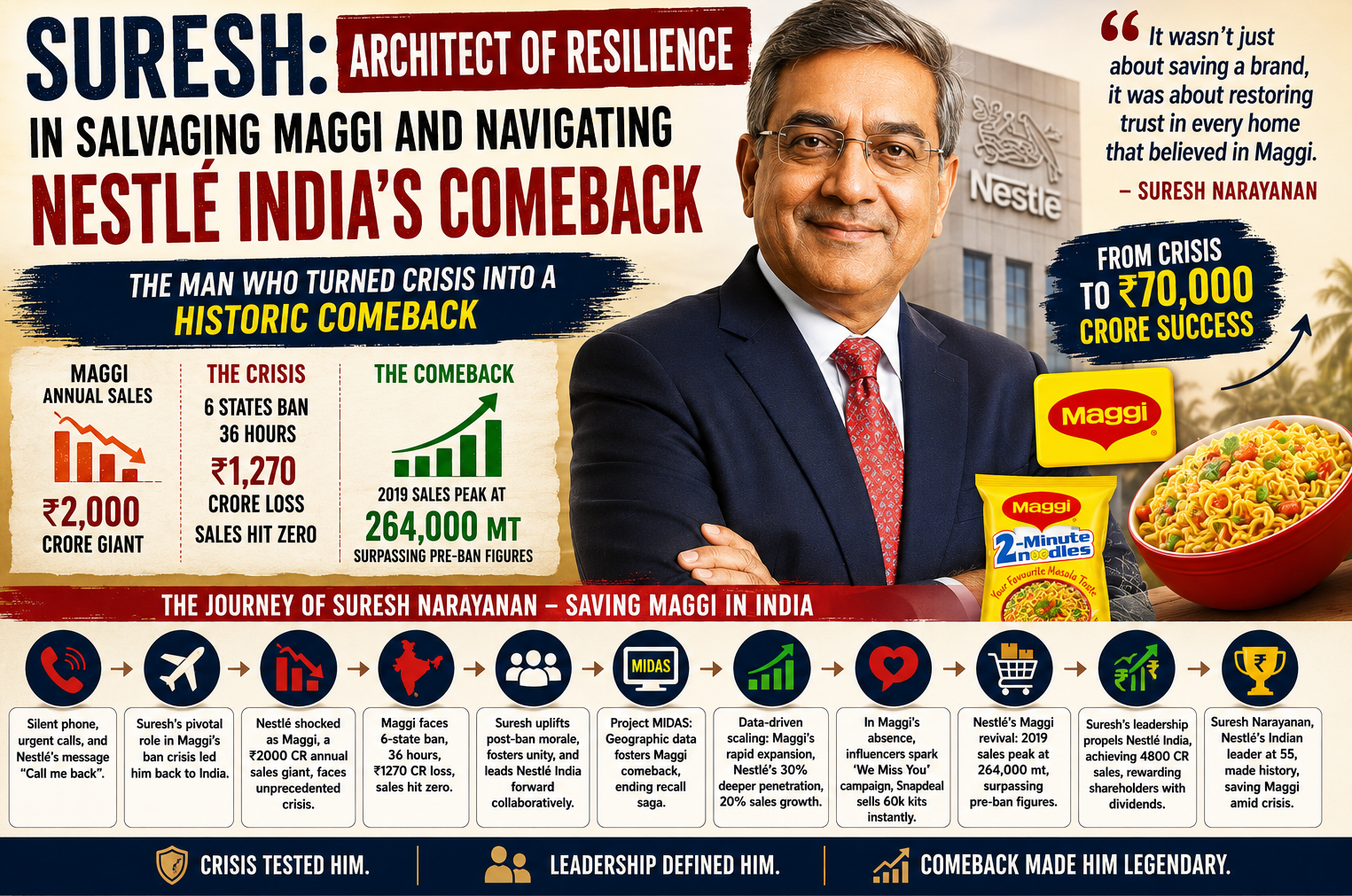
By 2015, the brand generated annual sales estimated at around ₹2,000 crore and enjoyed an overwhelming share of the instant noodles market.
Then came the crisis.
Questions regarding product safety triggered investigations, media attention, and regulatory action.
Public concern grew rapidly.
The controversy dominated headlines across the country.
Within a matter of weeks, a brand built over three decades faced an unprecedented challenge.
For Nestlé India, the impact was immediate and severe.
A Ban That Brought Sales to Zero
The crisis intensified when several states imposed restrictions on Maggi sales.
Within approximately 36 hours, the situation escalated dramatically.
Multiple states announced bans.
Retail shelves began emptying.
Consumers stopped purchasing the product.
What was once a market leader suddenly disappeared from stores.
The financial consequences were staggering.
Nestlé India reportedly suffered losses exceeding ₹1,270 crore due to recalls, inventory destruction, legal expenses, and lost sales.
More importantly, consumer trust had been shaken.
Sales effectively dropped to zero.
For a company accustomed to steady growth, the situation was unprecedented.
Many industry observers questioned whether Maggi could ever recover.
Returning to India in the Middle of the Storm
When Suresh Narayanan returned to India, he inherited one of the most difficult leadership assignments in modern corporate history.
The challenge extended far beyond operational issues.
Employees were anxious.
Distributors were uncertain.
Retailers were confused.
Consumers felt betrayed.
Investors were worried.
The company faced scrutiny from regulators, media organizations, and the public simultaneously.
In such circumstances, many leaders focus solely on damage control.
Narayanan chose a different path.
He focused on rebuilding trust.
Restoring Confidence Within the Organization
Before rebuilding consumer confidence, Narayanan understood that he needed to rebuild confidence inside the company.
Employees were emotionally affected by the crisis.
Many had spent years helping build the Maggi brand.
Seeing it disappear from store shelves was devastating.
Narayanan reportedly emphasized transparency, communication, and teamwork.
Rather than assigning blame, he encouraged collaboration.
He reassured employees that the company would face the challenge together.
This approach helped stabilize morale during an uncertain period.
By fostering unity, he ensured that the entire organization remained focused on recovery rather than panic.
The internal culture became one of Nestlé India’s greatest strengths during the crisis.
Facing the Recall Challenge
One of the most complex aspects of the crisis involved product recalls.
Millions of packets had to be withdrawn from markets across India.
Managing such a massive operation required extraordinary coordination.
The company had to identify products, collect inventory, manage logistics, and comply with regulatory requirements.
The process involved significant financial costs and operational complexity.
Yet Narayanan recognized that transparency was essential.
Rather than resisting scrutiny, Nestlé focused on cooperating with authorities and conducting extensive testing.
This willingness to engage openly helped lay the foundation for future trust-building efforts.
The Birth of Project MIDAS
As Nestlé prepared for a potential return of Maggi, Narayanan and his team realized that a traditional relaunch strategy would not be sufficient.
The company needed a smarter, more precise approach.
This led to the development of what became known internally as Project MIDAS.
The initiative relied heavily on geographic and consumer data.
Instead of attempting an immediate nationwide rollout, Nestlé carefully analyzed markets, consumer sentiment, and distribution readiness.
The objective was clear:
Reintroduce Maggi in a way that maximized impact while minimizing risk.
Project MIDAS became one of the key drivers of the brand’s eventual comeback.
It demonstrated the importance of data-driven decision-making during periods of uncertainty.
Winning Back Consumers
Rebuilding consumer trust is one of the most difficult tasks in business.
Trust lost during a crisis cannot be restored through advertising alone.
It requires consistency, transparency, and patience.
Narayanan understood this reality.
Nestlé invested heavily in communication initiatives aimed at reassuring consumers.
The company emphasized product testing, quality standards, and safety protocols.
Independent laboratory results were highlighted.
Consumer concerns were addressed openly.
The messaging focused not on defending the past but on demonstrating accountability and commitment to quality.
Gradually, public perception began to improve.
The Emotional Connection That Never Disappeared
One of the most surprising aspects of the Maggi crisis was the emotional attachment consumers continued to feel toward the brand.
Even while the product was unavailable, conversations about Maggi remained widespread.
Consumers shared memories.
Families discussed favorite recipes.
Social media users expressed nostalgia.
The emotional bond between the brand and its customers proved stronger than many analysts had anticipated.
This connection became an important asset during the recovery phase.
People had not forgotten Maggi.
In many cases, they were waiting for its return.
The “We Miss You” Movement
As Maggi remained absent from store shelves, an unusual phenomenon emerged.
Influencers, customers, and loyal fans began expressing their support online.
The popular “We Miss You” sentiment spread across social media platforms.
Consumers posted memories, photographs, and personal stories connected to the brand.
The campaign was largely organic.
It reflected genuine affection rather than traditional advertising.
The response highlighted an important lesson in brand building.
Strong brands are not merely products.
They become part of people’s lives.
For Nestlé India, this emotional support provided valuable evidence that recovery remained possible.
The Snapdeal Phenomenon
Another sign of Maggi’s enduring popularity emerged when the product returned to selected channels.
Reports suggested that approximately 60,000 Maggi kits sold almost instantly through online platforms such as Snapdeal.
The demand demonstrated that consumers were ready to welcome the brand back.
The rapid sales provided confidence to retailers, distributors, and investors.
It also validated Nestlé India’s strategy of carefully managing the relaunch process.
Consumer demand had survived the crisis.
Now the challenge was converting that demand into sustained growth.
Scaling Through Data and Precision
Following the initial relaunch, Nestlé adopted a carefully structured expansion strategy.
The company used data to determine where demand was strongest and where distribution networks could be activated most effectively.
This approach enabled efficient scaling.
Maggi returned to shelves gradually but confidently.
The company reportedly achieved deeper market penetration and stronger retail visibility than before the crisis.
Some estimates indicated a 30 percent improvement in penetration and approximately 20 percent growth in sales during recovery phases.
These results reflected the effectiveness of disciplined execution.
Rather than chasing quick wins, Nestlé focused on sustainable growth.
Surpassing Pre-Crisis Performance
One of the most remarkable aspects of the comeback story is that Maggi eventually surpassed its pre-crisis performance.
By 2019, sales volumes reportedly reached approximately 264,000 metric tonnes.
This figure exceeded levels recorded before the ban.
The achievement represented far more than a commercial victory.
It signaled complete consumer acceptance.
Millions of households once again trusted the brand.
The recovery demonstrated that even severe reputational crises can be overcome when organizations respond effectively.
For business leaders around the world, Maggi’s comeback became a case study in resilience.
Transforming Crisis into Opportunity
Suresh Narayanan often emphasized the importance of learning from adversity.
Under his leadership, Nestlé India emerged stronger, more agile, and more consumer-focused.
The crisis prompted improvements in communication, quality assurance, stakeholder engagement, and operational processes.
Instead of treating the episode as a setback, the company used it as a catalyst for transformation.
This mindset became a defining feature of Narayanan’s leadership style.
He viewed challenges as opportunities to strengthen the organization.
That perspective helped shape Nestlé India’s long-term success.
Driving Growth Beyond Maggi
While Maggi remained central to the recovery story, Narayanan’s contributions extended far beyond a single brand.
Under his leadership, Nestlé India continued expanding its portfolio across categories including beverages, dairy products, nutrition, and packaged foods.
The company strengthened its distribution network and invested in innovation.
Consumer trust improved across the broader brand ecosystem.
As a result, Nestlé India achieved significant business growth.
The company reportedly generated sales exceeding ₹4,800 crore while continuing to reward shareholders through strong financial performance and dividends.
These achievements reflected effective leadership at both strategic and operational levels.
Leadership Lessons from Suresh Narayanan
Several important lessons emerge from Suresh Narayanan’s journey.
First, leadership is tested during adversity, not prosperity.
Second, transparency builds credibility even in difficult situations.
Third, rebuilding trust requires patience and consistent action.
Fourth, data-driven decision-making can significantly improve recovery efforts.
Fifth, organizational culture plays a critical role during crises.
Perhaps most importantly, Narayanan demonstrated that resilience is not about avoiding challenges.
It is about responding to them with clarity, courage, and determination.
These principles remain relevant for business leaders across industries.
A Historic Legacy
Today, Suresh Narayanan is widely recognized as one of India’s most respected corporate leaders.
At a time when many believed Maggi’s reputation had suffered irreversible damage, he led one of the most remarkable brand recoveries in modern business history.
His leadership transformed a moment of crisis into a story of renewal.
More than saving a product, he helped restore confidence in an institution that millions of consumers had trusted for generations.
That achievement secured his place in Indian corporate history.
Conclusion
The story of Suresh Narayanan and Maggi’s revival stands as one of the greatest examples of crisis management and corporate resilience in India.
Faced with regulatory challenges, public scrutiny, collapsing sales, and widespread uncertainty, he chose transparency over defensiveness, collaboration over blame, and long-term trust over short-term optics.
His leadership helped Nestlé India navigate its darkest chapter and emerge stronger than before.
From managing massive recalls and restoring employee confidence to implementing Project MIDAS and leading Maggi’s successful return, Narayanan demonstrated exceptional strategic vision and execution.
Today, Maggi continues to be a beloved brand in India, and Nestlé India remains one of the country’s leading FMCG companies.
The comeback serves as a powerful reminder that even the most severe setbacks can be overcome through resilience, accountability, and leadership.
Suresh Narayanan’s journey proves that true leaders are not defined by the absence of crises but by their ability to guide organizations through them and emerge stronger on the other side.
AI Conversationalist, Global Marketer, TEDx Speaker, Member-Board Of Studies-CDSW, AI Governance, Mentor Onboarded CCMB-Atal Incubation Center, Entrepreneurship Coach