The Founder Who Waited 15 Years to Pay Himself-and Built an ₹8,929 Crore Analytics Empire Along the Way
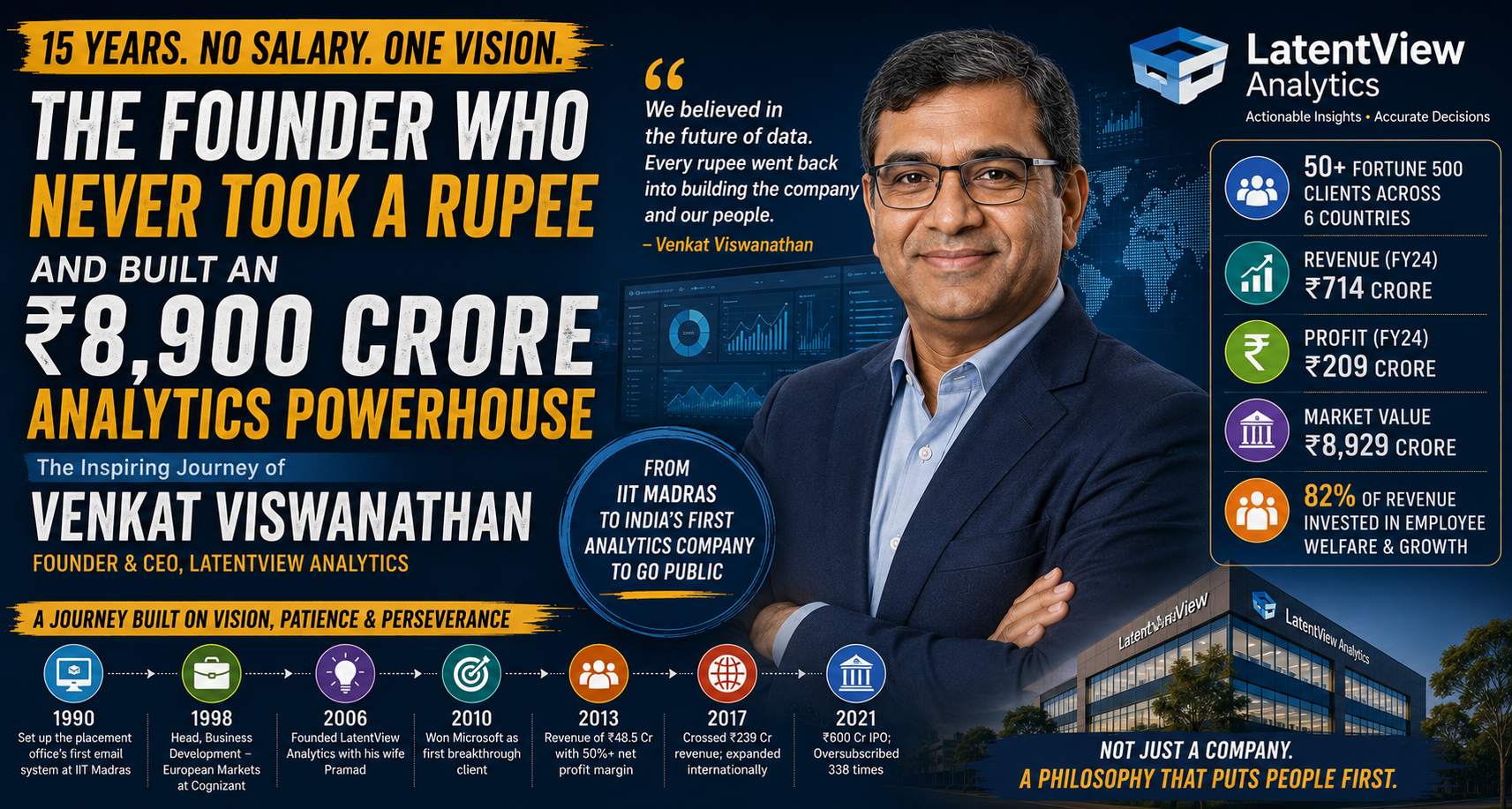
Discover the inspiring journey of Venkat Viswanathan, founder of LatentView Analytics, who left a successful corporate career, went years without a breakthrough client, took no money from his company for 15 years, and built an ₹8,929 crore analytics powerhouse serving Fortune 500 companies worldwide.
In the startup world, stories of overnight success often dominate headlines. Venture capital announcements, billion-dollar valuations, and high-profile exits create the impression that entrepreneurship is a fast track to wealth and recognition.
Reality is often very different.
Behind many successful businesses lie years of sacrifice, uncertainty, and relentless commitment. Few stories demonstrate this better than that of Venkat Viswanathan, the founder of LatentView Analytics, one of India’s most successful data analytics companies.
Today, LatentView Analytics serves more than 50 Fortune 500 companies across six countries, generates annual revenues exceeding ₹714 crore, earns profits of over ₹209 crore, and commands a market valuation of approximately ₹8,929 crore.
Yet perhaps the most remarkable detail about this success story has little to do with revenue, profit, or valuation.
For nearly fifteen years, Venkat Viswanathan reportedly chose not to take money from the company he founded.
Instead, he reinvested resources into building the business, supporting employees, and creating long-term value.
His journey from a curious engineering student in Chennai to the founder of India’s first publicly listed analytics company offers powerful lessons in patience, vision, and entrepreneurial perseverance.
A Technology Enthusiast Before the Internet Era
Long before terms like artificial intelligence, cloud computing, and big data became part of everyday business conversations, Venkat Viswanathan was fascinated by technology.
Born in Chennai to a father who worked as an accountant, he grew up in an environment that valued discipline, education, and problem-solving.
Technology captured his imagination early.
When he enrolled at the Indian Institute of Technology Madras, he became known for his curiosity and willingness to experiment with emerging technologies.
One of the most fascinating episodes from his student years occurred in 1990.
At a time when public internet services had not yet reached India, Venkat helped establish the first email system for the placement office at IIT Madras.
Today, sending emails is routine.
Three decades ago, it represented cutting-edge innovation.
The project reflected a characteristic that would define his career: the ability to recognize future trends before they became mainstream.
From Engineering to Management
After completing his education at IIT Madras, Venkat pursued management studies at the prestigious Indian Institute of Management Calcutta.
The combination of engineering expertise and business education gave him a unique perspective.
He understood technology deeply, but he also appreciated the commercial realities of running organizations.
Upon graduating, he joined the Chairman’s Office at the Essar Group.
The role exposed him to strategic decision-making at the highest levels of business.
He learned how large organizations operate, how investments are evaluated, and how long-term growth strategies are developed.
These experiences would later prove invaluable when building his own company.
Discovering the Power of Analytics
The next major chapter in Venkat’s career began in 1998 when he joined Cognizant.
At the time, the company was rapidly expanding its global footprint, and Venkat took responsibility for business development in European markets.
Working closely with international clients gave him exposure to a wide range of industries and business challenges.
During these years, he noticed a recurring pattern.
Organizations generated enormous amounts of data but struggled to extract meaningful insights from it.
Executives often relied on instinct, experience, and fragmented reports rather than comprehensive data-driven decision-making.
To Venkat, this represented an enormous opportunity.
He believed data would eventually become one of the most valuable business assets in the world.
The question was simple.
How could companies unlock that value?
A Life-Changing Sabbatical
In 2005, after years of corporate success, Venkat took a six-month sabbatical.
The break allowed him to step away from daily responsibilities and think deeply about the future.
What he discovered would shape the rest of his career.
Companies everywhere were sitting on what he described as “gold mines of data.”
Customer information.
Sales records.
Operational metrics.
Marketing performance.
Supply chain intelligence.
The information existed.
The expertise to use it effectively often did not.
Most organizations lacked the talent, tools, and frameworks necessary to transform raw data into business outcomes.
Venkat became convinced that analytics would emerge as a defining business capability for the future.
The realization was exciting.
The decision that followed was risky.
The Leap into Entrepreneurship
Encouraged by his wife, Pramad, Venkat decided to leave the comfort of corporate leadership.
Walking away from a successful career is never easy.
Doing so to enter an unproven market is even harder.
Nevertheless, he believed strongly in the opportunity.
Together, the couple launched a new venture in 2006.
The company was named LatentView Analytics.
Its mission was straightforward but ambitious.
Help organizations solve business problems through advanced analytics, artificial intelligence, machine learning, and data-driven decision-making.
Today that concept sounds obvious.
In 2006, it was revolutionary.
Most businesses had not yet embraced analytics as a strategic function.
The market needed education before it needed products.
That created challenges.
The Early Struggle
Launching a company is difficult.
Launching one in an emerging industry can be even harder.
For the first several years, growth was painfully slow.
Potential customers were interested in analytics but often unsure how to implement it.
Budgets were limited.
Decision-makers remained skeptical.
Then came the global financial crisis of 2008.
Businesses around the world reduced spending and delayed new technology investments.
For a young analytics startup, the environment could hardly have been worse.
Many founders would have abandoned their plans.
Venkat persisted.
He continued refining services, engaging clients, and strengthening capabilities.
The breakthrough simply took longer than expected.
Landing Microsoft
After years of persistence, the breakthrough finally arrived in 2010.
LatentView secured Microsoft as a client.
The engagement focused on optimizing digital marketing expenditure and standardizing marketing dashboards for global teams.
For a young company, winning Microsoft was transformational.
The project demonstrated that LatentView could deliver value to one of the world’s most sophisticated technology organizations.
Success with Microsoft opened new doors.
Prospective customers gained confidence.
The company’s credibility increased dramatically.
Most importantly, it proved that Venkat’s vision was commercially viable.
The years of patience had finally begun paying off.
Building a Strong American Presence
Following Microsoft’s engagement, LatentView secured additional contracts in the United States.
Soon, approximately 90 percent of company revenue originated from American clients.
This concentration was not accidental.
The U.S. market was more mature in its understanding of analytics and more willing to invest in data-driven transformation.
By focusing on the market where demand was strongest, LatentView accelerated growth.
The strategy worked remarkably well.
By 2013, annual revenue had reached approximately ₹48.5 crore.
Even more impressive was profitability.
Net profit margins approached 50 percent.
Such performance is rare for a growing technology services company.
Yet Venkat understood that long-term success required continuous evolution.
Expanding Beyond Analytics
As clients became more sophisticated, their needs expanded.
They no longer wanted only reports and dashboards.
They needed the underlying infrastructure capable of supporting advanced analytics.
Recognizing this trend, LatentView expanded into data engineering.
The company began helping organizations design, architect, and implement foundational data ecosystems.
These systems enabled scalable analytics, higher-quality data management, and improved business intelligence capabilities.
The move transformed LatentView from an analytics provider into a strategic technology partner.
Clients increasingly relied on the company for mission-critical initiatives.
Growth accelerated accordingly.
Investing in Delivery Capability
In 2013, LatentView established a new global delivery center in Chennai.
The investment reflected confidence in future demand.
The center enabled the company to recruit top talent, scale operations efficiently, and serve international customers more effectively.
The strategy paid dividends.
As capabilities expanded, so did customer relationships.
Organizations trusted LatentView with increasingly complex assignments.
The company developed expertise across industries, including technology, retail, financial services, healthcare, and consumer goods.
Its reputation continued strengthening globally.
Crossing Major Milestones
By 2017, LatentView had crossed ₹239 crore in annual revenue.
The company expanded further by establishing another delivery center in Bengaluru.
Its service portfolio also evolved significantly.
Instead of solving isolated analytical problems, LatentView adopted a “360-degree consumer analytics” approach.
This methodology helped organizations understand customer behavior comprehensively.
Businesses could identify patterns, anticipate needs, personalize experiences, and improve decision-making.
The approach resonated strongly with clients.
As digital transformation accelerated worldwide, demand for advanced analytics solutions continued rising.
LatentView was ideally positioned to capitalize on the trend.
The Historic IPO
The defining moment arrived in 2021.
LatentView Analytics decided to go public.
At the time, the company generated approximately ₹306 crore in annual revenue and served around 30 Fortune 500 clients, including globally recognized organizations such as Adobe and Uber.
Investor interest exceeded expectations.
The ₹600 crore initial public offering became one of the most sought-after issues in the market.
The IPO was oversubscribed an astonishing 338 times.
The response highlighted investor confidence in both the company and the broader analytics sector.
With the listing, LatentView became the first analytics-focused company to go public in India.
The market valuation reached approximately ₹3,800 crore.
For Venkat Viswanathan, it represented validation of a vision he had pursued for over fifteen years.
A Global Analytics Leader
Today, LatentView Analytics operates on a much larger scale.
The company generates annual revenue of approximately ₹714 crore and earns profits exceeding ₹209 crore.
Its customer portfolio includes more than 50 Fortune 500 organizations.
Operations span six countries.
The company’s valuation has grown to approximately ₹8,929 crore.
These achievements reflect not only market demand but also strategic execution.
It embraced artificial intelligence, machine learning, advanced analytics, data engineering, and digital transformation.
Rather than reacting to industry shifts, it frequently anticipated them.
That ability has become a defining competitive advantage.
The Remarkable Sacrifice
Among all the achievements associated with LatentView, one detail stands out.
Venkat Viswanathan reportedly chose not to take money from the company for nearly fifteen years.
The decision reflected extraordinary commitment.
Many entrepreneurs launch businesses with dreams of financial success.
Venkat prioritized building a sustainable organization.
Resources that might have gone toward personal compensation remained available for growth, hiring, capability development, and client service.
The choice required patience, discipline, and confidence in the future.
It also demonstrated belief in a simple principle.
If the company succeeded, long-term rewards would eventually follow.
That philosophy appears to have been correct.
Lessons from Venkat Viswanathan’s Journey
Several powerful lessons emerge from this remarkable story.
First, identifying future trends early can create significant opportunities. Venkat recognized the potential of analytics long before it became mainstream.
Second, patience matters. The company took years to secure its first major breakthrough.
Third, persistence often outperforms brilliance. Many founders have good ideas. Few continue pursuing them through difficult periods.
Fourth, customer trust is invaluable. Landing Microsoft created momentum that transformed the company’s trajectory.
The story of LatentView Analytics is not simply about revenue growth, profitability, or valuation.
It is a story about conviction.
A conviction that data would reshape business.
A conviction that analytics could solve complex problems.
And a conviction that building something meaningful requires sacrifice.
From installing an email system at IIT Madras before the internet era to leading one of India’s most respected analytics companies, Venkat Viswanathan’s journey illustrates the power of vision combined with perseverance.
Today, LatentView Analytics stands as an example of what can happen when a founder remains committed to a mission long before the rest of the world recognizes its value.
And perhaps that is the most inspiring lesson of all.
Sometimes, the biggest rewards come not from chasing immediate success, but from patiently building toward a future that only you can see.
AI Conversationalist, Global Marketer, TEDx Speaker, Member-Board Of Studies-CDSW, AI Governance, Mentor Onboarded CCMB-Atal Incubation Center, Entrepreneurship Coach