The Insurance Rebel: How Varun Dua Rewrote India’s Rulebook and Built an ₹8,800 Crore Digital Empire
From selling insurance policies online to building Acko into an ₹8,800 crore digital insurance powerhouse, discover how Shark Tank India judge Varun Dua transformed India's insurance industry through technology, customer-first innovation, and embedded insurance solutions.
From a Middle-Class Dreamer to Shark Tank India Investor, the Remarkable Journey of the Entrepreneur Who Made Insurance Simpler for Millions
In India, insurance has traditionally been viewed as one of the most complicated financial products.
Lengthy forms.
Confusing terms.
Aggressive sales pitches.
Slow claim settlements.
For decades, customers accepted these frustrations as unavoidable.
Then came an entrepreneur who questioned the entire system.
Instead of asking how to sell more insurance, he asked a much bigger question:
Why is buying insurance so difficult in the first place?
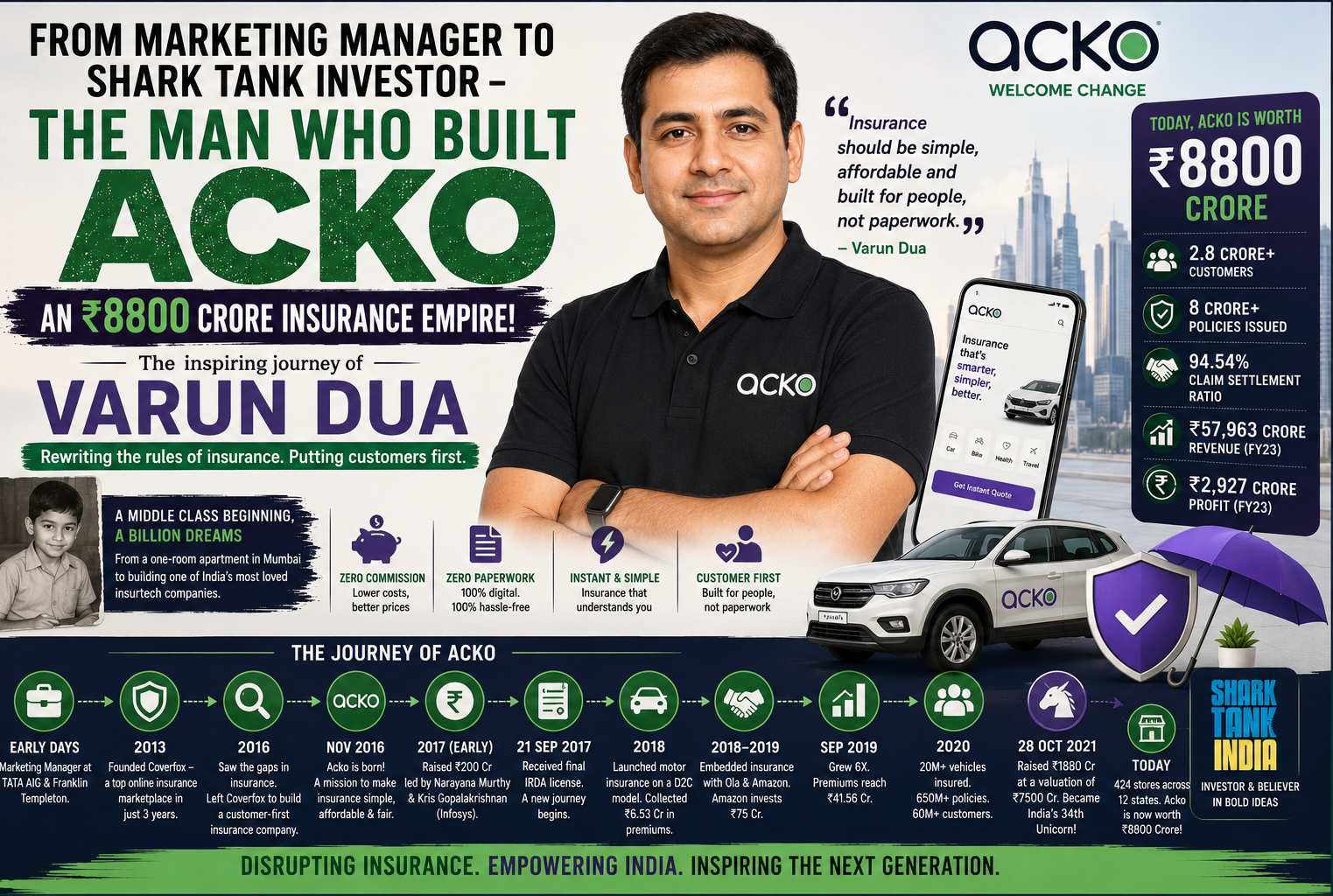
That question would eventually lead to the birth of Acko, one of India’s most successful insurtech companies, valued at nearly ₹8,800 crore today.
The man behind that transformation is Varun Dua, a first-generation entrepreneur who rose from a middle-class background to become one of India’s most recognized startup founders and a prominent investor on Shark Tank India.
His journey is not merely a story of building a unicorn.
It is a story of identifying an everyday problem, challenging decades-old industry practices, and using technology to make financial protection accessible to millions of Indians.
Today, Acko insures crores of customers, has issued hundreds of millions of policies, and boasts one of the strongest claim settlement records in the industry.
But its success began with dissatisfaction.
A dissatisfaction that pushed Varun Dua to leave behind a successful venture and start all over again.
Learning the Business from the Ground Up
Long before he became a startup founder, Varun Dua was a young professional learning the intricacies of financial services.
His career began in marketing roles with leading financial institutions, including Tata AIG and Franklin Templeton.
These experiences gave him a front-row seat to India’s evolving insurance and investment ecosystem.
He learned how products were designed.
How policies were sold.
How customer acquisition worked.
And most importantly, how customers felt during the buying process.
While many professionals spend years understanding industries from the outside, Varun was immersed in the day-to-day realities of insurance.
The experience planted seeds that would later shape his entrepreneurial vision.
The First Entrepreneurial Leap
Armed with industry knowledge and a growing ambition to build something meaningful, Varun launched Coverfox.
The platform aimed to simplify the process of comparing and purchasing insurance products online.
At a time when digital insurance adoption was still in its early stages, Coverfox represented a fresh approach.
Customers could compare multiple policies in one place and make informed decisions.
The concept resonated with consumers.
Within just a few years, Coverfox emerged as one of India’s leading online insurance marketplaces.
By most standards, it was a success.
The company was growing.
The platform was gaining recognition.
Customers were responding positively.
But Varun wasn’t satisfied.
Success had revealed a deeper problem.
Discovering the Real Problem
Running Coverfox exposed Varun to the limitations of India’s insurance ecosystem.
Even though the platform simplified policy comparison, the underlying industry remained complicated.
Customers still struggled to understand products.
Claims often involved lengthy procedures.
Documentation remained cumbersome.
The overall experience felt outdated.
Varun realized that marketplaces could only solve part of the problem.
The larger challenge lay within the insurance model itself.
Rather than continuing to improve distribution alone, he envisioned building an entirely new kind of insurance company.
One designed from the ground up around customer needs.
That vision led to a bold decision.
He left behind the comfort of an established business to start again.
The Birth of Acko
In November 2016, Acko was launched.
The company’s mission was clear.
Make insurance simple, affordable, and accessible.
The timing was significant.
India was experiencing rapid digital transformation.
Smartphone adoption was accelerating.
Online transactions were becoming mainstream.
Consumers were increasingly comfortable purchasing services digitally.
Varun believed insurance should evolve alongside these changes.
Instead of relying on traditional agent-driven distribution, Acko would operate digitally.
Instead of extensive paperwork, it would prioritize convenience.
Instead of complex products, it would offer simplicity.
The company was betting that technology could fundamentally transform insurance.
Eliminating Commissions and Complexity
One of Acko’s most disruptive innovations involved pricing.
Traditional insurance products often carried commission structures that added significantly to costs.
These commissions could account for 20 to 30 percent of premiums.
Varun saw an opportunity.
By selling directly through digital channels, Acko could eliminate intermediary commissions.
The savings could be passed on to customers.
The result was a new generation of bite-sized insurance products.
Affordable.
Easy to understand.
Quick to purchase.
Completely digital.
Zero paperwork.
This approach immediately differentiated Acko from traditional insurers.
Customers appreciated the convenience.
The industry took notice.
A disruption had begun.
Winning the Confidence of India’s Tech Titans
Building an insurance company requires substantial capital.
Fortunately for Varun, investors recognized the potential of his vision.
Shortly after receiving an in-principle license for general insurance operations, Acko secured approximately ₹200 crore in funding.
The round included support from industry legends Narayana Murthy and Kris Gopalakrishnan, co-founders of Infosys.
Their backing provided more than capital.
It offered credibility.
Validation.
Confidence.
For a young insurtech startup, these endorsements carried significant weight.
Yet an even more important milestone was approaching.
The IRDAI License That Changed Everything
On September 21, 2017, Acko received its final license from the Insurance Regulatory and Development Authority of India (IRDAI).
The approval represented a defining moment.
The company could now operate as a full-fledged insurer.
For Varun, this wasn’t merely regulatory clearance.
It was the green signal to execute a vision years in the making.
Acko could now challenge traditional insurance models directly.
And it wasted no time.
Starting with Motor Insurance
Acko initially focused on motor insurance.
The category offered significant scale opportunities.
Millions of vehicle owners required coverage.
However, customer experiences often remained frustrating.
Acko introduced a digital-first model.
Customers could purchase policies online without interacting with agents.
The process was streamlined, transparent, and efficient.
By 2018, the company had collected approximately ₹6.53 crore in insurance premiums.
The numbers were modest compared to industry giants.
But they demonstrated proof of concept.
Consumers were willing to embrace digital insurance.
The Insight That Changed Acko’s Growth Story
As Acko expanded, Varun identified a crucial insight.
Only a small percentage of India’s population had insurance coverage.
Traditional sales channels struggled to reach many consumers.
The solution was hiding in plain sight.
Instead of waiting for customers to seek insurance, why not offer protection precisely when they needed it?
This thinking gave rise to Acko’s embedded insurance strategy.
Insurance would become part of everyday transactions.
Purchased alongside products and services.
Simple.
Relevant.
Instant.
The strategy would become one of Acko’s most powerful growth engines.
The Ola Partnership
One of Acko’s most successful embedded insurance initiatives emerged through its partnership with Ola.
The collaboration introduced in-trip insurance coverage for ride-hailing customers.
Passengers could access protection seamlessly while booking rides.
The program eventually expanded across more than 110 cities.
For consumers, insurance became effortless.
For Acko, it created a scalable customer acquisition channel.
The partnership demonstrated the power of embedding insurance directly into digital experiences.
And it opened the door to additional collaborations.
Amazon Joins the Journey
Another major breakthrough came through Amazon India.
Acko partnered with the e-commerce giant to offer mobile protection plans and related insurance products.
The collaboration aligned perfectly with Varun’s vision.
Insurance became available at the exact moment customers purchased devices.
Convenience increased.
Adoption improved.
The potential impressed Amazon itself.
The company invested approximately ₹75 crore into Acko, becoming one of its strategic backers.
The investment signaled confidence in the future of embedded insurance.
Scaling Through Data and Technology
As partnerships multiplied, Varun recognized another important reality.
Insurance success depended heavily on underwriting accuracy.
The better the understanding of customer behavior, the stronger the business model.
Technology became central to Acko’s operations.
Data analytics helped assess risk more effectively.
By September 2019, Acko’s insurance premium collections had increased approximately six-fold to ₹41.56 crore.
Growth was accelerating.
The model was working.
Expansion Beyond Motor Insurance
Once the foundation was established, Acko expanded into adjacent categories.
Micro-loans.
Travel insurance.
Health-related products.
Gadget protection plans.
Each category addressed real consumer needs while leveraging Acko’s digital capabilities.
The company continued building partnerships across industries.
By creating insurance solutions tailored to specific transactions and customer journeys, Acko expanded its reach far beyond conventional distribution models.
Reaching Millions of Customers
The numbers soon became extraordinary.
By 2020, Acko had issued approximately 650 million policies.
Its customer base surpassed 60 million unique users.
Few startups in India’s financial services sector had achieved comparable scale in such a short period.
The success validated Varun’s belief that simplicity drives adoption.
Consumers wanted insurance.
They simply wanted it delivered differently.
Acko provided that alternative.
Becoming a Unicorn
The defining moment arrived in 2021.
Acko’s annualized premium run rate crossed ₹1,000 crore.
Customer numbers reached approximately 70 million.
Investor enthusiasm surged.
On October 28, 2021, Acko raised approximately ₹1,880 crore in fresh funding at a valuation of ₹7,500 crore.
The company officially entered India’s unicorn club.
It became the country’s 34th unicorn of the year.
For Varun Dua, the milestone represented years of persistence, experimentation, and belief in a radically different vision for insurance.
Building an ₹8,800 Crore Company
Today, Acko is valued at approximately ₹8,800 crore.
The company serves around 2.8 crore customers.
It manages over 8 crore active policies.
Its claim settlement ratio of approximately 94.54 percent reflects a strong commitment to customer service.
What began as a challenge to industry norms has evolved into one of India’s most influential insurtech businesses.
Acko continues to redefine how insurance is purchased, experienced, and understood.
From Entrepreneur to Shark
Success has also transformed Varun into an investor and mentor.
As a Shark Tank India judge, he now supports emerging entrepreneurs pursuing their own dreams.
The role represents a full-circle moment.
A founder who once sought investors is now backing the next generation of innovators.
His presence on the show reflects more than financial success.
It reflects credibility earned through execution.
Founders respect him because he has built a business from scratch.
Investors admire him because he created value through innovation.
Customers trust him because he solved real problems.
Lessons from Varun Dua’s Journey
Several powerful lessons emerge from Acko’s success story.
First, industries often contain hidden opportunities disguised as frustrations.
Second, customer-centric thinking can create competitive advantages that technology alone cannot.
Third, simplifying complex experiences can unlock massive markets.
Fourth, partnerships can accelerate growth when aligned with a clear strategy.
And finally, disruption doesn’t always require inventing something new.
Sometimes it means reimagining something old.
A New Blueprint for Insurance
For decades, insurance in India was associated with paperwork, complexity, and confusion.
Varun Dua challenged those assumptions.
He proved that insurance could be digital.
Affordable.
Transparent.
Convenient.
His journey from a middle-class upbringing to building an ₹8,800 crore company illustrates what happens when entrepreneurial vision meets relentless execution.
Today, millions of Indians interact with insurance differently because of Acko.
And while the company continues to grow, its greatest achievement may be something far more important.
It changed how people think about protection itself.
That transformation is what truly makes Varun Dua one of India’s most influential entrepreneurs-and one of the most compelling success stories to emerge from the country’s startup ecosystem.
AI Conversationalist, Global Marketer, TEDx Speaker, Member-Board Of Studies-CDSW, AI Governance, Mentor Onboarded CCMB-Atal Incubation Center, Entrepreneurship Coach