The Late Bloomer Who Challenged Biscuit Giants: How Krishnadas Paul Built a ₹2,100 Crore FMCG Empire After Turning 60
Discover the inspiring journey of Krishnadas Paul, who started Bisk Farm at the age of 60 and transformed it into a ₹2,100 crore biscuit empire. Learn how persistence, regional innovation, and entrepreneurial courage helped him challenge industry giants.
When Most People Plan Retirement, He Started a New Venture That Went On to Become One of India’s Biggest Biscuit Brands
Conventional wisdom often tells us that entrepreneurship is a young person’s game.
The startup world celebrates founders in their twenties.
Investors chase youthful disruptors.
Success stories frequently begin in college dormitories or corporate offices filled with ambitious young professionals.
But every once in a while, a story emerges that challenges every assumption about age, timing, and opportunity.
The story of Krishnadas Paul is one such example.
At an age when many people begin slowing down, thinking about retirement, and handing responsibilities to the next generation, Krishnadas Paul did something extraordinary.
He started a new business.
Not a small side project.
Not a consulting venture.
But a full-fledged consumer brand in one of India’s most competitive industries.
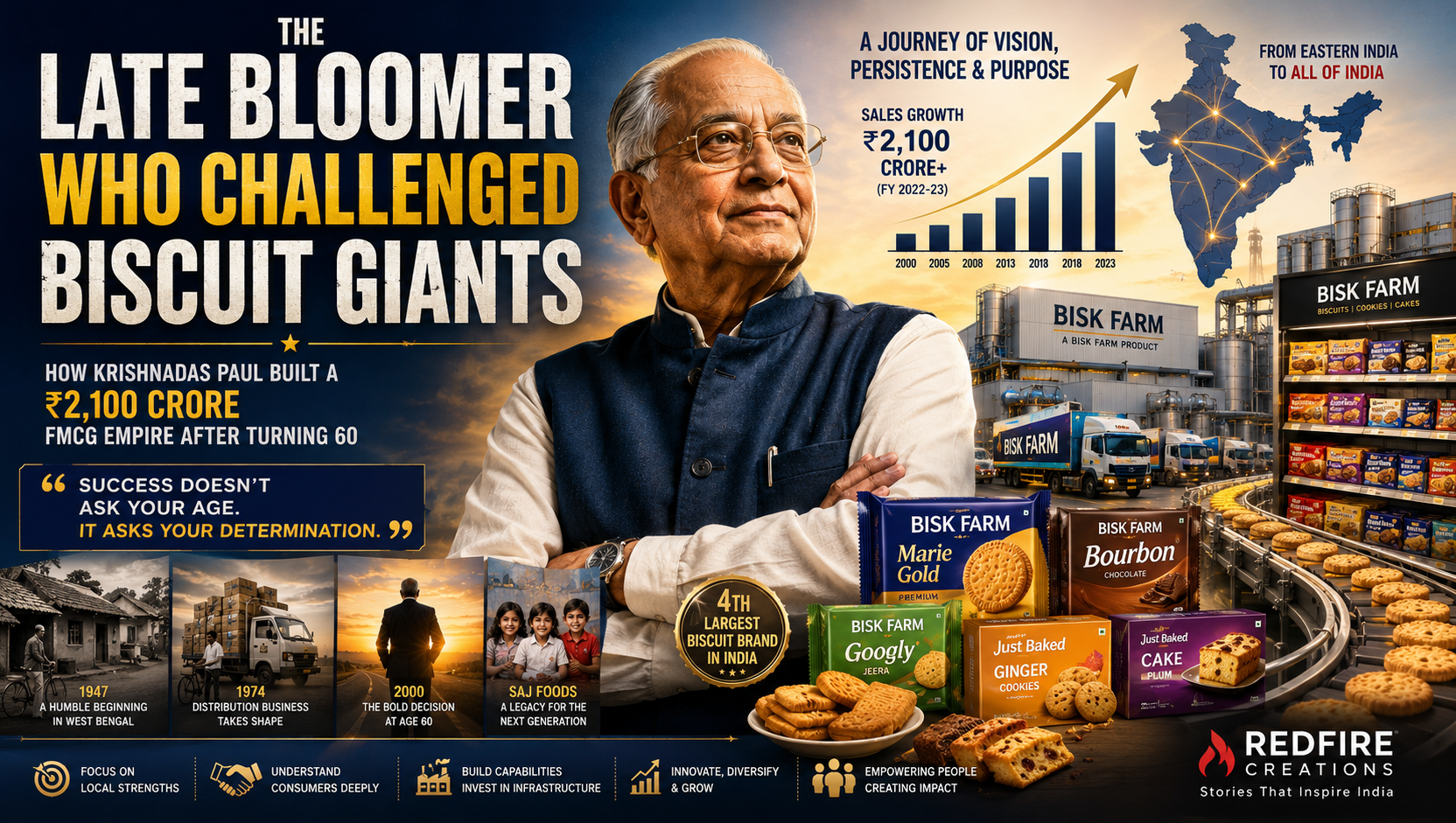
That decision eventually led to the creation of Bisk Farm, a company that grew into a ₹2,100 crore biscuit and bakery powerhouse, competing against some of the biggest names in the FMCG sector.
His journey is a reminder that entrepreneurship has no expiration date.
Success belongs not to the youngest person in the room, but to the one who refuses to stop dreaming.
A Humble Beginning in West Bengal
Krishnadas Paul was born in Kamarkita, a village in West Bengal.
Like many business families of the era, the Paul family believed in hard work, discipline, and building enterprises from the ground up.
His father established a distribution business in 1947, the same year India gained independence.
The venture started modestly but gradually earned a reputation for reliability and trust.
Young Krishnadas grew up watching the mechanics of trade and distribution.
He learned how products moved from manufacturers to consumers.
He observed customer relationships.
He understood logistics long before supply-chain management became a fashionable business term.
By 1974, the family distribution business had reached annual sales of approximately ₹3 lakh, a respectable figure for its time.
The future appeared stable.
The business was growing.
The family was progressing.
Everything seemed to be moving in the right direction.
Then circumstances changed.
When Family Business Became Family Division
As often happens in family enterprises, the business eventually underwent division among the next generation.
The operations were split among five brothers.
Krishnadas Paul inherited the distribution business.
While many people may have viewed the division as a setback, he saw it as an opportunity.
He focused relentlessly on expanding operations.
Over the next 26 years, he worked tirelessly to strengthen the distribution network.
His dedication paid off.
The company secured relationships with some of India’s most respected brands.
Names such as Dabur, Bournvita, and Reckitt became part of his growing business portfolio.
The distribution operation flourished.
Revenue expanded.
Industry connections strengthened.
Yet despite the success, something continued to bother him.
He was helping build other people’s brands.
He wanted to build his own.
The Dream That Refused to Fade
For decades, Krishnadas nurtured a personal ambition.
He wanted to create a consumer brand that would carry his vision and identity.
Distribution generated income.
But ownership of a brand created legacy.
The desire remained alive even after years of business success.
Most people would have considered the risk too great.
After all, launching a consumer brand required significant investment.
Competition was intense.
Market leaders were deeply entrenched.
Failure could erase years of accumulated wealth.
But entrepreneurs often see possibilities where others see obstacles.
Krishnadas made a bold decision.
He walked away from the comfort of an established business.
And he did so at the age of 60.
The Birth of SAJ Foods
In 2000, Krishnadas Paul incorporated SAJ Foods.
The company name held deep personal significance.
SAJ represented the initials of his three children—Sharmistha, Arpan, and Jayeeta.
The naming reflected his vision of creating not just a business, but a family legacy.
Under the umbrella of SAJ Foods, he launched a biscuit brand that would eventually become known across India.
Its name was Bisk Farm.
The objective was ambitious.
Build a biscuit company capable of challenging established giants.
The odds were daunting.
But Krishnadas believed experience could compensate for scale.
Entering a Market Dominated by Giants
The Indian biscuit industry was already crowded with powerful competitors.
Brands like Britannia and Parle enjoyed nationwide recognition.
Their products occupied shelves across urban and rural India.
Consumer loyalty was strong.
Advertising budgets were massive.
For a newcomer, breaking through seemed nearly impossible.
Yet Krishnadas had a different perspective.
Years spent in distribution had given him unique market insights.
He understood retailer behavior.
He knew consumer preferences.
He recognized gaps that larger companies often overlooked.
Most importantly, he understood regional tastes.
That understanding would become a decisive advantage.
The Googly Experiment
One of Bisk Farm’s earliest product concepts was called “Googly.”
The idea reflected variety and surprise.
Consumers could experience flavors inspired by diverse culinary traditions, ranging from traditional sesame recipes to European-style Petite Beurre biscuits.
The concept was innovative.
The products were distinctive.
The ambition was national.
However, execution proved challenging.
Despite enthusiasm and investment, the brand struggled to achieve widespread acceptance.
The dream of becoming a pan-India brand appeared increasingly distant.
By 2004, Bisk Farm had accumulated losses of approximately ₹15 crore.
For many entrepreneurs, this would have been the end.
The losses were substantial.
The competition remained fierce.
The future looked uncertain.
Krishnadas considered giving up.
But he decided to make one final attempt.
The Strategy That Changed Everything
Instead of trying to conquer the entire country, Krishnadas narrowed his focus.
He concentrated on Eastern India.
West Bengal.
Jharkhand.
Bihar.
Odisha.
These markets shared cultural preferences and consumer behaviors that he understood deeply.
The company launched seven new products designed specifically around regional tastes.
The strategy represented a significant shift.
Rather than competing directly with national brands on their terms, Bisk Farm would win by serving local consumers better.
In January 2005, the company supported the product launches with television advertising campaigns.
The results exceeded expectations.
Consumers responded enthusiastically.
Retailers increased orders.
Brand awareness surged.
The turnaround had begun.
Becoming Eastern India’s Favorite Biscuit
The breakthrough products included localized versions of popular biscuit categories such as Marie Gold and Bourbon.
These offerings balanced familiarity with regional preferences.
Consumers embraced them.
Within a relatively short period, Bisk Farm emerged as the second-largest biscuit brand in Eastern India.
Its market share approached an impressive 40 percent in several key markets.
The success validated Krishnadas Paul’s strategy.
Understanding local consumers proved more powerful than attempting to replicate national competitors.
Revenue accelerated rapidly.
By 2008, Bisk Farm had reached sales of approximately ₹200 crore.
The company that had been struggling just a few years earlier was now a major regional force.
Thinking Beyond Biscuits
Success brought new challenges.
Krishnadas understood that market leadership could attract aggressive competition.
Industry giant Britannia was unlikely to ignore a fast-growing challenger indefinitely.
The solution was diversification.
Rather than relying solely on biscuits, SAJ Foods expanded into adjacent bakery categories.
In 2009, the company launched Just Baked.
The brand offered products including cakes, rusks, cookies, and premium bakery items.
The move broadened the company’s revenue streams and strengthened its consumer presence.
By November 2009, Just Baked operated through multiple retail outlets and was gaining traction among customers.
The expansion demonstrated Krishnadas’ willingness to evolve rather than remain dependent on a single product category.
Building Manufacturing Strength
As demand increased, production capacity became critical.
To support growth, Bisk Farm invested heavily in manufacturing infrastructure.
New facilities were established at Uluberia and Sankrail.
The company later added a large-capacity plant serving markets across Eastern and Northeastern India.
These investments transformed SAJ Foods from a regional player into an integrated FMCG manufacturer.
The facilities improved production efficiency.
They reduced logistical costs.
They strengthened quality control.
Most importantly, they provided the foundation needed for nationwide expansion.
Infrastructure became a competitive advantage.
Taking Bisk Farm National
With manufacturing capacity secured and Eastern India firmly established, Krishnadas revived his original dream.
Bisk Farm would become a national brand.
The company expanded into southern markets including Tamil Nadu and Andhra Pradesh.
A rapidly growing distribution network supported the rollout.
Eventually, more than 1,700 distributors carried Bisk Farm products across multiple regions.
Unlike many competitors, the company maintained stable pricing despite expansion.
This strategy helped build consumer trust.
Customers appreciated consistency.
Retailers valued reliability.
The combination accelerated market penetration.
The brand was no longer a regional success story.
It had become a pan-India challenger.
The Just Baked Success Story
While Bisk Farm continued growing in biscuits, Just Baked emerged as another major success.
The brand introduced innovative bakery products that resonated strongly with consumers.
Among the standout performers were Just Ginger cookies.
The product became a blockbuster success.
Its popularity demonstrated the company’s ability to innovate beyond traditional biscuit categories.
The bakery business generated additional revenue streams while strengthening overall brand equity.
This diversification reduced risk and created opportunities for long-term growth.
Crossing the ₹1,200 Crore Milestone
The momentum continued throughout the 2010s.
Distribution expanded.
Product portfolios widened.
Manufacturing capabilities improved.
Consumer trust deepened.
By 2021, Bisk Farm’s revenues had climbed to approximately ₹1,251.4 crore.
Profits exceeded ₹104 crore.
These figures reflected more than financial success.
They represented the triumph of persistence.
A company that once faced losses had evolved into one of India’s fastest-growing FMCG brands.
Yet the biggest milestone was still ahead.
Reaching ₹2,100 Crore in Sales
By 2023, Bisk Farm crossed approximately ₹2,100 crore in annual sales.
The achievement positioned the company among India’s largest biscuit manufacturers.
Nationally, Bisk Farm became the fourth-largest player in the category.
Its market share reached approximately 4 percent.
While that figure may appear modest, it is significant in a market dominated by long-established giants.
The accomplishment demonstrated how focused execution and consumer understanding can overcome scale disadvantages.
Krishnadas Paul’s vision had become reality.
Leadership Rooted in Experience
One of the most remarkable aspects of Krishnadas Paul’s journey was his leadership philosophy.
He never relied on startup buzzwords.
He did not chase trends.
His decisions were grounded in decades of practical business experience.
He understood distribution.
He understood consumers.
He understood retailers.
These insights allowed him to navigate challenges with patience and confidence.
His success illustrates the value of accumulated wisdom.
Age became an advantage rather than a limitation.
A Legacy Beyond Business
On August 3, 2020, Krishnadas Paul passed away.
His departure marked the end of an extraordinary entrepreneurial life.
But his legacy continues.
Every Bisk Farm product on a retail shelf tells part of his story.
A story of courage.
A story of reinvention.
A story of refusing to accept that dreams have an age limit.
Thousands of employees, distributors, retailers, and consumers remain connected to the enterprise he built.
His impact extends far beyond revenue numbers.
Lessons from Krishnadas Paul’s Journey
There are powerful lessons embedded within this remarkable success story.
First, experience can be one of the greatest competitive advantages in business.
Second, understanding local markets often creates opportunities that larger competitors overlook.
Third, setbacks do not define entrepreneurs—responses do.
Fourth, diversification strengthens resilience.
Most importantly, age should never determine ambition.
Krishnadas Paul launched the defining venture of his life at 60.
Many people spend that stage of life reflecting on achievements.
He used it to create new ones.
The Entrepreneur Who Proved It’s Never Too Late
In a world obsessed with youthful founders and overnight success stories, Krishnadas Paul offered a different blueprint.
His journey demonstrates that entrepreneurship is not about age.
It is about vision.
It is about persistence.
It is about believing in possibilities long after others have stopped.
From a village in West Bengal to building a ₹2,100 crore FMCG powerhouse, he transformed decades of experience into one of India’s most inspiring business success stories.
And perhaps his greatest achievement was not building Bisk Farm.
It was proving to millions of aspiring entrepreneurs that some dreams are worth pursuing regardless of when you start.
AI Conversationalist, Global Marketer, TEDx Speaker, Member-Board Of Studies-CDSW, AI Governance, Mentor Onboarded CCMB-Atal Incubation Center, Entrepreneurship Coach