The Man Who Turned ₹13,000 Into a Dairy Revolution: How R.G. Chandramogan Built an ₹8,000+ Crore Legacy One Scoop at a Time
Discover how R.G. Chandramogan transformed a ₹13,000 investment into one of India’s largest private dairy businesses through Arun Icecreams, Arokya and Hatsun’s relentless focus on quality, distribution and consumer trust.
And a rare few build habits that become part of everyday life.
For millions across South India and increasingly across the country, ice cream was not simply dessert-it became a memory attached to one name: Arun.
Behind that familiar brand stands a man whose journey began with neither inherited industrial wealth nor elite corporate networks.
He began with a small amount of capital, a practical understanding of consumers, and the courage to start.
His name is R. G. Chandramogan.
Today, through Hatsun Agro Product Ltd and brands like Arun Icecreams, Arokya Milk and Ibaco, his entrepreneurial journey has become one of India’s most remarkable business stories. Hatsun has grown into one of India’s largest private-sector dairy companies. But this story did not begin in corporate headquarters.
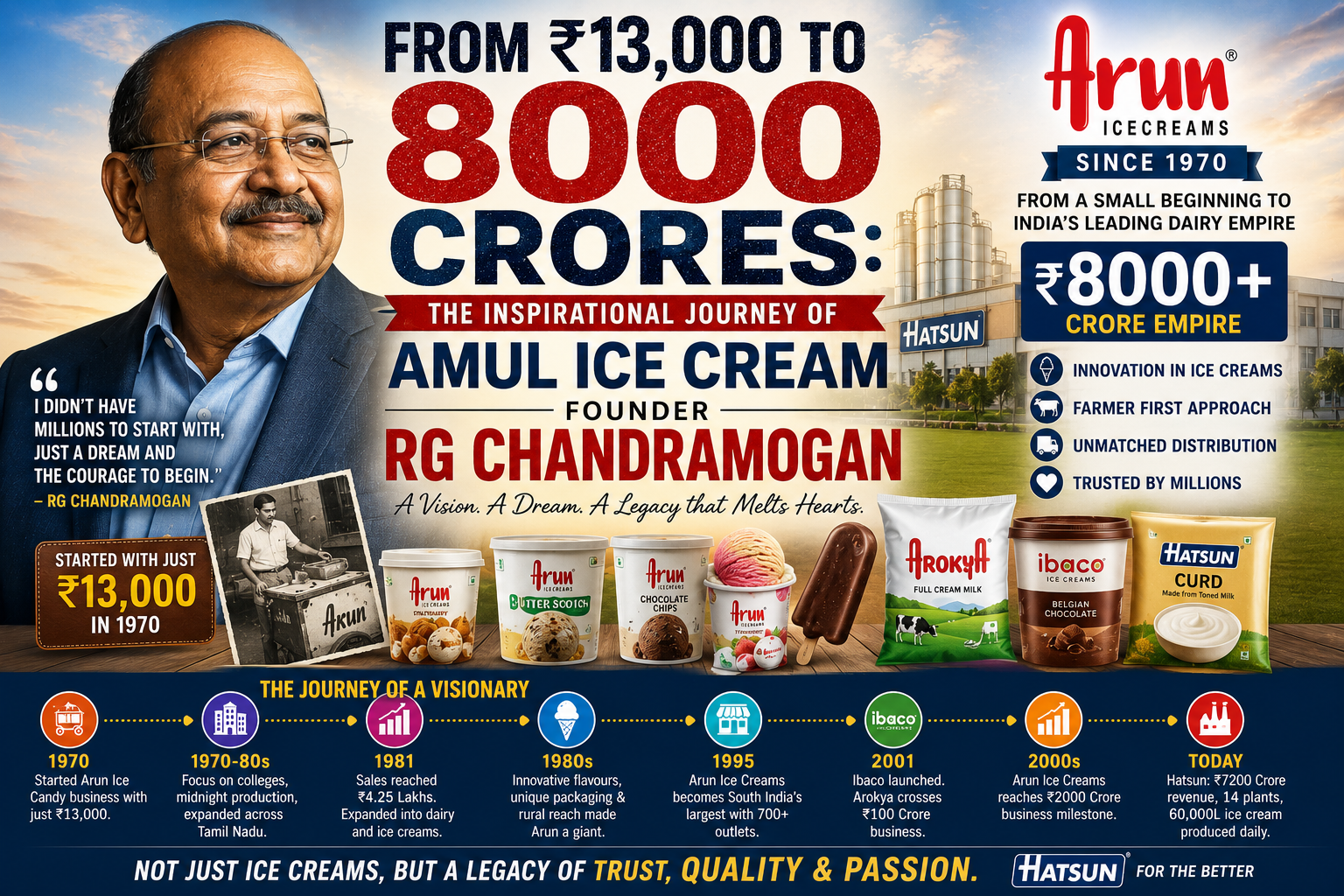
It began with ₹13,000.
A Small Town Dream That Refused to Stay Small
R.G. Chandramogan was born in Thiruthangal near Sivakasi in Tamil Nadu and belonged to the first generation of entrepreneurs emerging from the region. His early years were shaped more by observation and hustle than privilege.
Unlike many celebrated business founders today, his path was not built through prestigious institutions.
He left formal education early.
He entered the world of business young.
And he chose something that, at that time, few considered a scalable opportunity:
Ice cream.
That decision would eventually redefine India’s dairy landscape.
The ₹13,000 Bet
Every successful business has a moment where possibility outweighs certainty.
For Chandramogan, that moment arrived in 1970.
Armed with roughly ₹13,000, operating from a small setup and supported by a tiny team, he launched his ice cream business. Early operations relied on simple distribution and local demand rather than large infrastructure.
There was no venture capital.
No growth hacking.
No startup ecosystem.
Just execution.
The business started modestly-making ice candies and selling them through pushcarts.
But what appeared small carried one important advantage:
Direct customer understanding.
Learning the Market Before Building Scale
Many entrepreneurs begin with a product.
Chandramogan began with behavior.
Instead of immediately expanding, he studied:
When people bought
Which flavours worked
Where demand appeared
How distribution affected sales
His earliest growth came through educational institutions, local retail channels and carefully selected locations.
Within the first year, revenues reportedly crossed ₹1.5 lakh-a significant signal that demand existed.
The business had momentum.
Now it needed identity.
Birth of Arun Icecreams
The company launched under what would become one of South India’s most recognized food brands—Arun.
Arun Icecreams would gradually become known for affordability, accessibility and local flavor preferences.
Unlike premium international formats, Arun positioned itself for everyday consumers.
That decision became a strategic advantage.
The brand expanded rapidly and became a leading ice cream name in Tamil Nadu. Over time, its retail footprint spread across multiple southern states.
Building at Midnight So Customers Could Buy Tomorrow
One of the recurring stories around Chandramogan’s entrepreneurial phase was operational intensity.
Factories worked late.
Distribution moved constantly.
Execution became culture.
This wasn’t only about manufacturing more.
It was about making products available where competitors were absent.
That principle helped create early market leadership.
The lesson was simple:
Availability wins before advertising does.
Turning a Seasonal Business Into a Daily Habit
Ice cream had one obvious limitation.
Seasonality.
Summer sales were strong.
Other months created uncertainty.
Many businesses accept seasonality.
Chandramogan challenged it.
He began expanding deeper into dairy.
That strategic move later changed everything.
The Dairy Pivot That Created an Empire
As procurement capabilities improved, the company moved beyond frozen products.
Milk became the next growth engine.
That decision eventually led to the creation and expansion of Arokya.
This transformed the company from an ice cream manufacturer into a dairy ecosystem.
Milk.
Curd.
Butter.
Ghee.
Value-added products.
The company built relationships directly with farming communities and expanded processing capacity.
The business was no longer seasonal.
It became everyday consumption.
Thinking Beyond Cities
One of Chandramogan’s lesser-discussed strengths was market selection.
Instead of concentrating only on metros, expansion moved into smaller cities and emerging consumption zones.
This approach created deep distribution.
The company recognized something early:
India’s future demand would not come from only major cities.
It would come from everywhere.
That insight later became a major competitive advantage.
Packaging That Changed Consumer Behavior
Sometimes growth comes not from invention-but from accessibility.
Arun and Hatsun continuously adapted formats and retail experience.
Smaller pack sizes.
Localized preferences.
Strong cold-chain execution.
Wider retail access.
The company made premium experiences feel approachable.
Consumers responded.
Building Brands, Not Just Products
Over time, the portfolio expanded.
Beyond Arun and Arokya, the company introduced premium formats.
One of the most visible examples became Ibaco.
Ibaco moved into experience-driven ice cream retail through scoop-based parlour formats.
This created multiple price points.
Multiple audiences.
Multiple growth engines.
A business that once depended on pushcarts had evolved into a branded consumer ecosystem.
The Distribution Obsession
Many companies focus heavily on product.
Hatsun invested heavily in distribution.
Collection networks.
Cold storage.
Retail presence.
Farmer partnerships.
Processing plants.
This created operating scale difficult to replicate.
Over time, the company expanded to thousands of retail points and multiple processing locations while serving a rapidly growing customer base.
Growth That Stayed Grounded
What makes Chandramogan’s story distinctive is that the company remained closely linked to operational fundamentals.
Consumer trust.
Supply consistency.
Farmer relationships.
Efficiency.
Instead of chasing short-term excitement, growth was built patiently over decades.
That discipline helped Hatsun emerge as India’s leading private-sector dairy company.
Recognition Arrived After Decades of Quiet Execution
Success did not arrive overnight.
It arrived after years of repetition.
Over time, R.G. Chandramogan became one of India’s notable business leaders and entered national conversations around entrepreneurship and industry leadership.
In 2025, he received the Padma Shri for contributions to trade and industry.
Recognition followed impact.
Not the other way around.
Why This Journey Matters Today
Modern entrepreneurship often celebrates speed.
This story celebrates endurance.
There were no billion-dollar funding rounds.
No overnight valuation spikes.
No viral launches.
Just:
Start small.
Understand customers.
Solve distribution.
Expand carefully.
Build trust.
Repeat.
That formula turned ₹13,000 into one of India’s most respected dairy stories.
The Scoop That Became a Legacy
Today, millions know the products.
But fewer know the person.
A founder who started with a tiny investment.
Built with patience.
Expanded with discipline.
And transformed everyday consumption habits.
R.G. Chandramogan did not merely build an ice cream company.
He built a dairy movement.
His story reminds entrepreneurs that scale rarely begins with abundance.
AI Conversationalist, Global Marketer, TEDx Speaker, Member-Board Of Studies-CDSW, AI Governance, Mentor Onboarded CCMB-Atal Incubation Center, Entrepreneurship Coach