From Startup Spark to Titan’s Triumph: Mithun Sacheti’s ₹17,000 Crore CaratLane Journey Unveiled
Discover the inspiring journey of Mithun Sacheti, founder of CaratLane, who transformed India’s jewellery industry through innovation, virtual try-ons, and digital retail. Learn how CaratLane scaled to ₹2200 crore revenue and became Titan’s ₹17,000 crore success story.
Bengaluru/New Delhi: India’s jewellery market has long been dominated by family-run businesses, heritage brands, and centuries-old buying traditions. But in the middle of this conventional landscape, one entrepreneur dared to challenge the status quo -not by opening another jewellery showroom, but by asking a radical question:
What if people could buy jewellery online with trust?
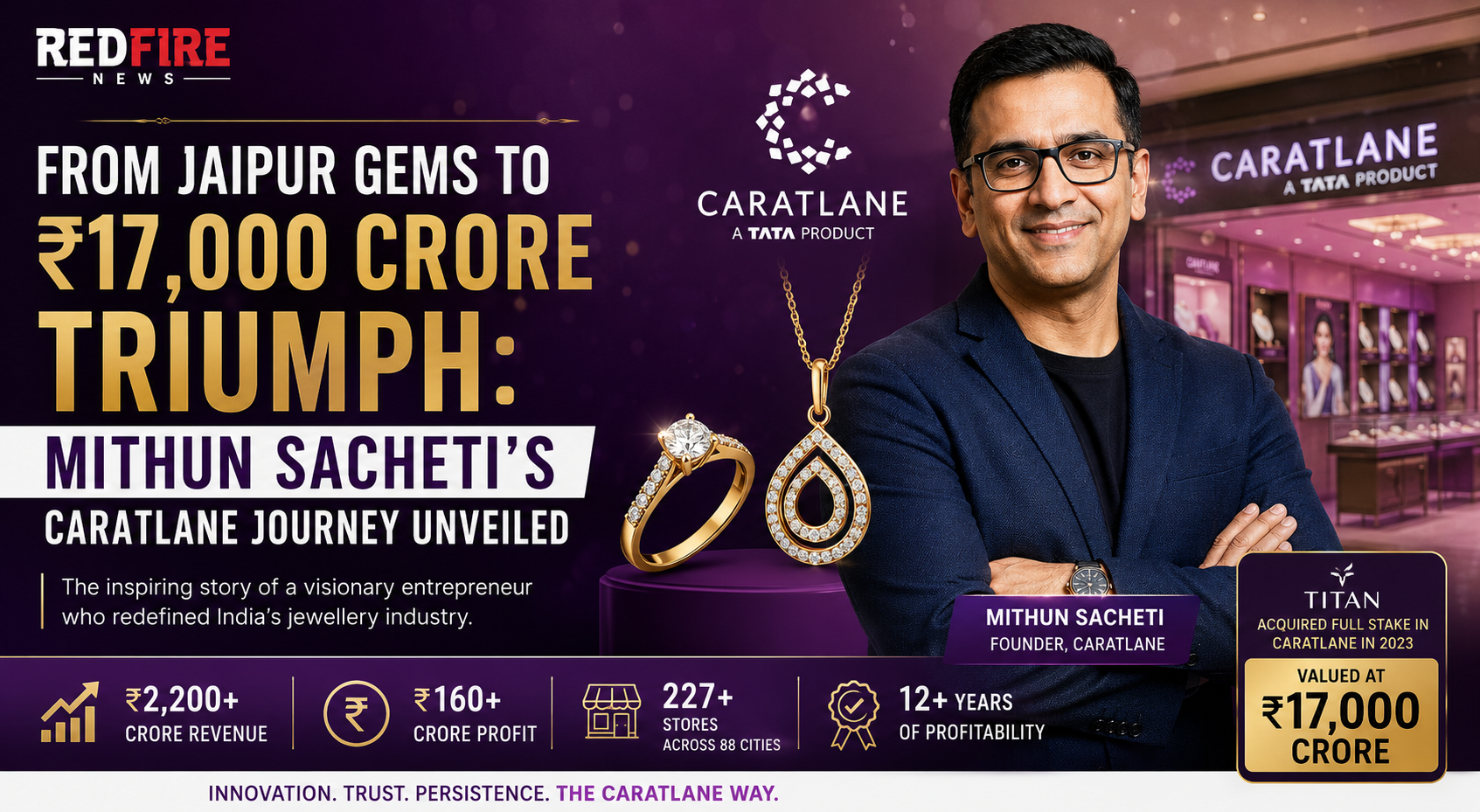
That simple yet disruptive idea became CaratLane, one of India’s biggest jewellery success stories, founded by entrepreneur Mithun Sacheti. Today, CaratLane stands as a modern retail giant with more than 227 stores across 88 Indian cities, over ₹2,200 crore revenue, and profitability exceeding ₹160 crore, ultimately culminating in a strategic acquisition journey with Titan Company Ltd, which valued CaratLane at around ₹17,000 crore.
But behind the success lies years of rejection, risk-taking, innovation, and persistence.
This is the story of how Mithun Sacheti transformed a bold startup idea into one of India’s most valuable jewellery businesses.
Legacy to Liberation: A Journey Beyond Family Business
For Mithun Sacheti, entrepreneurship was not entirely unfamiliar.
Born into a family deeply rooted in the gemstone trade, he belonged to the renowned Jaipur Gems business family -a respected name in India’s jewellery and gemstone industry.
Yet despite inheriting a successful legacy, Sacheti wanted something different.
He admired the craftsmanship and tradition of jewellery, but he also saw limitations in how the industry operated. Buying jewellery often felt intimidating, inaccessible, and outdated for younger consumers.
Traditional jewellers offered limited inventory visibility, inconsistent pricing, and little customization.
Meanwhile, India’s growing internet population was rapidly changing shopping behavior.
Mithun recognized an opportunity.
Instead of continuing solely within the family business, he decided to create something of his own — a jewellery brand built for the digital generation.
It was a risky decision.
Jewellery was one of the least likely categories expected to succeed online because of trust concerns.
People buy clothes online.
People buy electronics online.
But gold and diamonds?
That seemed impossible.
Mithun decided to prove otherwise.
The Birth of CaratLane in 2008
In 2008, Mithun Sacheti co-founded CaratLane alongside Srinivasa Gopalan with a mission to democratize jewellery shopping.
The idea was revolutionary for its time.
CaratLane aimed to make high-quality diamond jewellery available online at transparent pricing while solving major pain points in the traditional jewellery business.
Instead of forcing consumers into physical stores with limited collections, CaratLane promised:
Wider jewellery options
Transparent pricing
Certified diamonds
Better affordability
Convenience of shopping from anywhere
However, launching an online jewellery startup in 2008 came with massive skepticism.
Investors questioned the business model.
Customers hesitated to trust online diamond purchases.
The ecosystem for digital retail barely existed.
Yet Mithun remained convinced that India’s jewellery industry was ready for disruption.
The timing was difficult.
But sometimes the biggest opportunities emerge when nobody believes in them.
Struggles, Setbacks, and the Fight to Survive
CaratLane’s early years were far from glamorous.
The company struggled to convince customers to buy expensive jewellery online.
Even securing investment proved difficult.
Many investors simply rejected the concept.
Their argument was simple:
“Who will buy diamonds online?”
At one stage, CaratLane reportedly faced repeated rejections from investors before eventually receiving a crucial breakthrough – a ₹27 crore term sheet, a turning point that gave the startup breathing room.
That moment changed everything.
Instead of slowing down, Mithun doubled down on growth.
He understood one critical lesson:
If people did not trust online jewellery, CaratLane had to build trust aggressively.
This meant investing heavily in branding, technology, customer education, and quality assurance.
Betting Big: ₹4 Crore Marketing Gamble
One of Mithun Sacheti’s boldest decisions came when he invested approximately ₹4 crore into marketing, website development, and retail presence.
At the time, this was considered risky.
CaratLane was still a young company without guaranteed returns.
But Mithun believed scale required visibility.
The company invested in:
A user-friendly website
Brand awareness campaigns
Premium jewellery photography
Better customer service
Strong diamond certification standards
Unlike traditional jewellers, CaratLane focused heavily on high-quality diamond jewellery with improved margins, helping the company stand apart from competitors.
The strategy worked.
Consumers slowly began trusting online jewellery shopping.
CaratLane started building credibility among younger buyers, working professionals, and urban consumers seeking affordable luxury.
The Innovation That Changed Everything: “Perfect Look”
Perhaps one of CaratLane’s biggest competitive advantages came through innovation.
Understanding customer hesitation around online jewellery purchases, CaratLane introduced a game-changing virtual try-on experience known as “Perfect Look.”
This technology transformed online jewellery shopping.
Instead of guessing how jewellery might look, customers could virtually try ornaments using digital visualization.
The feature solved a major problem:
How do you convince someone to buy jewellery without physically wearing it?
Perfect Look offered the answer.
The innovation blended technology with trust – two things rarely associated with jewellery retail before CaratLane.
Consumers became more confident.
Online conversions improved.
Customer engagement increased dramatically.
This technological leap positioned CaratLane as far more than just another jewellery seller.
It became a tech-driven retail innovator.
Industry experts widely credit this customer-first digital approach for accelerating CaratLane’s rapid growth.
Meteoric Rise: From Startup to ₹100 Crore Company
Once customer trust began growing, CaratLane’s business accelerated rapidly.
The company reportedly experienced nearly 300% revenue growth during key scaling phases, establishing itself as one of India’s fastest-growing jewellery startups.
Soon, CaratLane crossed the ₹100 crore milestone, proving that digital jewellery retail was not merely possible – it was scalable.
This success attracted global investors.
Among the biggest believers was Tiger Global Management, which invested in CaratLane and provided both capital and credibility.
Tiger Global’s involvement helped CaratLane scale aggressively while strengthening technology and retail expansion.
Investor confidence boosted the company’s valuation and market visibility.
What once looked impossible suddenly seemed inevitable.
CaratLane was no longer just a startup.
It had become a serious challenger to established jewellery giants.
Titan Enters the Picture: A Strategic Bet
CaratLane’s momentum soon caught the attention of Titan Company, the Tata Group-backed jewellery giant behind Tanishq.
Titan recognized something important:
India’s future jewellery consumers would increasingly shop digitally.
Rather than competing directly against CaratLane, Titan decided to partner strategically.
In 2016, Titan acquired approximately 62% stake in CaratLane, marking a major milestone in the company’s growth journey.
The partnership offered CaratLane access to:
Stronger supply chains
Greater credibility
Operational expertise
Wider market reach
Financial support
At the same time, Titan gained exposure to younger consumers and digital-first jewellery retail.
It was a win-win partnership.
Importantly, this was not a complete acquisition.
Mithun Sacheti continued leading CaratLane while scaling the business further.
Exponential Growth After Titan Partnership
The years following Titan’s investment transformed CaratLane dramatically.
The company expanded both online and offline.
CaratLane shifted from a pure online business into an omnichannel retail model, blending digital convenience with physical experience centers.
The numbers reflected extraordinary momentum.
At one stage, CaratLane operated:
130 stores across 36 cities
Revenue of around ₹621 crore
More than a decade of profitability-focused growth
But the story didn’t stop there.
CaratLane continued expanding aggressively.
Today, the company reportedly has 227 stores across 88 cities in India, generating nearly ₹2,200 crore in annual revenue and over ₹160 crore profitability.
This remarkable financial performance established CaratLane as one of India’s biggest jewellery success stories.
Dominating Key Retail Moments
CaratLane’s strategic expansion played a major role in its success.
Unlike traditional jewellers dependent only on weddings, CaratLane targeted younger buyers and everyday jewellery consumers.
The company leveraged:
Festive shopping
Daily wear jewellery trends
Personalized gifting
Lightweight jewellery demand
Digital-first campaigns
Major festive events like Akshaya Tritiya became especially important growth drivers.
CaratLane consistently reported strong sales during peak buying seasons, helping strengthen Titan’s confidence in the brand.
Its combination of affordable luxury, convenience, and digital trust gave it a strong competitive advantage.
The ₹17,000 Crore Milestone: Titan Takes Full Control
In 2023, Titan made its biggest move yet.
The company acquired the remaining stake in CaratLane from Mithun Sacheti and private equity investor Warburg Pincus, making CaratLane a wholly owned subsidiary.
The deal valued CaratLane at approximately ₹17,000 crore.
This detail matters because many narratives wrongly describe it as a one-time acquisition.
In reality:
2016: Titan acquired ~62% stake
2023: Titan bought the remaining ownership
Overall valuation: Around ₹17,000 crore
The move reflected Titan’s confidence in CaratLane’s future potential and digital-first model.
For Mithun Sacheti, it represented more than a financial milestone.
It validated a vision that many initially dismissed.
The entrepreneur who once struggled to convince people to buy jewellery online had helped build one of India’s most successful jewellery brands.
Lessons from Mithun Sacheti’s Entrepreneurial Journey
Mithun Sacheti’s success story carries powerful lessons for entrepreneurs.
1. Solve a Real Problem
CaratLane succeeded because it solved genuine customer pain points – trust, transparency, and accessibility.
2. Innovation Creates Trust
The Perfect Look virtual try-on feature reduced buying hesitation and transformed customer behavior.
3. Persistence Beats Rejection
Repeated investor rejection did not stop CaratLane. Persistence eventually brought funding and scale.
4. Digital Disruption Works
Even industries considered impossible to digitize can evolve through customer-first thinking.
5. Partnerships Matter
Titan’s strategic partnership accelerated CaratLane’s scale without killing its entrepreneurial DNA.
More Than a Business Story
CaratLane’s journey is not just about valuation numbers.
It reflects how technology can modernize even India’s most traditional industries.
It is also a story about courage.
Leaving family legacy to build something uncertain.
Facing skepticism.
Taking financial risks.
Betting on innovation.
And believing in an idea before the world catches up.
From Jaipur Gems to India’s jewellery revolution, Mithun Sacheti’s journey shines as proof that entrepreneurship rewards those willing to challenge convention.
Today, CaratLane is no longer merely a startup success.
It is a case study in digital transformation, customer trust, and relentless persistence.
And for aspiring founders, the message is clear:
Sometimes the brightest businesses begin with the boldest questions.
AI Conversationalist, Global Marketer, TEDx Speaker, Member-Board Of Studies-CDSW, AI Governance, Mentor Onboarded CCMB-Atal Incubation Center, Entrepreneurship Coach