Harsh Mariwala’s Sky-High Success: The Man Who Turned Parachute into a ₹70,000 Crore FMCG Powerhouse
Discover how Harsh Mariwala transformed a traditional family business into Marico, built Parachute into India's leading coconut oil brand, and created a ₹70,000 crore FMCG powerhouse.
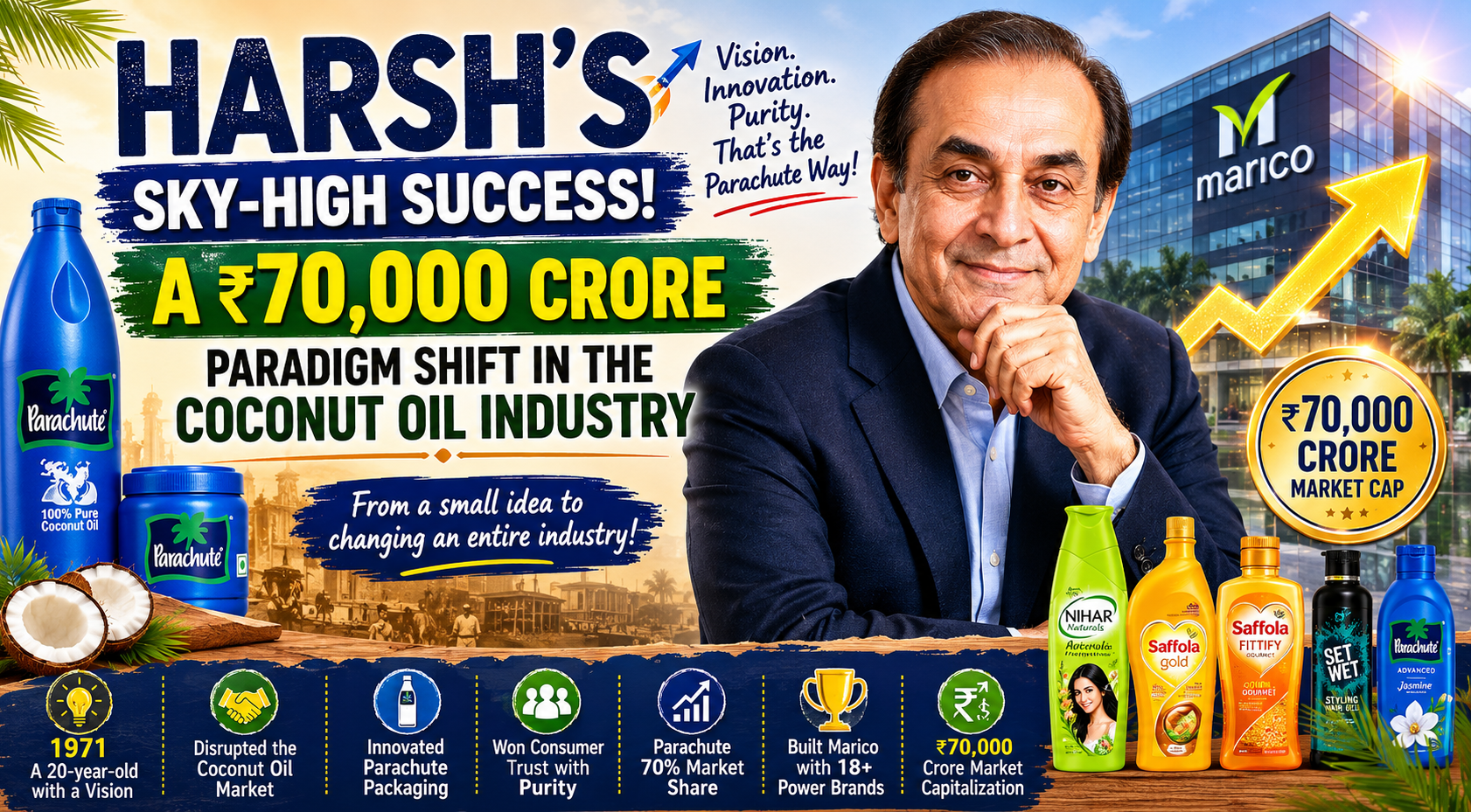
Mumbai: India’s corporate history is filled with remarkable entrepreneurs who transformed ordinary products into extraordinary businesses. Among them, few stories are as inspiring as that of Harsh Mariwala, the visionary businessman who revolutionized the coconut oil industry and built one of India’s most respected consumer goods companies.
Today, Marico is a household name with a market capitalization of nearly ₹70,000 crore, a portfolio of leading consumer brands, and a presence in multiple countries. Yet the company’s incredible journey began with a young entrepreneur who dared to challenge industry conventions and rethink how coconut oil was sold to Indian consumers.
The rise of Harsh Mariwala is not merely a story of financial success. It is a lesson in innovation, resilience, customer understanding, and the courage to challenge established business practices.
A Young Entrepreneur with Big Ambitions
The story begins in 1971.
At just 20 years old, Harsh Mariwala joined his family’s traditional business, which primarily dealt with spices and commodity trading.
While many would have been content managing an established operation, Mariwala had bigger ambitions.
He believed the future belonged to branded consumer products rather than unorganized commodity businesses.
India’s consumer market was evolving. Urbanization was increasing, disposable incomes were slowly rising, and customers were becoming more conscious about quality and packaging.
Mariwala recognized that consumer trust could become a powerful business advantage.
Rather than focusing solely on spices, he began exploring opportunities in fast-moving consumer goods.
This decision would ultimately change the trajectory of both his career and the Indian FMCG industry.
Discovering a Massive Market Opportunity
During the 1970s, coconut oil was primarily sold as a commodity.
Consumers typically purchased loose oil from local retailers.
Packaging standards were inconsistent.
Product quality varied significantly.
Adulteration was a common concern.
Despite being widely used across Indian households, particularly in southern and western regions, coconut oil lacked strong national branding.
Mariwala noticed an important gap.
Consumers wanted purity.
They wanted consistency.
They wanted assurance about what they were purchasing.
Yet few companies were addressing these concerns.
This observation became the foundation for one of India’s most successful consumer brands.
The Birth of Bombay Oil Industries Limited’s Transformation
At the time, the family’s business operated under Bombay Oil Industries Limited (BOIL).
Mariwala saw an opportunity to move beyond commodity trading and create a consumer-focused brand.
Instead of simply selling coconut oil, he wanted to sell trust.
The idea sounds simple today, but at the time it represented a significant shift in thinking.
Most businesses competed on price.
Mariwala wanted to compete on quality, branding, and customer confidence.
This strategic vision set the stage for the creation and growth of Parachute.
Building the Parachute Brand
Parachute was already present in certain regional markets, particularly around Nagpur and Vidarbha.
The brand held approximately 20 percent market share in some areas and had developed a loyal customer base.
However, its potential remained largely untapped.
Harsh Mariwala believed Parachute could become much bigger.
He focused on strengthening product quality, improving packaging, and creating a clear brand identity.
Rather than treating coconut oil as a generic product, he positioned Parachute as a trusted household brand.
The strategy began producing results.
Consumers increasingly preferred branded products over unbranded alternatives.
Parachute’s popularity continued growing across multiple regions.
Yet significant challenges still lay ahead.
Betrayal and Market Challenges
As Parachute gained traction, Mariwala faced one of the most difficult periods in the company’s history.
Several distributors and business partners shifted their support to competing brands.
The competition intensified.
Some rivals offered significantly higher margins to distributors.
This created pressure on Parachute’s distribution network.
For many companies, such setbacks could have derailed growth.
However, Mariwala viewed challenges differently.
Rather than reacting emotionally, he focused on understanding the root causes behind customer and distributor behavior.
His ability to analyze problems objectively would become one of his defining leadership qualities.
Understanding Consumer Pain Points
One of Mariwala’s greatest strengths was his willingness to listen to consumers.
Through extensive market interactions, he discovered a surprising problem.
Parachute’s square plastic packaging had become vulnerable to damage caused by rats in retail storage facilities.
While this might sound like a minor issue, it created significant losses for distributors and retailers.
Damaged packaging led to leaking products, inventory losses, and customer dissatisfaction.
Competitors quickly exploited the weakness.
Among them was Shalimar Oils, which aggressively expanded its presence by offering attractive distributor margins.
Many distributors switched allegiances because they saw better short-term profitability.
The challenge threatened Parachute’s market position.
Innovation That Changed the Industry
Instead of accepting defeat, Mariwala responded with innovation.
He and his team redesigned the product packaging.
The company introduced durable cylindrical bottles that were significantly more resistant to damage.
The new packaging solved the rat problem and improved product durability during transportation and storage.
This seemingly simple innovation had a profound impact.
Retailers appreciated the reduced losses.
Distributors regained confidence.
Consumers viewed the packaging as more premium and trustworthy.
The redesign helped Parachute recover lost momentum and strengthen its market position.
It became one of the most important turning points in the brand’s history.
Defeating Strong Competition
The packaging innovation proved transformational.
Parachute began regaining market share.
As consumer trust increased, competitors struggled to keep pace.
The brand eventually captured nearly 48 percent market share in several key regions.
Shalimar Oils, which had once threatened Parachute’s dominance, found it increasingly difficult to compete.
The episode demonstrated an important business principle.
Major breakthroughs often emerge from solving practical customer problems rather than pursuing flashy innovations.
Mariwala’s focus on execution and consumer needs helped Parachute emerge stronger than ever.
The Road to ₹100 Crore
By the 1980s and early 1990s, Parachute’s growth accelerated dramatically.
The company expanded distribution networks, improved manufacturing capabilities, and strengthened brand visibility.
Consumers increasingly associated Parachute with purity and quality.
As demand rose, revenues continued climbing.
Eventually, Parachute crossed the significant milestone of ₹100 crore in sales.
At the time, this achievement represented a remarkable accomplishment in the Indian FMCG sector.
The success validated Mariwala’s long-term vision.
More importantly, it proved that strong branding could transform even the most traditional product categories.
The Challenge from Hindustan Unilever
No successful market leader remains unchallenged forever.
As Parachute strengthened its position, larger corporations took notice.
Among them was Hindustan Unilever Limited (HUL), one of India’s most powerful consumer goods companies.
HUL possessed vast resources, strong distribution networks, and extensive marketing capabilities.
Many observers believed it would be difficult for Parachute to maintain its dominance.
However, Mariwala remained confident.
He understood that market leadership is not secured through size alone.
It requires deep consumer understanding and relentless innovation.
Rather than retreating, he prepared for competition.
The rivalry would eventually reshape India’s consumer goods landscape.
The Birth of Marico
One of Harsh Mariwala’s most important strategic decisions involved creating greater autonomy for the business.
He believed the company needed independent leadership and a clear growth strategy.
This vision ultimately led to the formation of Marico as a focused consumer products company.
The move provided greater flexibility and allowed management to concentrate entirely on brand building and innovation.
Marico rapidly expanded its portfolio beyond coconut oil.
The company entered new categories while maintaining its commitment to quality and consumer trust.
The transformation marked a new chapter in the organization’s journey.
What began as a traditional family enterprise was evolving into a modern FMCG powerhouse.
Winning Through Purity
One of Mariwala’s most effective growth strategies centered on purity campaigns.
He understood that consumers cared deeply about product authenticity.
Parachute consistently highlighted its purity standards through advertising and consumer education initiatives.
The messaging resonated strongly with customers.
Families trusted the brand because they believed it delivered exactly what it promised.
This trust became a formidable competitive advantage.
Over time, Parachute achieved nearly 70 percent market share in the branded coconut oil segment.
Such dominance is rare in any consumer category.
The achievement reflected decades of consistent quality and strategic execution.
Expanding Beyond Coconut Oil
While Parachute remained the flagship brand, Mariwala recognized the importance of diversification.
He systematically expanded Marico’s portfolio.
The company introduced products across multiple categories, including hair care, edible oils, wellness, and personal care.
This diversification reduced dependence on a single product line while creating new growth opportunities.
Brands such as Saffola became major success stories in their own right.
Marico demonstrated an ability to identify consumer needs and create solutions that resonated across diverse market segments.
The company’s growth increasingly reflected its strength as a brand-building organization rather than merely a coconut oil manufacturer.
Building a Culture of Innovation
A key factor behind Marico’s success has been its organizational culture.
Harsh Mariwala encouraged experimentation, creativity, and entrepreneurial thinking.
Unlike many traditional family-run businesses, Marico adopted professional management practices.
Employees were encouraged to take ownership and explore innovative ideas.
This culture enabled the company to adapt quickly to changing market conditions.
Innovation became embedded in the organization’s DNA.
As a result, Marico consistently remained ahead of emerging consumer trends.
The company’s willingness to evolve helped sustain long-term growth.
From National Brand to Global Presence
As Marico strengthened its domestic position, international expansion became the next logical step.
The company entered several overseas markets and built a presence across Asia, Africa, and the Middle East.
Global expansion diversified revenue streams and increased brand visibility.
It also demonstrated that Indian consumer brands could successfully compete on the world stage.
Today, Marico operates in numerous countries and serves millions of consumers worldwide.
Its international footprint reflects the scalability of Mariwala’s business model.
What started as a local coconut oil brand evolved into a global FMCG company.
Creating a ₹10,000 Crore Business
Over the years, Marico’s revenues continued rising steadily.
The company expanded its product portfolio, strengthened distribution, and improved operational efficiency.
Eventually, Marico crossed the ₹10,000 crore revenue milestone.
The achievement highlighted the strength of its business model and the effectiveness of its leadership.
Few companies in India’s consumer goods sector have achieved comparable success while maintaining such strong brand equity.
The milestone also reinforced Mariwala’s reputation as one of India’s most respected entrepreneurs.
A ₹70,000 Crore Market Leader
Today, Marico stands among India’s leading FMCG companies.
The company owns approximately 18 well-known brands and serves consumers across multiple categories.
Its market capitalization has grown to around ₹70,000 crore, making it one of the country’s most valuable consumer goods businesses.
The scale of this achievement is extraordinary.
A company that once focused primarily on coconut oil has evolved into a diversified consumer products powerhouse.
Its success reflects decades of disciplined execution and strategic thinking.
Lessons from Harsh Mariwala’s Journey
Harsh Mariwala’s story offers several valuable lessons for entrepreneurs and business leaders.
The first lesson is that innovation does not always require complex technology. Sometimes, changing packaging can transform an entire industry.
Second, consumer trust is one of the most powerful assets a business can build.
Third, long-term success often comes from solving practical problems rather than chasing trends.
Fourth, competition should be viewed as motivation for improvement rather than a threat.
Finally, professional management and continuous innovation are essential for sustainable growth.
These principles helped Mariwala build a company that continues thriving decades after its founding.
Conclusion
Harsh Mariwala’s transformation of Parachute from a regional coconut oil brand into the foundation of a ₹70,000 crore FMCG empire remains one of India’s most inspiring business success stories.
From joining a family business at the age of 20 to challenging industry norms, redesigning products, defeating powerful competitors, and building Marico into a global consumer brand, his journey reflects vision, resilience, and strategic excellence.
What makes his story particularly remarkable is that it began in one of the most traditional product categories imaginable. Through innovation, branding, and customer focus, he turned coconut oil into a symbol of trust and built a company that reshaped India’s consumer goods industry.
Today, Marico’s success serves as a powerful reminder that great businesses are not built merely through capital or scale. They are built through understanding customers, solving problems, and consistently delivering value over time.
Harsh Mariwala’s journey proves that even the simplest products can create extraordinary success when guided by bold vision, relentless execution, and an unwavering commitment to quality.
AI Conversationalist, Global Marketer, TEDx Speaker, Member-Board Of Studies-CDSW, AI Governance, Mentor Onboarded CCMB-Atal Incubation Center, Entrepreneurship Coach