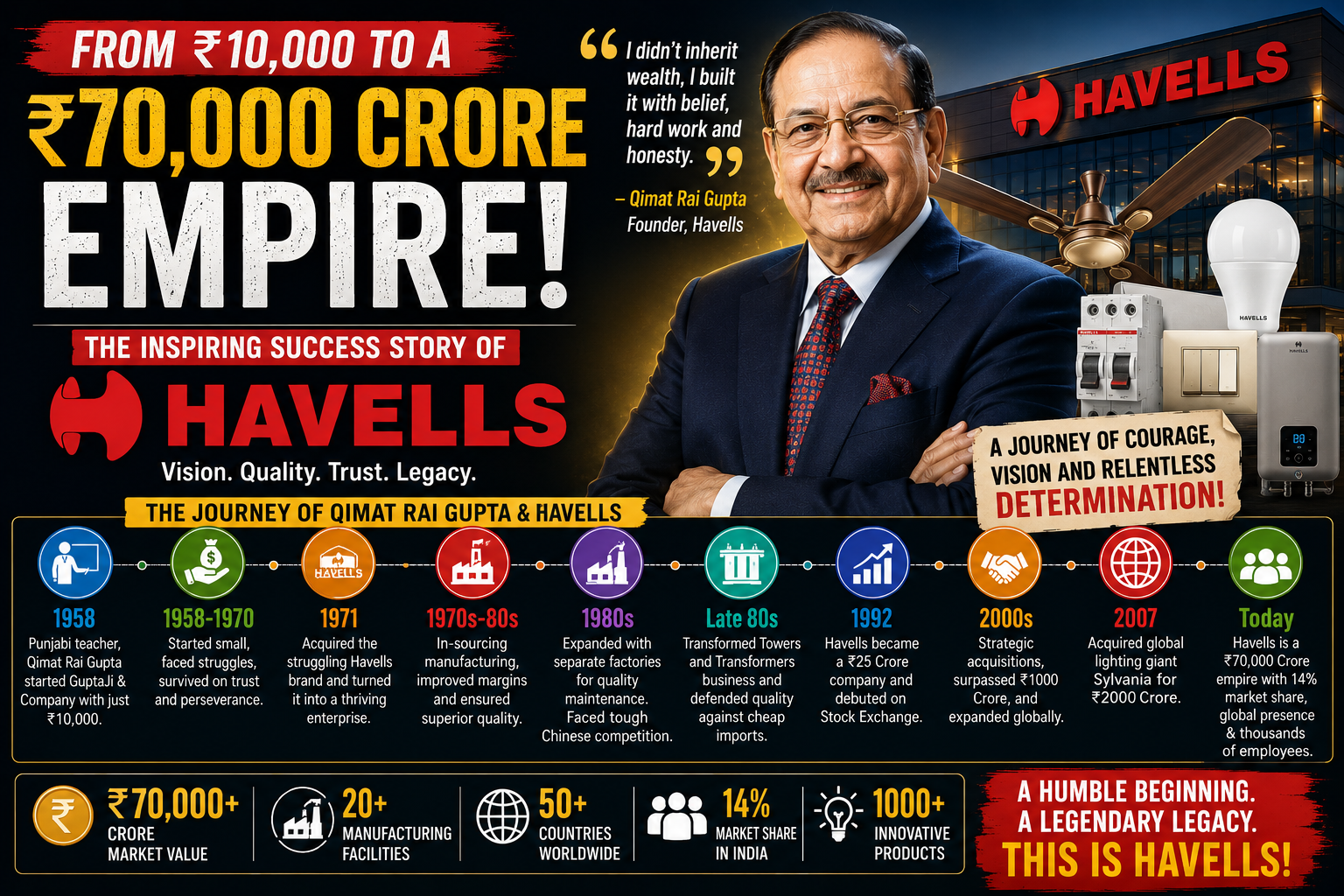
The Man Who Turned ₹10,000 Into a ₹70,000 Crore Empire: The Extraordinary Success Story of Havells Founder Qimat Rai Gupta
Discover the inspiring success story of Qimat Rai Gupta, the founder of Havells, who transformed a ₹10,000 investment into a ₹70,000 crore empire through vision, resilience, and smart business strategies
Success stories are often built on ambition, sleepless nights, failures, and relentless determination. But every once in a while, a story comes along that proves how vision and patience can transform an ordinary beginning into something extraordinary.
The story of Qimat Rai Gupta, the man behind Havells, is one such tale.
Imagine starting a business with just ₹10,000 in your pocket and building it into a company worth more than ₹70,000 crore, competing with global giants and becoming a trusted household brand across India and beyond.
Today, when you switch on a fan, use a geyser, or install electrical fittings in your home, chances are you have encountered the Havells brand. But few people know the incredible struggle, smart decisions, and fearless risks that built this empire.
This is not just the story of a company. It is the story of a school teacher’s son who believed that quality, trust, and long-term thinking could beat even the toughest competition.
Let’s dive into the inspiring journey of Qimat Rai Gupta and how Havells became one of India’s biggest electrical giants.
Humble Beginnings: A Teacher From Punjab With Big Dreams
Long before Havells became a household name, Qimat Rai Gupta lived a modest life in Punjab.
Born into a middle-class family, Gupta did not inherit wealth or a massive family business. Like many Indians of his time, he understood hardship closely. Opportunities were limited, and success demanded grit.
In 1958, with only ₹10,000, Gupta started a small electrical goods trading business named Gupta Ji & Company in Delhi.
At that time, India’s electrical market was highly fragmented. Trustworthy brands were rare, and product quality often varied. Instead of chasing quick profits, Gupta focused on building strong relationships with dealers and customers.
He believed one thing deeply:
“If you consistently deliver quality, customers will come back.”
This simple philosophy would later become the foundation of Havells.
The Turning Point: Buying the Struggling Havells Brand in 1971
Every successful entrepreneur eventually faces a moment that changes everything.
For Qimat Rai Gupta, that moment came in 1971.
A small but struggling electrical brand called Havells, owned by Haveli Ram Gandhi, was up for sale.
Many saw it as a risky investment.
Gupta saw opportunity.
Despite limited financial resources, he made a bold move and acquired the Havells brand for around ₹7 lakh-a massive amount during that era.
It was not just a business purchase.
It was a bet on the future.
Most entrepreneurs would have played safe. But Gupta knew that building a strong brand would matter more than remaining a local trader forever.
And that decision changed everything.
From Trading to Manufacturing: The Bold Move That Built Havells
Buying the brand was just the beginning.
The real transformation came when Gupta made another unconventional decision-moving from trading to manufacturing.
During those days, many companies outsourced production to save money.
Qimat Rai Gupta did the opposite.
He believed that if Havells had to win customer trust, it had to control quality directly.
So, he invested heavily in in-house manufacturing, creating dedicated factories for different products.
This strategy gave Havells three major advantages:
1. Better Quality Control
By manufacturing products internally, Havells ensured consistent quality standards.
2. Higher Profit Margins
Instead of depending on third-party suppliers, the company retained more profits.
3. Faster Innovation
Having full control allowed the company to improve products quickly based on market demand.
At a time when competitors were cutting corners, Havells doubled down on quality.
And customers noticed.
Surviving Competition: The Chinese Challenge
As India’s market opened up, cheaper Chinese electrical products flooded the market.
Many Indian companies struggled to survive.
Low-cost imports made competition brutal.
But Qimat Rai Gupta refused to compromise.
Instead of reducing quality to match cheap pricing, he focused on premium reliability.
His philosophy was simple:
“People may buy cheap products once. But they always return to trusted brands.”
Rather than engaging in a price war, Havells invested in better engineering, safer products, and stronger branding.
This long-term approach protected the company when several competitors vanished.
Expansion Strategy: Separate Factories, Better Standards
One of Gupta’s smartest business decisions was specialization.
Instead of running one giant factory making everything, Havells created dedicated manufacturing plants for separate products.
Each factory focused on a single category:
Switchgear
Cables
Fans
Lighting
Home appliances
Electrical accessories
This ensured superior expertise and strict quality management.
While competitors chased quantity, Havells mastered consistency.
This helped the company establish trust—a priceless asset in electrical goods where safety matters.
1992: Havells Becomes a ₹25 Crore Company
By the early 1990s, Havells was already growing rapidly.
In 1992, the company got listed on the stock exchange and crossed approximately ₹25 crore in valuation.
For someone who started with ₹10,000, this was already remarkable.
But Qimat Rai Gupta was thinking bigger.
Much bigger.
He understood that the Indian middle class was expanding and electrical consumption would explode in coming decades.
So instead of slowing down, he accelerated growth.
Strategic Acquisitions: Havells Goes Aggressive
One thing that separated Gupta from average businessmen was his willingness to think globally.
He understood that to become an international player, Havells needed scale.
So the company began expanding through strategic acquisitions.
By the early 2000s, Havells crossed the ₹1,000 crore milestone.
But the biggest gamble was still waiting.
The Boldest Bet: Acquiring Sylvania in 2007
In 2007, Havells shocked the business world.
The company acquired European lighting giant Sylvania for nearly ₹2,000 crore.
People called it risky.
Some even believed Havells had overextended itself.
After all, how could an Indian electrical company successfully absorb a large global business?
But Qimat Rai Gupta believed in global ambitions.
He wanted Havells to become more than just an Indian brand.
He wanted it to compete with international giants.
Though integration challenges followed, the acquisition significantly expanded Havells’ international presence.
Sometimes, entrepreneurship demands courage more than certainty.
And Gupta never lacked courage.
Havells Marketing Genius: Selling Trust, Not Products
Most companies advertise features.
Havells sold emotions.
Their advertising campaigns became iconic because they focused on trust, safety, and reliability.
Remember the famous line:
“Wires that don’t catch fire.”
Simple.
Powerful.
Memorable.
Havells understood something important:
People don’t buy electrical products for excitement.
They buy them for peace of mind.
This consumer understanding helped the brand become a household favorite.
Diversification: Beyond Switches and Wires
Under Gupta’s leadership, Havells evolved beyond electrical components.
The company entered:
Fans
Water heaters
Kitchen appliances
Lighting solutions
Consumer electronics
Smart electrical products
This diversification ensured that Havells became part of everyday Indian life.
From kitchens to offices to industrial plants—Havells was everywhere.
And this widened revenue streams significantly.
The Numbers Speak for Themselves
What started with ₹10,000 transformed into:
₹70,000+ crore company valuation
Presence in 50+ countries
Thousands of dealers and distributors
Massive manufacturing capabilities
One of India’s most trusted electrical brands
Around 14% market share in several segments
Few entrepreneurs in India have built such a lasting industrial legacy.
Leadership Lessons From Qimat Rai Gupta
What makes Qimat Rai Gupta’s story special is that his success was not built on shortcuts.
It came from timeless principles.
1. Think Long-Term
Gupta never chased overnight profits.
He built patiently.
2. Never Compromise on Quality
Even during tough competition, quality remained non-negotiable.
3. Take Calculated Risks
Buying Havells and acquiring Sylvania were bold decisions.
But calculated boldness changes businesses.
4. Build Trust Before Revenue
Customers trusted Havells because Gupta valued relationships.
5. Adapt Constantly
From trading to manufacturing to global expansion—Gupta kept evolving.
The Legacy of a Visionary
Sadly, Qimat Rai Gupta passed away in 2014, but his vision continues to power millions of homes.
Today, Havells is not just a business.
It is a symbol of Indian entrepreneurship.
A reminder that you don’t need massive funding or privilege to build something extraordinary.
Sometimes, all you need is courage, patience, and relentless belief in your vision.
From a modest trader with ₹10,000 to the creator of a ₹70,000 crore empire, Qimat Rai Gupta proved that dreams backed by discipline can transform industries.
And perhaps the biggest lesson from his story is this:
Great empires are not built overnight—they are built one smart decision at a time.
For every entrepreneur struggling today, Havells’ story offers hope.
Your beginning does not decide your ending.
What matters is how long you are willing to stay in the game.
Because sometimes, ₹10,000 and an unstoppable mindset are enough to build history.
AI Conversationalist, Global Marketer, TEDx Speaker, Member-Board Of Studies-CDSW, AI Governance, Mentor Onboarded CCMB-Atal Incubation Center, Entrepreneurship Coach